
This fortnightly brief tracks the decisions by the Central Government and what they add up to. We begin with the launch of National Monetisation Pipeline 2.0, aimed at recycling capital from operational public assets, before turning to amendments to the Mineral Concession Rules that enable flexible co-mining of newly discovered minerals, the enhanced equity delegation for POWERGRID to accelerate transmission expansion, a pause on rice fortification under PMGKAY, and the Union Cabinet’s approval of the proposal to rename the State of Kerala as “Keralam”.
Recycling Capital through National Monetisation Pipeline 2.0
The Government has launched National Monetisation Pipeline 2.0 for FY 2026 to 2030, targeting ₹ 16.72 lakh crore in asset monetisation, including ₹ 5.8 lakh crore in private investment. The focus is on operational brownfield assets, highways, power transmission, ports, railways, and coal that already generate revenue but have untapped value.
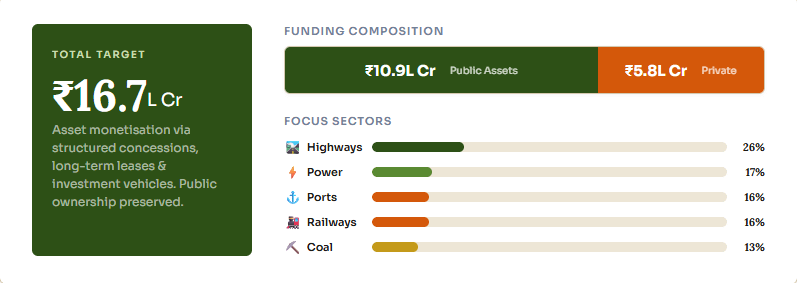
The important distinction here is that this isn’t privatisation. The Government retains ownership. What changes is who runs things. Structured concessions, long-term leases, and investment vehicles hand over operational control to private players while keeping the asset in public hands. The capital freed up goes back into new infrastructure.
NMP 2.0 could crowd in institutional capital and reduce pressure on public finances. The risks lie in asset valuation disputes, concession structuring challenges, and investor appetite in a volatile global financial environment.
Flexible Mineral Extraction Under Revised Concession Rules
For years, discovering a new mineral within an existing lease area was more of a headache than a windfall. The regulatory uncertainty it triggered often left deposits stranded. The Government has now amended the Mineral Concession Rules to fix that.
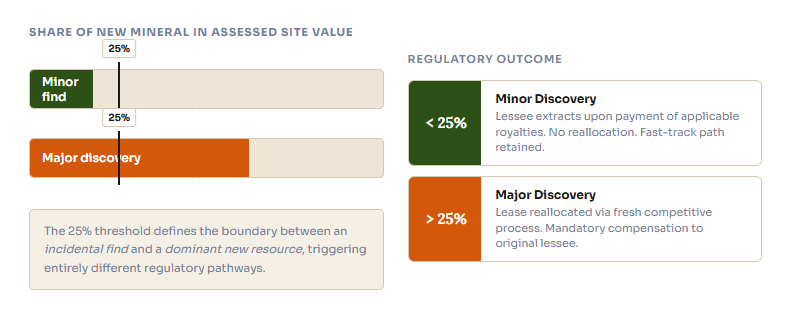
The new framework is simple: if a newly discovered mineral turns out to be a major one, accounting for more than 25% of the assessed site value, the lease goes through a fresh process, and the original lessee gets compensated. Smaller discoveries can simply be extracted on payment of applicable royalties.
This reform addresses a long-standing rigidity in India’s mining regime, where the discovery of a new mineral often triggered procedural delays and regulatory uncertainty. It helps to ensure high-value energy minerals are channelled to specialist operators.
Enhanced Investment Capacity For Power Transmission Expansion
The Cabinet Committee on Economic Affairs has increased Power Grid Corporation of India Limited’s equity investment ceiling from ₹ 5,000 crore to ₹ 7,500 crore per subsidiary, while retaining the 15% net worth cap. This decision strengthens POWERGRID’s ability to undertake large renewable energy evacuation and high-capacity transmission projects under tariff-based competitive bidding.
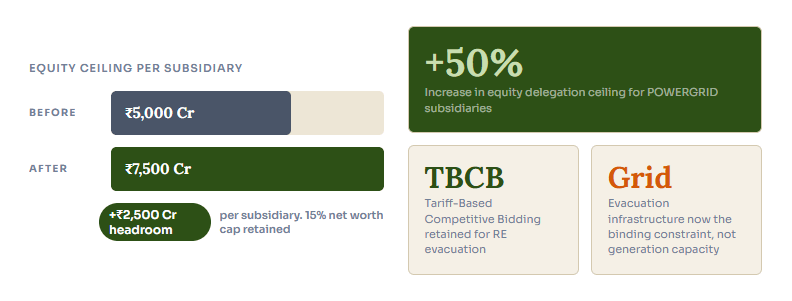
The renewable energy expansion is increasingly constrained not by generation capacity but by evacuation infrastructure. Strengthening transmission financing authority reflects recognition that grid readiness must keep pace with clean energy ambitions.
The challenge will be execution. Transmission projects routinely face land acquisition disputes, right-of-way challenges, and coordination hurdles across states. Financial delegation alone will not eliminate these structural bottlenecks.
Pause On Rice Fortification Under PMGKAY
Following findings from an IIT Kharagpur study indicating micronutrient degradation in stored fortified rice, the Government has temporarily paused rice fortification under PMGKAY and related welfare schemes. Foodgrain entitlements remain unaffected, and States retain flexibility in managing Kharif 2025-2026 supplies.
Fortification had been positioned as a large-scale nutritional intervention to address anaemia and micronutrient deficiencies. The pause reflects recalibration of the nutrient delivery mechanism to ensure effectiveness at the point of consumption, while maintaining full foodgrain entitlements.
Renaming Of “Kerala” To “Keralam”
The Union Cabinet has approved the proposal to rename the State of “Kerala” as “Keralam”, initiating the formal process to amend the First Schedule under Article 3. The Bill will be referred to the Kerala Legislative Assembly for its views before being introduced in Parliament. The move aligns the State’s official name with its Malayalam linguistic identity and carries symbolic significance within India’s federal framework.
If you are interested in more detailed coverage of these and other policy developments, we invite you to read the full India Governance Watch (16th February to 28th February, 2026) newsletter here.