
Welcome to the latest edition of India Governance Watch, our fortnightly review of major policy, economic, and strategic developments at the national level. This issue covers the entry into force of the India–Oman CEPA, which provides duty-free access to 99.38% of Indian goods exports to Oman, the Cabinet’s ₹10,000 crore aviation fuel stabilisation package, the successful test of the indigenous RudraM-II missile, and key outcomes from NITI Aayog’s 11th Governing Council Meeting. Together, these developments highlight the Government’s focus on expanding market access, strengthening strategic capabilities, enhancing economic resilience, and advancing the vision of Viksit Bharat@2047.
I. India–Oman CEPA Comes Into Effect
The India–Oman Comprehensive Economic Partnership Agreement (CEPA) is now in effect. The agreement grants Indian exporters near‑unrestricted duty‑free access to the Omani market, offering a significant boost to sectors such as engineering, textiles, gems and jewellery, and pharmaceuticals.
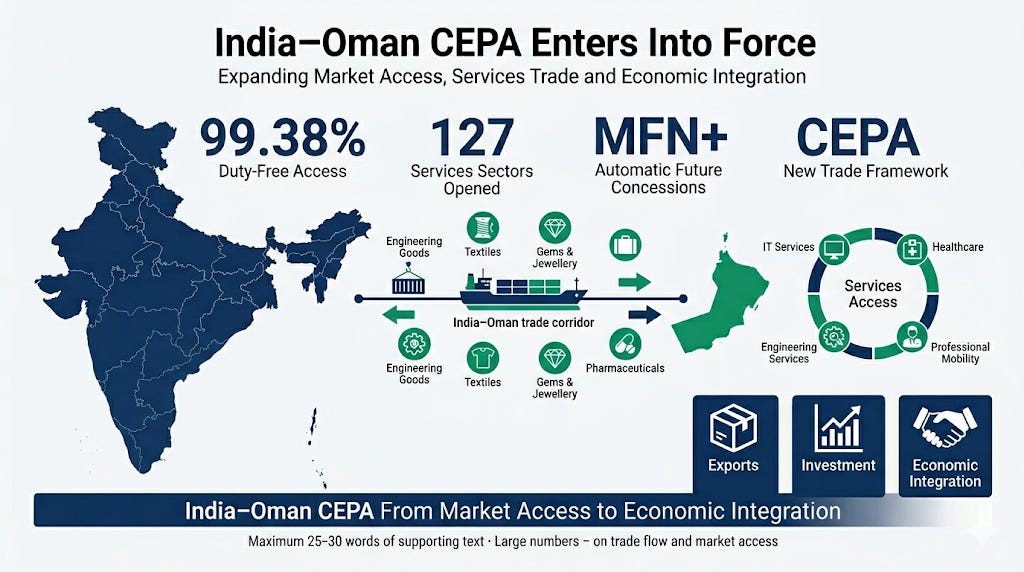
The pact also provides substantial opportunities for services: Oman has opened market access in areas including IT, healthcare, and engineering, and has simplified procedures for Indian professionals seeking to work there. The CEPA marks an important new chapter in economic and commercial cooperation between the two countries.
The CEPA contains a most‑favoured‑nation type provision ensuring India benefits automatically if Oman grants more favourable market access to other partners in the future. Negotiations on a potential Social Security Agreement are under discussion and, if concluded, could reduce social‑security contributions for Indian workers in Oman. For Indian firms and professionals seeking Gulf market entry, the CEPA’s services provisions represent an immediate and strategic advantage.
II. ATF Price Stabilisation Fund For Scheduled Airlines
To mitigate the impact of elevated ATF prices driven by the West Asia crisis, the Union Cabinet has approved a one‑time ₹ 10,000 crore interest‑free advance to Oil Marketing Companies (OMCs). The facility aims to stabilise domestic jet fuel prices and prevent abrupt fare increases or service disruptions. Participating airlines must purchase fuel from domestic OMCs for up to three years, any windfall gains from falling fuel prices will be returned to the government until the advance is repaid. The measure functions as a temporary liquidity buffer to absorb short‑term price shocks and buy airlines time to adjust capacity and pricing.
III. DRDO and IAF Successfully Test RudraM-II Missile
In a big win for the DRDO and the IAF, India just successfully test-fired the indigenous RudraM-II air-to-surface missile over in Chandipur. Launched from the air, the test was a total success, with the missiles locking onto and taking out their targets exactly as planned. Think of the RudraM-II as a specialised anti-radiation hunter: it’s built to sniff out and neutralise enemy radar systems and air defence networks.
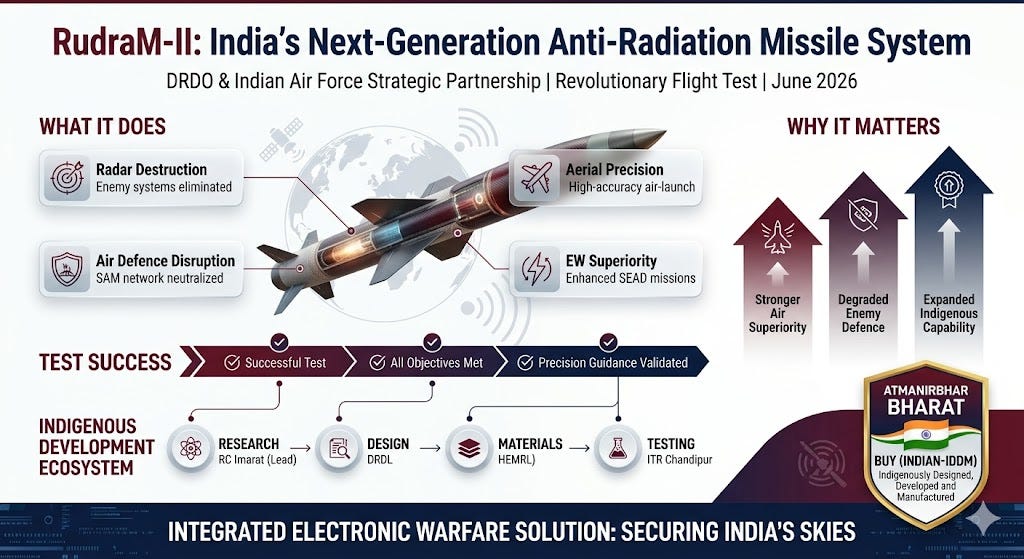
Led by the Research Centre Imarat with support from multiple DRDO laboratories, this development is a cornerstone of the 'Buy Indian-IDDM' procurement strategy. It’s more than just a successful test, it’s a clear indicator of India’s accelerating journey toward self-reliance in high-end defence tech.
IV. NITI Aayog’s 11th Governing Council Meeting Endorses Strategic Framework For Viksit Bharat@2047
At its 11th Governing Council meeting, Prime Minister Shri Narendra Modi stressed that the Vision of Viksit Bharat@2047 must become the collective resolve of every State, district, block and village. Discussions focused on equipping India’s youth with the skills needed for future growth, while also encouraging states to make better use of Free Trade Agreements to boost MSME exports and attract investment.
The meeting also highlighted priorities such as One District One Product (ODOP), domestic defence manufacturing, and emerging technologies like artificial intelligence. The broader message was clear: achieving long-term economic transformation will require localised development strategies backed by stronger human capital.
Also, please consider subscribing to NFPRC Foundation’s focused centres covering latest economic, policy and administrative developments -
Centre for Law, Policy and Governance - Link
Centre for Accelerating India’s Growth - Link
Centre for Studies in Indian Social Systems - Link
NFPRC Foundation - Link