

This fortnightly brief tracks the key policy decisions taken by the Central Government and what they add up to. We begin with the Government’s enhanced commitment to the National Investment and Infrastructure Fund (NIIF), followed by the commissioning of three indigenously built Indian Navy ships. We then cover the Reserve Bank of India’s draft framework for governing Artificial Intelligence and Machine Learning models in the financial sector, the new digital authorisation framework under the Telecommunications Act, 2023, and a Smart Warehouse Management System to modernise foodgrain storage.
Government Doubles NIIF Commitment To Accelerate Infrastructure Investment
The Union Cabinet has approved an additional Government investment commitment of ₹ 30,000 crore to the National Investment and Infrastructure Fund (NIIF), taking the total Government commitment to ₹ 60,000 crore. The additional funding will support the launch of NIIF Infrastructure Fund II while strengthening future investment platforms across key sectors.

The expanded commitment will catalyse investment in transportation, energy, digital infrastructure, urban infrastructure and emerging sectors such as e-mobility. By leveraging both public and private capital, the NIIF continues to play a central role in financing large-scale infrastructure projects that support India's long-term economic growth.
Commissioning Of Three Indigenously Built Naval Ships
In a major boost to India's maritime capabilities, the Prime Minister commissioned three indigenously built naval platforms, marking another milestone in the country's pursuit of defence self-reliance under the Atmanirbhar Bharat initiative. Built entirely in India, these platforms strengthen the Navy's operational readiness while showcasing the growing maturity of the domestic shipbuilding ecosystem.

The induction enhances India’s ability to safeguard its maritime interests through improved surveillance, force projection and combat preparedness. Beyond defence, it also demonstrates the country’s expanding capacity to design and build advanced naval platforms domestically, reducing dependence on foreign suppliers and reinforcing India’s long-term strategic autonomy.
RBI Issues Draft Framework To Govern AI And Machine Learning Models In Finance
The Reserve Bank of India has released draft Regulatory Principles for Model Risk Management, establishing a comprehensive governance framework for the use of Artificial Intelligence and Machine Learning models by regulated entities. It covers models used across credit assessment, risk management, fraud detection and customer services, while introducing requirements for independent validation, continuous monitoring, board-level oversight and robust model documentation.
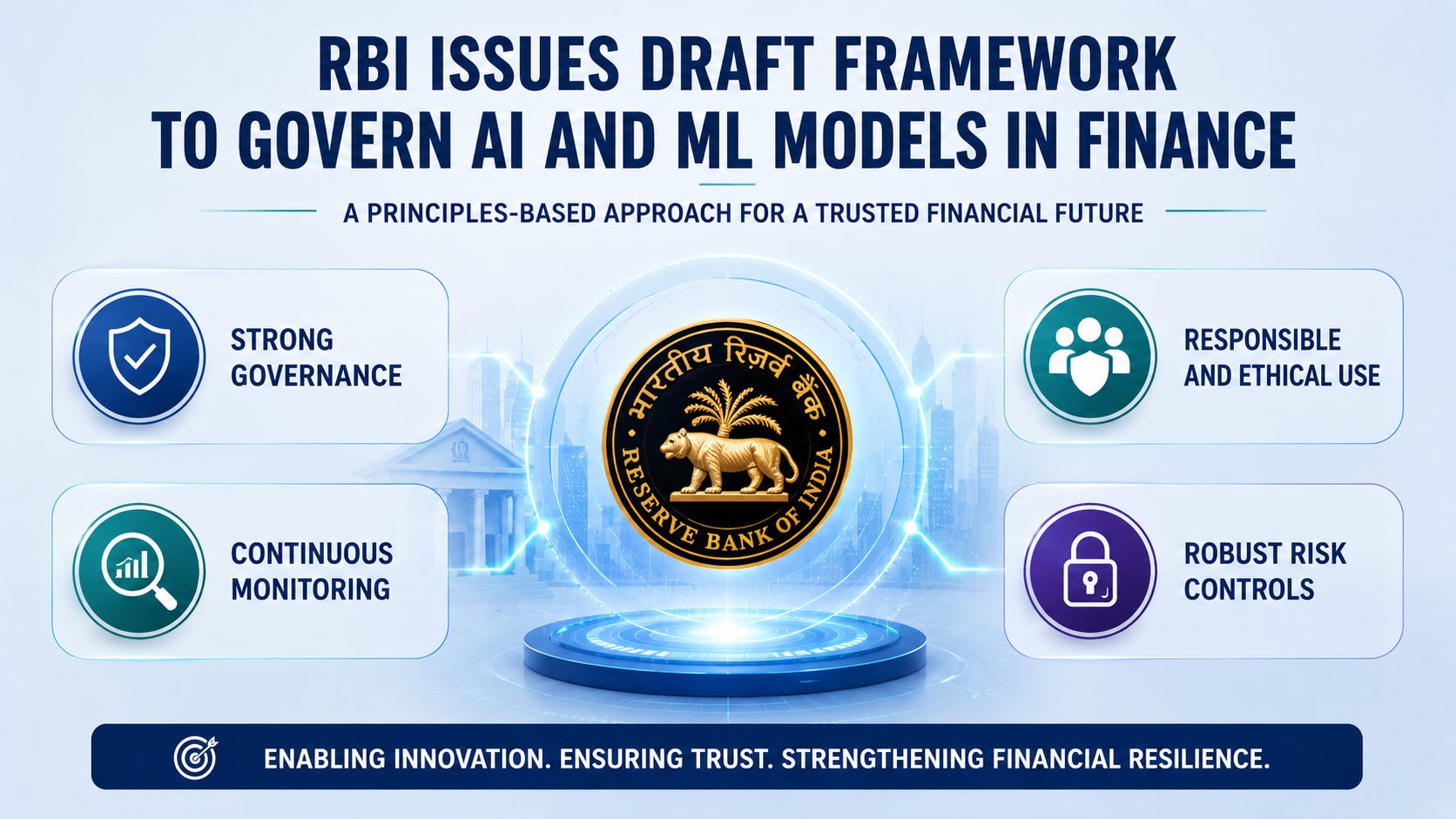
The draft guidelines emphasise explainability, bias mitigation, human oversight, cybersecurity safeguards and greater scrutiny of third-party and generative AI models. As financial institutions increasingly integrate advanced analytics into their operations, the proposed framework seeks to promote the responsible adoption of AI while strengthening transparency, consumer protection and the operational resilience of India’s financial sector.
India Transitions To A New Digital Telecom Authorisation Framework
The Department of Telecommunications has operationalised the Telecom eServices Portal under the Telecommunications Act, 2023, formally transitioning India’s telecom sector to a new digital authorisation framework. The new system replaces the earlier licensing regime with a streamlined, digital-first approach for granting telecom service authorisations.
The reform simplifies regulatory processes, reduces administrative burden and provides greater clarity for telecom operators entering or expanding in the market. As India’s digital economy continues to grow, the new framework establishes a modern regulatory architecture designed to support innovation, improve ease of doing business and strengthen digital governance.
Smart Warehouse Management System To Modernise Foodgrain Storage
The Ministry of Consumer Affairs, Food and Public Distribution has launched a Smart Warehouse Management System to modernise foodgrain storage across the country. The platform introduces digital monitoring and inventory management tools aimed at improving operational efficiency within the public food storage network.
The initiative will strengthen stock management, reduce storage inefficiencies and support more efficient movement of foodgrains across the supply chain. As India continues to modernise its food security architecture, the adoption of digital warehouse management systems represents an important step towards improving transparency, operational efficiency and service delivery within the Public Distribution System.
If you are interested in more detailed coverage of these and other policy developments, we invite you to read the full India Governance Watch (16th June to 30th June, 2026) newsletter.
Also, please consider subscribing to NFPRC Foundation’s focused centres covering latest economic, policy and administrative developments -
Centre for Law, Policy and Governance - Link
Centre for Accelerating India’s Growth - Link
Centre for Studies in Indian Social Systems - Link
NFPRC Foundation - Link