
This edition of India Governance Watch tracks how recent decisions by the Central Government are shaping the broader economic and regulatory landscape. The focus is not just on announcements, but on the institutional logic behind them—how policy design is evolving to address execution gaps, market volatility, and external risks.
From the launch of the BHAVYA scheme aimed at building industry-ready manufacturing ecosystems, to regulatory interventions by the RBI to manage currency exposure, and the continued push toward regional connectivity through an expanded UDAN framework, the developments reflect a calibrated shift toward system-level efficiency. Alongside this, legislative reforms such as the Jan Vishwas Bill and the creation of empowered groups to respond to geopolitical disruptions point to a more coordinated and anticipatory governance approach
I. BHAVYA Scheme To Boost Industrial Manufacturing
The Union Cabinet has approved the Bharat Audyogik Vikas Yojna (BHAVYA), with a ₹ 33,660 crore outlay to back it. The headline number is 100 new industrial parks, each between 100 and 1,000 acres. But the more interesting detail is how they’re being built.
Parks under BHAVYA come with pre-approved utilities and clearances, so an investor doesn’t arrive at an empty plot sorting out power, water, and paperwork. The scheme also offers up to ₹ 1 crore per acre in financial assistance and covers up to 25% of external infrastructure costs.
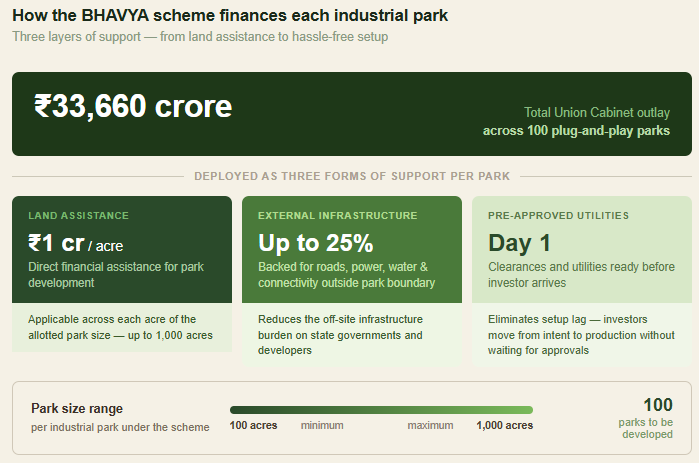
The context here is worth noting. Earlier initiatives saw underutilisation, with nearly 1.35 lakh hectares out of 7.7 lakh hectares of mapped industrial land remaining unused across over 4,500 industrial parks. BHAVYA addresses this gap by shifting from mere land creation to industry-ready ecosystems, designed to be operational from day one.
II. RBI Caps NOP-INR Position For Authorised Dealers
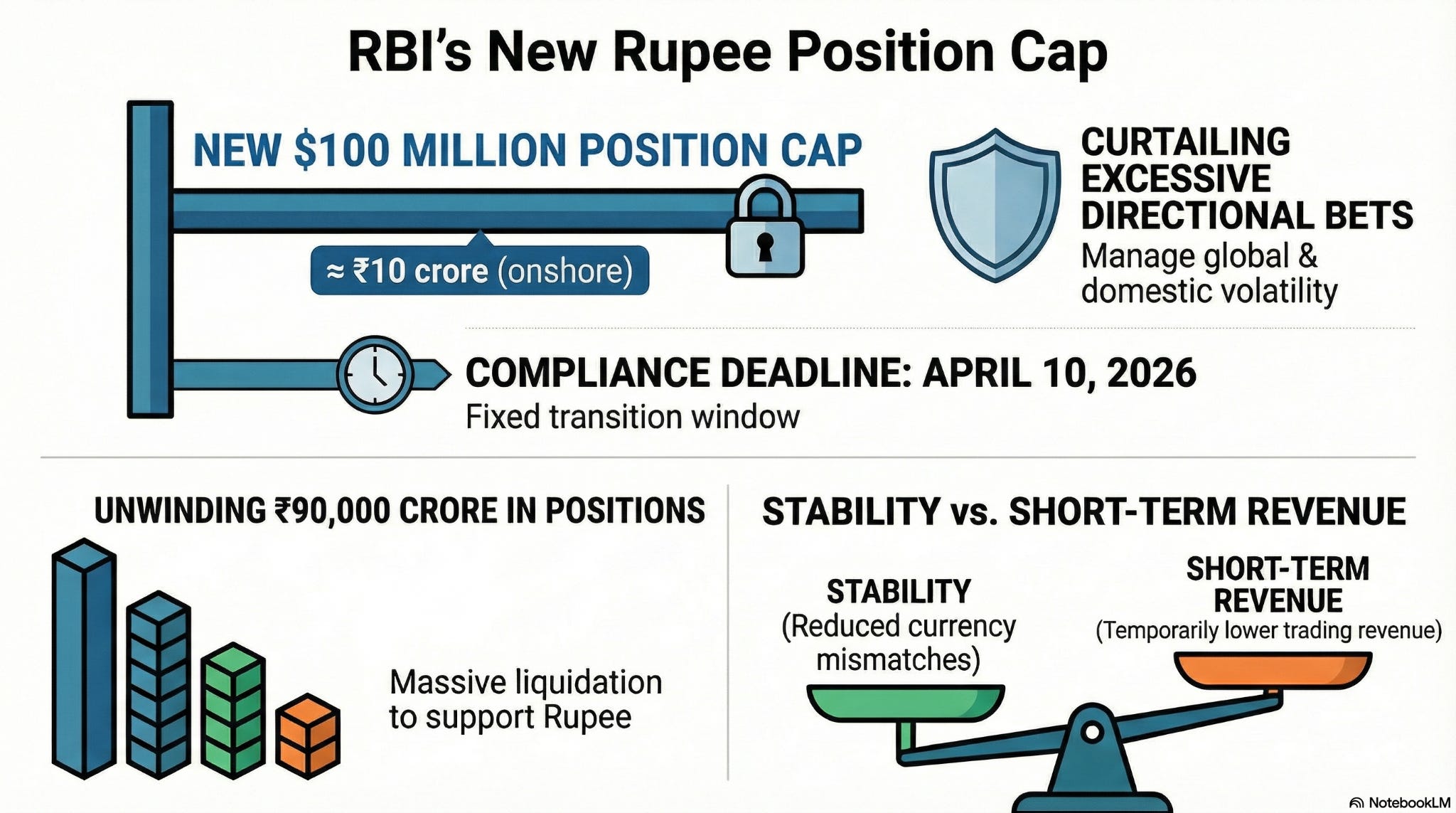
In a move to manage market volatility, the Reserve Bank of India (RBI) has prescribed a $ 100 million cap (~ ₹ 10 crore) on the Net Open Position in INR (NOP-INR) that Authorised Dealers can hold in the onshore deliverable foreign exchange market. Dealers are required to comply with this revised limit by 10th April, 2026, indicating a tight transition window intended to curb excessive directional bets.
The cap is expected to trigger an unwinding of₹ 90,000 – ₹ 1,20,000 crore in existing positions, which may lend immediate support to the rupee but risks mark-to-market losses for banks. While it reduces structural vulnerabilities arising from large currency mismatches, it simultaneously curtails trading revenue for financial institutions in the short run.
III. Recalibrated UDAN Scheme To Boost Regional Connectivity
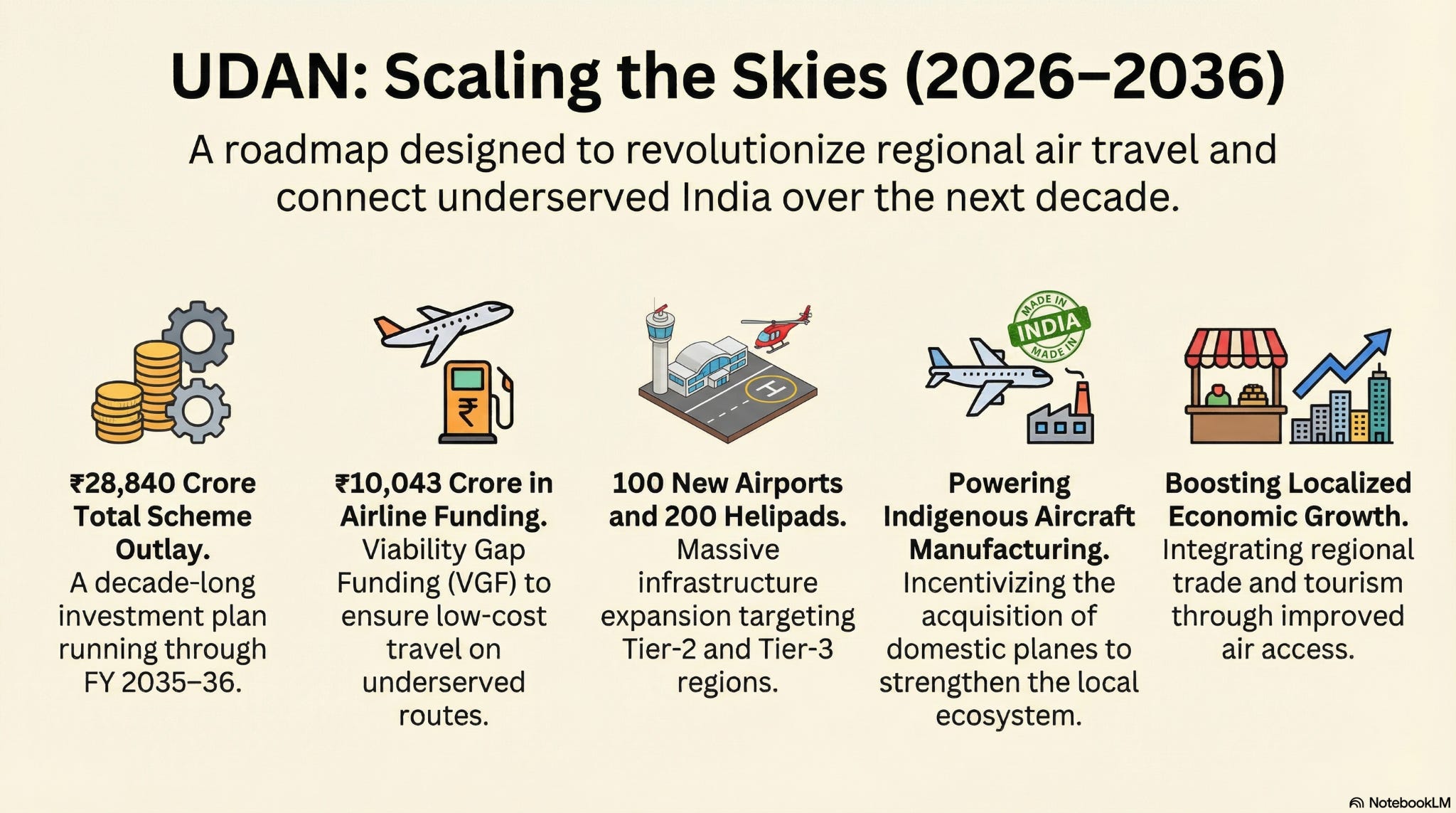
The Union Cabinet has approved the Modified UDAN (Ude Desh Ka Aam Nagrik) Scheme for the period FY 2026–27 to FY 2035–36 with a total outlay of ₹ 28,840 crore. It targets 100 new airports, 200 helipads, and over ₹ 10,043 crore in Viability Gap Funding.
This extension enhances regional connectivity and economic integration by improving air access to Tier-2 and Tier-3 regions. By lowering the barriers to entry for regional travel, the initiative is poised to boost tourism, trade, and localised economic growth across previously underutilized aviation corridors.
IV. Jan Vishwas Bill 2026 Decriminalises Minor Offenses
The Government has introduced the Jan Vishwas (Amendment of Provisions) Bill, 2026 in the Lok Sabha, seeking to decriminalise 717 provisions across 79 Central Acts. This covers amendments across 23 ministries, and the bill also proposes new adjudicating and appellate authorities to handle enforcement under the revised framework.
The reform aims to decongest courts, while the Select Committee recommends establishing a Centralised Regulatory Management System. This would track compliance requirements across Ministries and institutionalise the reform as an ongoing process, rather than a one-time legislative exercise.
V. Seven Empowered Groups Constituted To Address The West Asia Crisis Impact
Recognising the potential for external volatility, the Government has constituted seven empowered groups of senior officials to assess and mitigate the economic, energy, and security impacts of the ongoing West Asia conflict.
Modelled on the COVID-19 response framework, these groups adopt a “whole-of-Government” approach to address critical vulnerabilities in supply chains, petroleum and energy (LPG/LNG), fertilisers, and essential commodities. Each group is tasked with real-time monitoring and strategy formulation to ensure time-bound implementation of response measures.
If you are interested in more detailed coverage of these and other policy developments, we invite you to read the full India Governance Watch (16th March to 31st March, 2026) newsletter - Click Here