
This fortnightly brief tracks the decisions by the Central Government and what they add up to. We start with the Sixteenth Finance Commission’s devolution formula, before turning to the interim India–US trade framework that resets tariff structures, the ₹ 1 lakh crore Urban Challenge Fund, draft rules that simplify drug trials by scrapping provisional ethics‑committee registration, tighter RBI norms that force brokers to post 100% collateral for bank loans, and a draft defence acquisition regime that emphasises institutional preference for Indigenously Designed, Developed and Manufactured.
Government Retains Devolution At 41% As Recommended By 16th FC
The Ministry of Finance has accepted the Sixteenth Finance Commission’s recommendation to retain the vertical tax devolution share of states at 41% of the divisible pool, effectively continuing the Fifteenth Commission’s benchmark.
Horizontally, the Commission has retained a familiar set of criteria but has added “contribution to national Gross Domestic Product” as a new performance‑linked indicator with a 10% weight. Tax effort has been dropped as a separate parameter, and the weights on income‑distance and demographic performance have been calibrated to keep substantial redistribution towards poorer and demographically better‑performing states.
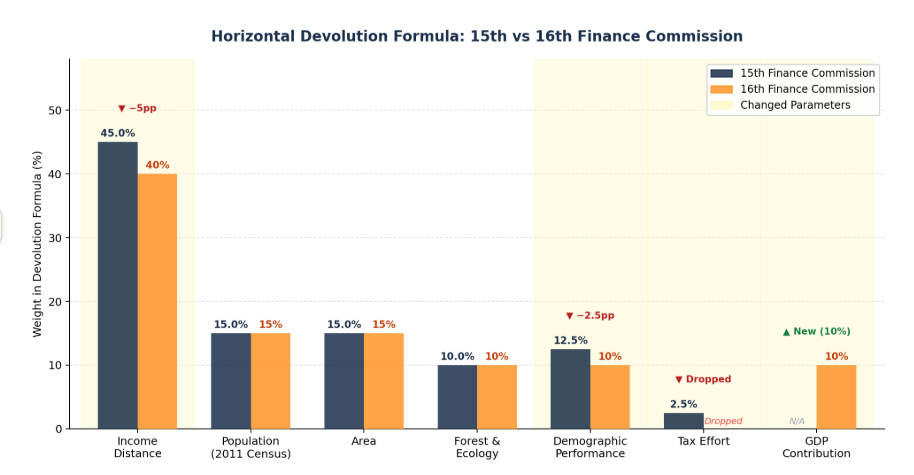
This formula nudges towards rewarding economic performance without abandoning needs‑based redistribution, improving shares for more industrialised, higher‑GDP states.
Read NFPRC’s Summary of Sixteenth Finance Commission Report here.
India–US Interim Deal Resets Tariffs And Tech Flows
India and the United States have issued a Joint Statement outlining a framework for an Interim Trade Agreement preceding a full Bilateral Trade Deal, under which India will lower or eliminate tariffs on US industrial and agricultural goods, while the US will impose an 18% reciprocal tariff on Indian exports, with potential rollbacks for key Indian sector.
On the Indian side, the interim trade deal seeks to unlock export gains in sectors such as textiles and apparel, leather and footwear, plastics and rubber, organic chemicals, engineering goods, aircraft parts, gems and jewellery, and IT‑enabled services through lower US tariffs and reduced non‑tariff barriers.
The core economic bet is that the combination of tariff cuts, clearer rules of origin and greater certainty on standards will embed its firms deeper into US‑linked supply chains and crowd in investment into export‑oriented manufacturing and services clusters.
Urban Challenge Fund Pushes Cities To The Market
The Union Cabinet has approved a ₹ 1 lakh crore Urban Challenge Fund (UCF) to unlock roughly ₹ 4 lakh crore of investment in urban infrastructure over five years through market‑linked financing rather than pure grants.
The Fund will cover all state and Union Territory capitals, cities and major industrial centres. Central support will be capped at 25% of project cost, with at least 50% to be raised from market sources such as municipal bonds, bank loans and PPPs, and the balance filled by states, Union Territories and urban local bodies. For first‑time borrowers, the Centre will guarantee up to ₹ 7 crore or 70% of the loan amount (whichever is lower), dropping to 50% coverage for subsequent loans.
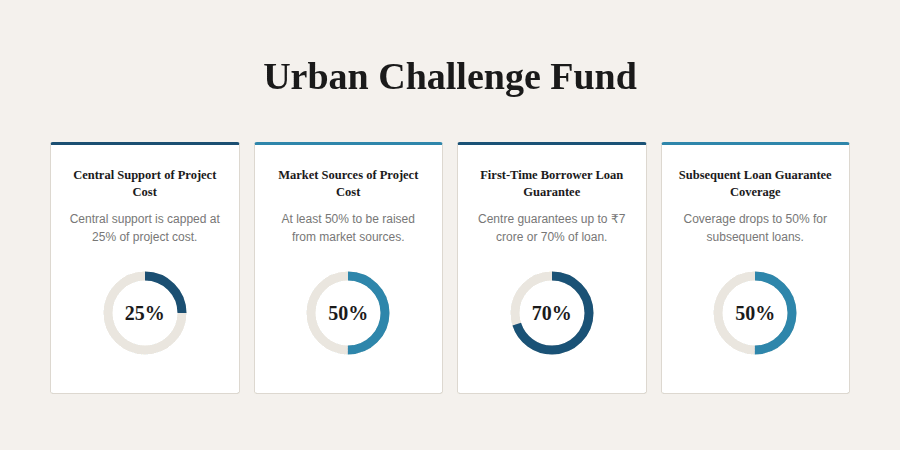
If the challenge‑mode and guarantee structures work as intended, the UCF could accelerate the emergence of ULBs as credible, rated and repeat market borrowers, gradually shifting India away from one‑off, scheme‑led city funding.
Draft NDCT Rules Propose Ending Provisional Ethics‑Committee Registration
The Ministry of Health and Family Welfare has circulated draft New Drugs and Clinical Trials (Amendment) Rules, 2026, targeting the ethics‑committee bottleneck as a key procedural reform lever. The draft proposes to do away with the current provisional registration requirement for ethics committees, moving to a single final registration granted after full scrutiny of the application.
Rather than altering core safeguards, the amendment leaves participant‑protection, informed‑consent and safety‑reporting provisions in the parent NDCT Rules intact, while tightening the entry bar by allowing only fully compliant ethics committees to operate once they secure final registration.
The net effect is to front‑load regulatory expectations at the committee level, while reducing redundant interfaces between committees and the central regulator. The draft framework could cut activation times for multi‑centre and global trials, and reduce uncertainty for academic investigators.
RBI Clamps Down On Leveraged Broker Funding
The Reserve Bank of India has amended its Commercial Banks Credit Facilities Directions to tighten how banks can lend to stockbrokers and capital‑market intermediaries, with the new norms taking effect from 1st April 2026. Under the revised rules, all credit to SEBI‑regulated brokers and similar intermediaries must be fully secured, meaning 100% collateral coverage, promoter or corporate guarantees alone will no longer be sufficient.
The circular also draws harder lines on what banks can and cannot fund. Funding of proprietary trading books of brokers is explicitly barred, though credit can still be extended for market‑making and short‑term warehousing of debt securities within prudential exposure limits.
If sustained, these norms will push brokers and other intermediaries towards higher‑quality collateral, lower balance‑sheet leverage, which should reduce systemic vulnerability to market shocks and broker failures. The near‑term friction will show up in tighter liquidity for margin funding, higher costs for less‑capitalised brokers.
Draft DAP‑2026 Rewrites India’s Defence Sourcing Rules
The Ministry of Defence has published the Draft Defence Acquisition Procedure (DAP) 2026 and invited stakeholder comments, signalling a planned overhaul of the current DAP‑2020. It reiterates and deepens institutional preference for Buy (Indian‑IDDM) categories that prioritise indigenous design, development and manufacturing.
Substantively, the proposed procedure simplifies financial and experience criteria to widen the pool of eligible firms, especially MSMEs and newer players, and leans on digitisation, automation and standardisation to speed up decision‑making. On paper, this is in lines industry has been asking for, predictability on what qualifies as “indigenous”, a realistic view of where Indian firms can lead and where they should partner.
The stress point will be implementation capacity and risk appetite inside the system, particularly whether stricter indigenous‑content rules delay critical buys, and whether the Services and the bureaucracy are willing to tolerate early‑stage failures when backing Indian designs over proven imports.
If you are interested in more detailed coverage of these and other policy developments, we invite you to read the full India Governance Watch (1st February to 15th February, 2026) newsletter here.