

The Macro Story
India entered FY2026-27 with growth momentum on a firm footing. Economic activity remained broad-based across manufacturing, services, exports and government revenues, while inflation stayed within manageable levels. What stands out is that this performance came amid continuing geopolitical tensions in West Asia and renewed uncertainty in global energy markets, underscoring the economy’s growing ability to navigate external disruptions.
The broader picture is one of increasing resilience. Strong foreign exchange reserves, healthy export growth, robust tax collections and sustained domestic demand have together strengthened India’s economic foundations. While global uncertainties remain, the latest data suggests that India is approaching this period from a position of greater confidence, with stronger buffers and a wider policy space than in many previous cycles.
I. Three Trends That Defined The Month
1. Growth Remains Investment-Led
GDP growth for FY2025-26 is estimated at 7.7%, supported by manufacturing, construction and infrastructure activity.
Industrial output expanded 4.9% year-on-year, while capital goods production grew 16%, indicating that investment activity remains a key driver of growth. Business confidence also improved, with both Manufacturing and Services PMI remaining firmly in expansion territory.
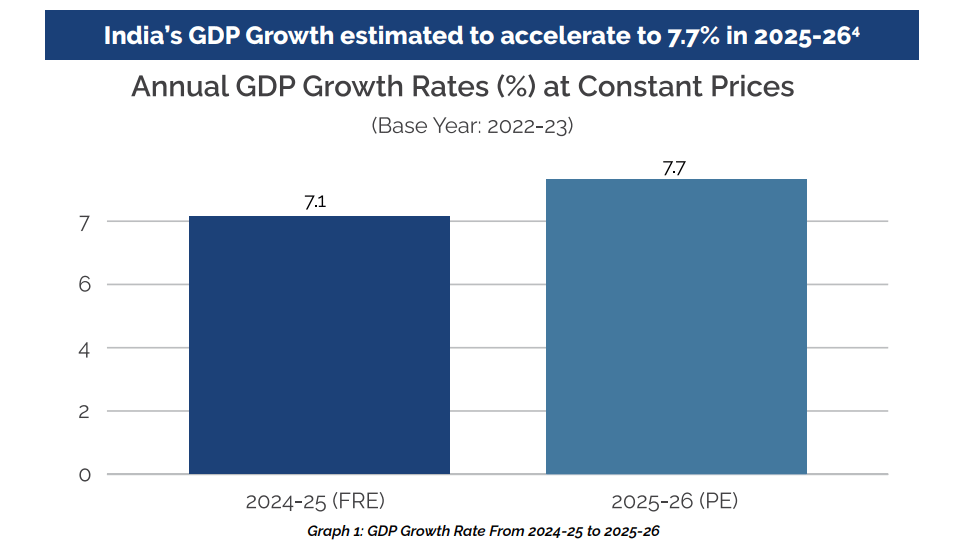
Why it matters: Strong capital goods growth often signals future capacity creation rather than short-term consumption strength, making it a useful indicator of underlying economic momentum.
2. External Resilience Continues To Improve
India’s exports grew 13.6% year-on-year to $80.8 billion, while the trade deficit narrowed significantly compared to the same period last year.
Foreign exchange reserves rose above $703 billion, providing a substantial cushion against currency volatility and external shocks.
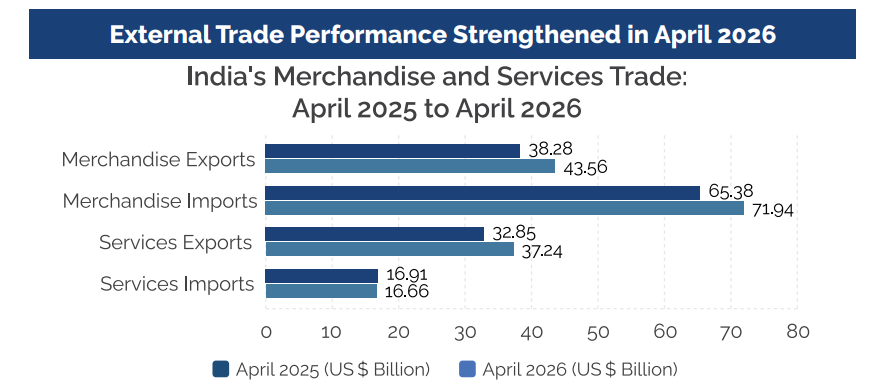
Why it matters: At a time when shipping routes, energy markets and global trade remain vulnerable to geopolitical disruptions, stronger external balances provide policymakers with greater flexibility.
3. Inflation Is Contained
Headline inflation remained moderate at 3.48%, comfortably within the RBI’s target range. However, food inflation edged higher and commodity-linked price pressures remain visible in selected categories.
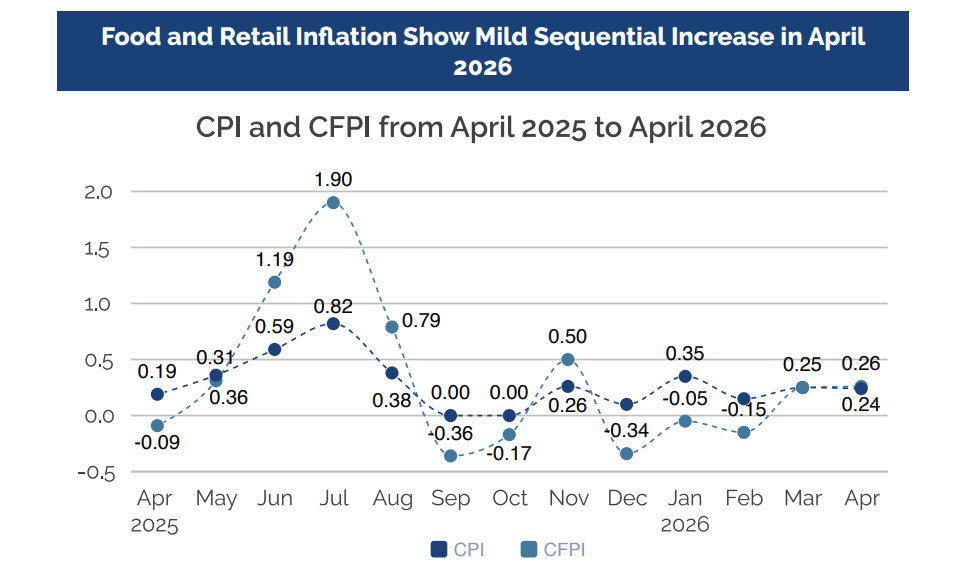
Why it matters: The inflation challenge has shifted from broad-based price pressures to managing sector-specific volatility, particularly in food and imported commodities.
II. Sector Watch
Infrastructure-linked sectors continued to outperform.
Steel production grew 5.8% year-on-year, cement output expanded 9.4%, and renewable energy capacity increased by 4.6 GW during the month. Cumulatively, these indicators point to sustained momentum in construction, industrial activity and energy investment.
At the same time, coal continued to account for over 70% of electricity generation, highlighting the reality that India’s energy transition remains an expansion strategy rather than a substitution strategy.
III. Policy Spotlight
The Union Cabinet approved two new projects under the India Semiconductor Mission with a combined investment of nearly ₹3,936 crore.
The significance of these projects extends beyond their immediate investment value. They represent another step in India’s effort to build capabilities across the semiconductor value chain, ranging from advanced display manufacturing and chip packaging to broader electronics production ecosystems. The projects are expected to add capacity in Mini/Micro-LED display manufacturing and semiconductor assembly, testing and packaging, while creating over 2,200 skilled jobs.
More importantly, they contribute to a larger strategic objective of reducing dependence on imported semiconductor components and positioning India as an alternative manufacturing destination within increasingly diversified global supply chains. The next phase will depend on execution, ecosystem development, technology transfer and workforce creation to convert these investments into durable manufacturing capacity.
Looking Ahead
The central economic story remains unchanged - growth is strong, inflation is manageable and external indicators are improving.
The broader message from this month's data is one of increasing economic resilience. Growth remains strong, inflation is contained, exports are expanding and investment activity continues to gather pace. If these trends are sustained, India enters the next phase of development with an opportunity to translate macroeconomic stability into greater industrial capacity, technological capability and long-term prosperity.
Also, please consider subscribing to NFPRC Foundation’s focused centres covering latest economic, policy and administrative developments -
Centre for Law, Policy and Governance - Link
Centre for Accelerating India’s Growth - Link
Centre for Studies in Indian Social Systems - Link
NFPRC Foundation - Link