
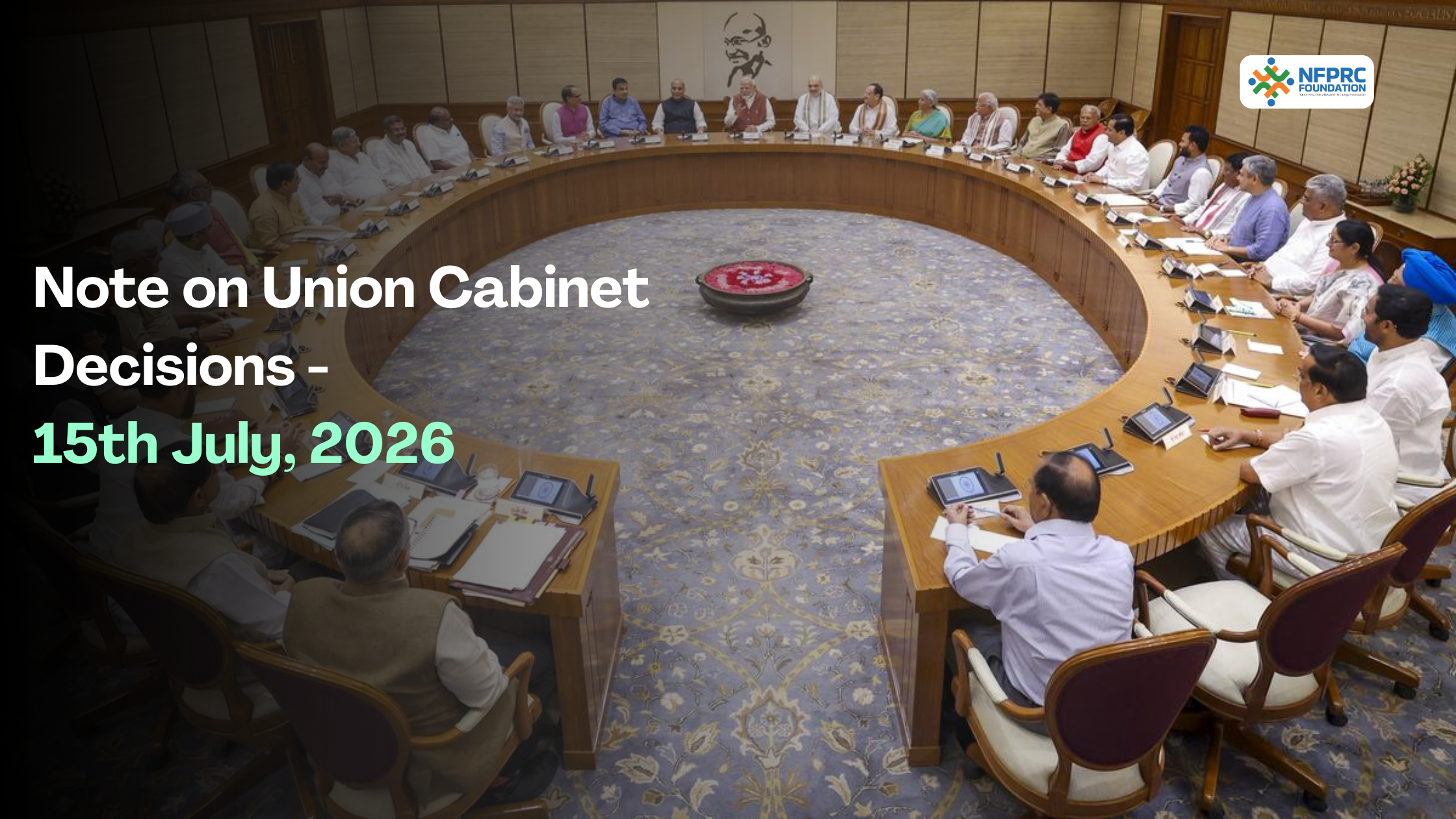
On 15th July, 2026, the Union Cabinet and the Cabinet Committee on Economic Affairs (CCEA), chaired by Prime Minister Shri Narendra Modi Ji, approved several major initiatives to strengthen manufacturing, infrastructure, and connectivity. The key decisions included the approval of Semicon 2.0, the Mobile Phone Manufacturing Scheme (MPMS), the National Investment Policy for Urea 2026 (NIPU-2026), two railway multi-tracking projects worth ₹ 3,907 crore, and a ₹ 14,447.64 crore Greenfield Elevated Corridor connecting NH-19 with the Varanasi Ring Road. These measures are expected to boost domestic manufacturing, improve logistics and transport connectivity, enhance industrial self-reliance, and accelerate economic growth under the vision of Atmanirbhar Bharat and Viksit Bharat.
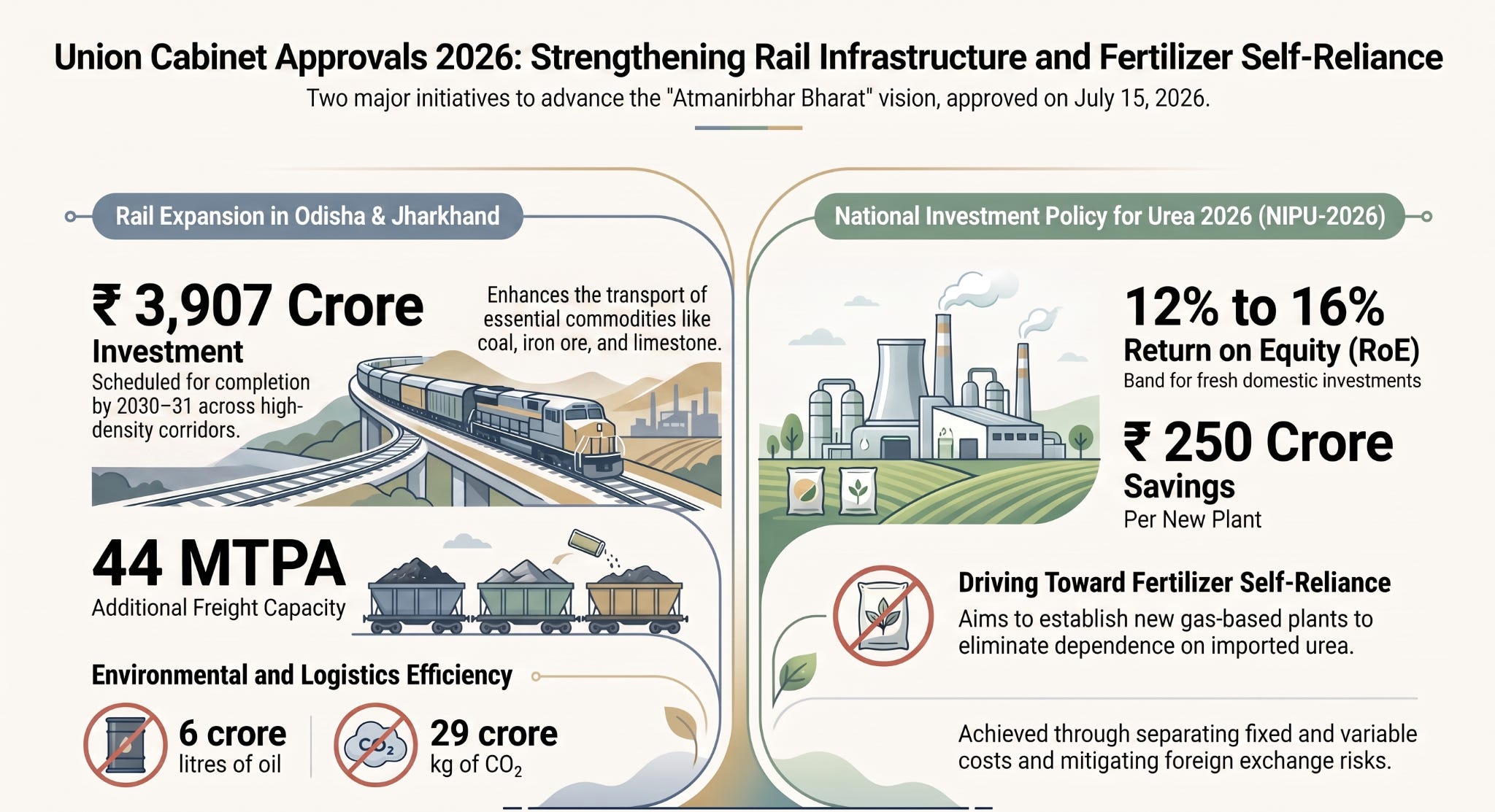
I. Approval Of Two Multi-Tracking Railway Projects In Odisha And Jharkhand
The Cabinet Committee on Economic Affairs (CCEA) has approved two railway multi-tracking projects, namely Paradeep to Haridaspur Doubling and Rajkharsawan to Dangoaposi 4th Line, at an estimated cost of ₹3,907 crore. Covering four districts across Odisha and Jharkhand, the projects will add about 145 km to the Indian Railways network and are scheduled for completion by 2030–31.
Planned under the PM Gati Shakti National Master Plan, the projects aim to enhance rail capacity, improve operational efficiency, decongest high-density rail corridors, and strengthen multimodal connectivity. They will facilitate seamless passenger and freight movement while improving access to around 1,526 villages with a combined population of nearly 14 lakh. The upgraded network will also improve connectivity to the Lalitgiri Buddhist Complex, Shree Baladevjew Temple, and Meghahatuburu Hills.
The projects are expected to create an additional freight handling capacity of 44 million tonnes per annum (MTPA), supporting the movement of coal, iron ore, dolomite, limestone, and gypsum. They are also projected to reduce logistics costs, save around 6 crore litres of oil imports, and cut 29 crore kg of CO₂ emissions, equivalent to planting one crore trees, supporting India’s climate and sustainable transport goals.
II. Approval Of National Investment Policy For Urea 2026 (NIPU-2026)
The Cabinet Committee on Economic Affairs (CCEA) has approved the National Investment Policy for Urea 2026 (NIPU-2026) to promote fresh investments in the domestic urea sector. The policy aims to encourage new gas-based urea manufacturing plants, strengthen fertilizer self-sufficiency, and reduce dependence on imported urea.
NIPU-2026 introduces key reforms over NIP 2012, including the separation of fixed and variable costs, a Return on Equity (RoE) band of 12% to 16%, and the conversion of fixed costs into Indian Rupees after four years based on prevailing exchange rates to mitigate foreign exchange risks. These reforms are expected to save over ₹250 crore for each new urea plant established under the policy.
The policy builds on the six urea plants established under NIP 2012. India currently has 33 operational urea manufacturing units with an installed capacity of 269.42 lakh metric tonnes (LMT), but domestic production continues to fall short of demand. NIPU-2026 aims to reduce import dependence through additional domestic capacity and advance fertilizer self-reliance.
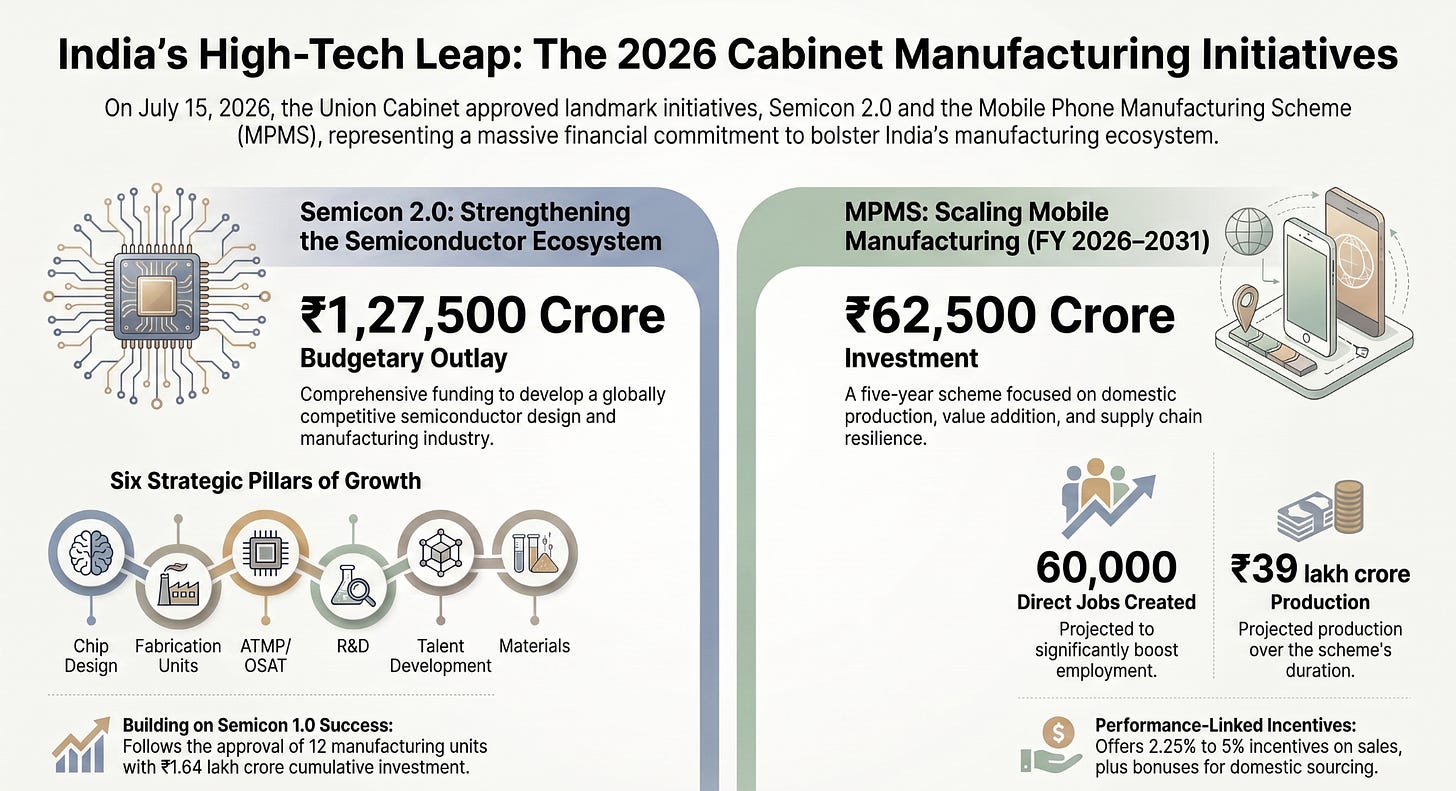
Image 2: Cabinet Decisions on 15th July, 2026.
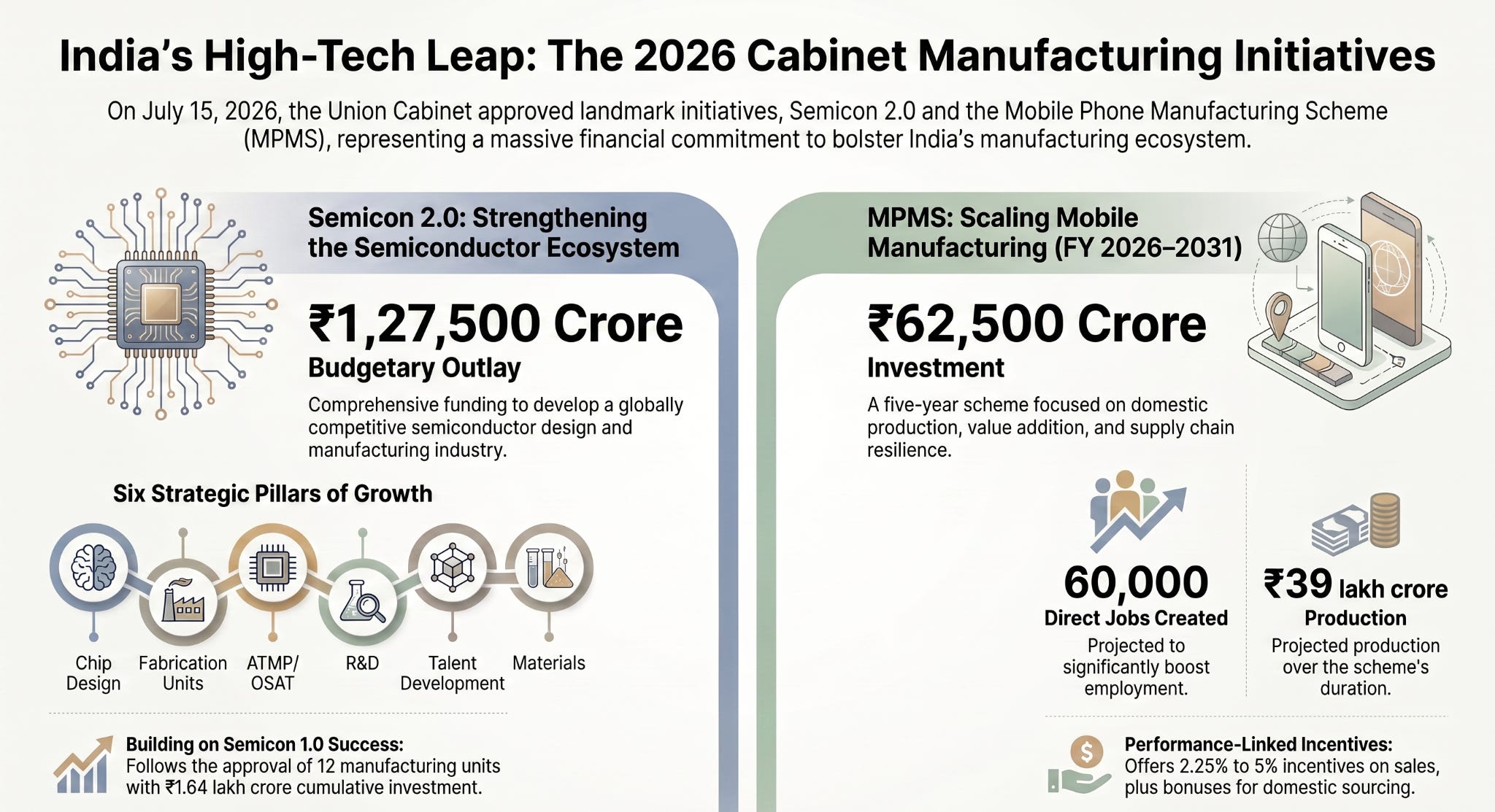
IV. Approval Of Semicon 2.0 For Strengthening India's Semiconductor Ecosystem
The Union Cabinet has approved Semicon 2.0 with a total budget outlay of ₹ 1,27,500 crore to strengthen India’s semiconductor design and manufacturing ecosystem. Building on Semicon 1.0, the programme aims to provide sustained policy support for developing a globally competitive semiconductor industry and advancing technological self-reliance.
Semicon 2.0 is structured around six strategic pillars, covering chip design, semiconductor machines and materials, additional fabrication (fab) units, expansion of the ATMP/OSAT industry, research and development, and talent development. The programme seeks to strengthen the entire semiconductor value chain through indigenous innovation, manufacturing, research, and skill development.
The programme builds on the achievements of Semicon 1.0, under which 12 semiconductor manufacturing units with investments exceeding ₹ 1.64 lakh crore have been approved. It has also supported 24 chip design projects and provided 105 startups and MSMEs access to advanced Electronic Design Automation (EDA) tools. Semicon 2.0 aims to strengthen domestic manufacturing, improve supply chain resilience, and position India as a global semiconductor hub.
V. Approval Of Mobile Phone Manufacturing Scheme (MPMS)
The Union Cabinet has approved the Mobile Phone Manufacturing Scheme (MPMS) with a budgetary outlay of ₹ 62,500 crore to strengthen India’s mobile phone manufacturing ecosystem. The scheme will be implemented over five years from FY 2026–27 to FY 2030–31 to increase domestic production, enhance value addition, strengthen supply chains, and improve global competitiveness.
The scheme provides performance-linked incentives of 2.25% to 5%, along with an additional incentive of up to 1.5% for domestic sourcing of key components and 3% for Indian brands undertaking product design and research and development. These measures aim to promote indigenous manufacturing, innovation, and Indian intellectual property.
During the scheme period, India’s cumulative mobile phone production is expected to reach approximately ₹ 39 lakh crore, with higher exports and around 60,000 direct jobs. Building on the Production Linked Incentive Scheme for Large Scale Electronics Manufacturing (PLI-LSEM), the scheme seeks to sustain India’s position as the world’s second-largest mobile phone manufacturer, with 99.2% of phones used domestically manufactured in India.
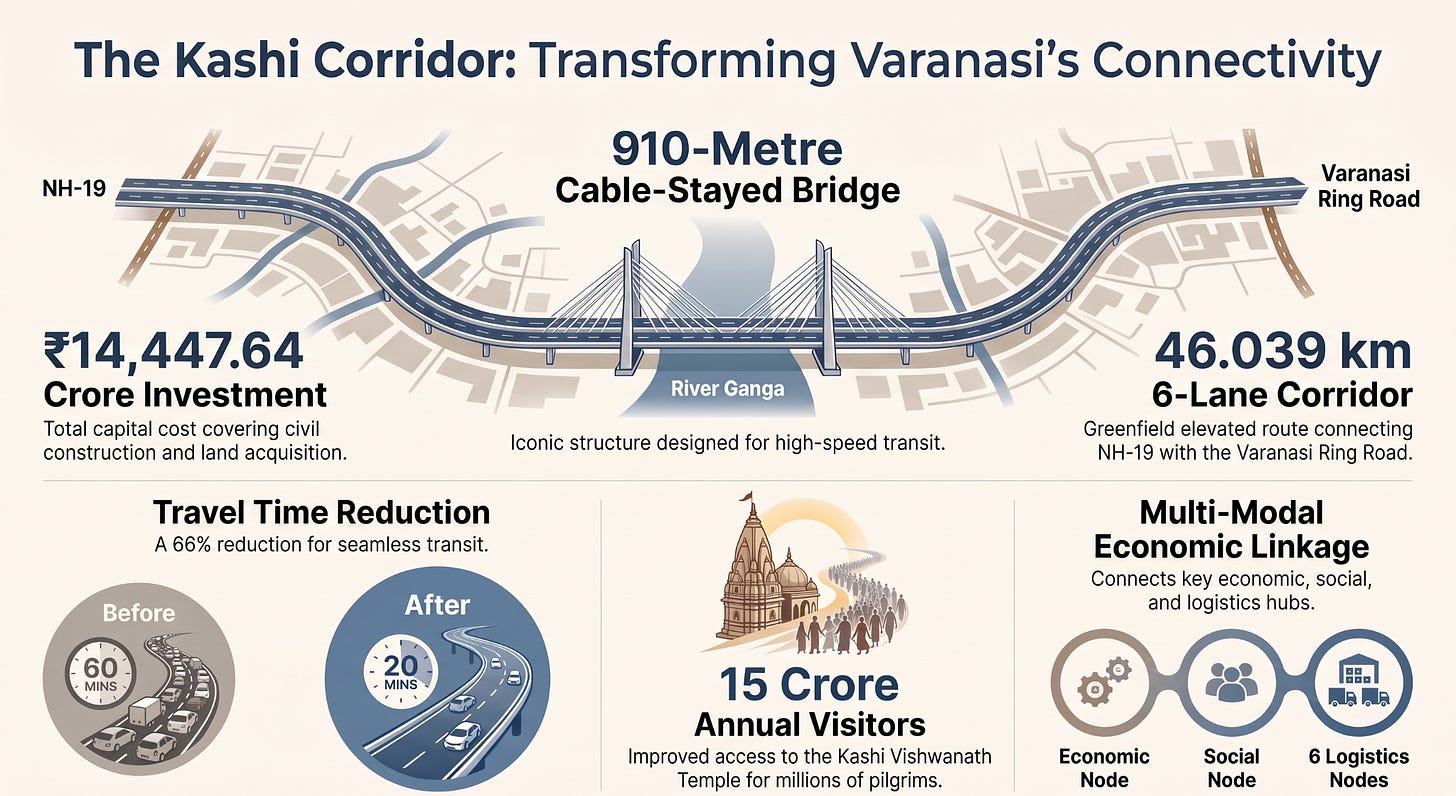
Image 3: Cabinet Decision on 15th July, 2026.
VI. Development Of 6-Lane Greenfield Elevated Corridor Between NH-19 And Varanasi Ring Road (Uttar Pradesh)
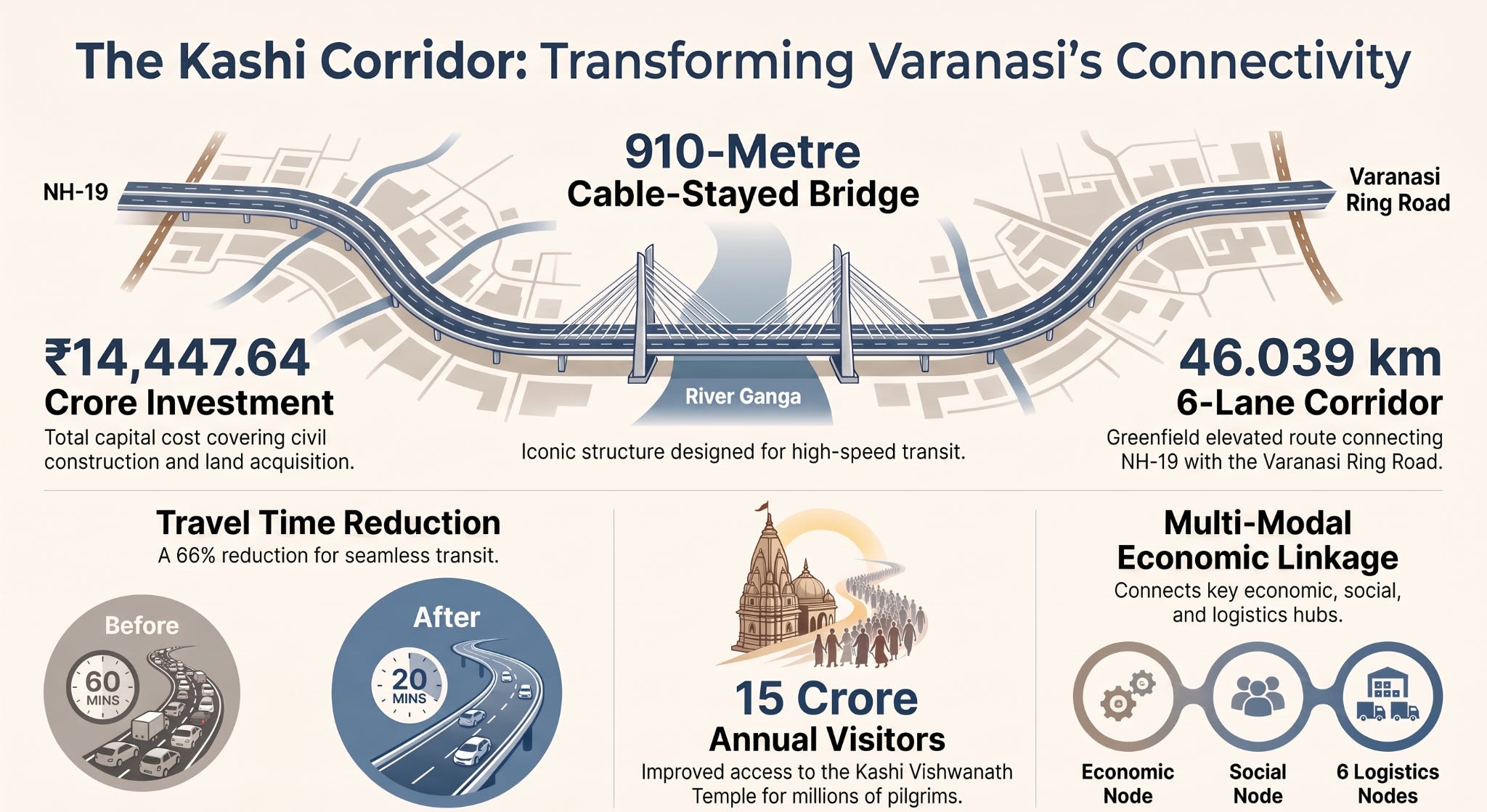
The Cabinet Committee on Economic Affairs (CCEA) has approved the development of a 46.039 km, 6-lane Greenfield Elevated Corridor connecting NH-19 with the Varanasi Ring Road (NH-135B) in Uttar Pradesh. The project will be implemented under the Hybrid Annuity Model (HAM) at a total cost of ₹14,447.64 crore.
The corridor includes a 910-metre cable-stayed bridge over the River Ganga, a 1.32 km Foot Over Bridge-cum-Major Bridge with travelators, and supporting infrastructure such as loops, ramps, service roads, and link roads. Designed for speeds of 80–100 km/h, it will improve connectivity between NH-19, the Varanasi Ring Road, Ramnagar, BHU, and the riverfront while reducing urban congestion.
The project is expected to reduce travel time from 60 minutes to 20 minutes, with travel between NH-19 and Kashi Railway Station falling from 50 minutes to 25 minutes. It will improve connectivity to key landmarks, including Kashi Vishwanath Temple, BHU, Namo Ghat, Ramnagar Fort, and the Ghats of Varanasi, supporting over 15 crore tourists and pilgrims annually. The corridor will also link one economic node, one social node, and six logistics nodes, enhancing logistics efficiency, tourism, road safety, and regional economic growth.
The Union Cabinet’s decisions of 15 July 2026 reflect a comprehensive approach to strengthening India’s long-term economic capabilities. Spanning semiconductors, electronics manufacturing, fertilizer production, rail infrastructure, and multimodal connectivity, these approvals collectively represent an investment commitment of over ₹2.08 lakh crore towards enhancing industrial capacity, infrastructure, and strategic self-reliance.
The expected outcomes are equally significant. Semicon 2.0 builds upon more than ₹1.64 lakh crore of approved investments in semiconductor manufacturing. The Mobile Phone Manufacturing Scheme is projected to generate nearly ₹39 lakh crore in production and 60,000 direct jobs over five years. Railway expansion projects will add 44 million tonnes of annual freight capacity while improving connectivity for nearly 14 lakh people, and the Varanasi Greenfield Corridor will substantially reduce travel time, strengthen logistics, and improve access to one of India’s most important cultural and economic centres.
Viewed together, these initiatives reinforce India’s focus on building competitive manufacturing ecosystems, modern logistics networks, and resilient industrial value chains. By combining strategic investments with targeted policy reforms, these decisions contribute to improving productivity, expanding domestic value addition, and advancing the broader objectives of Atmanirbhar Bharat and Viksit Bharat 2047.