
On 1st July, 2026, the Cabinet Committee on Economic Affairs (CCEA), chaired by Prime Minister Shri Narendra Modi Ji, approved major infrastructure initiatives aimed at strengthening road connectivity, eliminating urban bottlenecks, and fostering regional economic development. The decisions included the construction of a ₹ 6,969.67 crore 6-lane road tunnel in Delhi connecting the Dwarka Expressway to Vasant Kunj, and a ₹ 7,145 crore 4-lane access-controlled highway from Kanpur to Kabrai in Uttar Pradesh. These critical projects are part of a massive infrastructure push under NDA 3.0, which has approved total infrastructure projects (including rail, road, metro, and energy) exceeding ₹ 26 lakh crore.
I. Construction Of 6-Lane Road Tunnel (NH-148AE) In Delhi
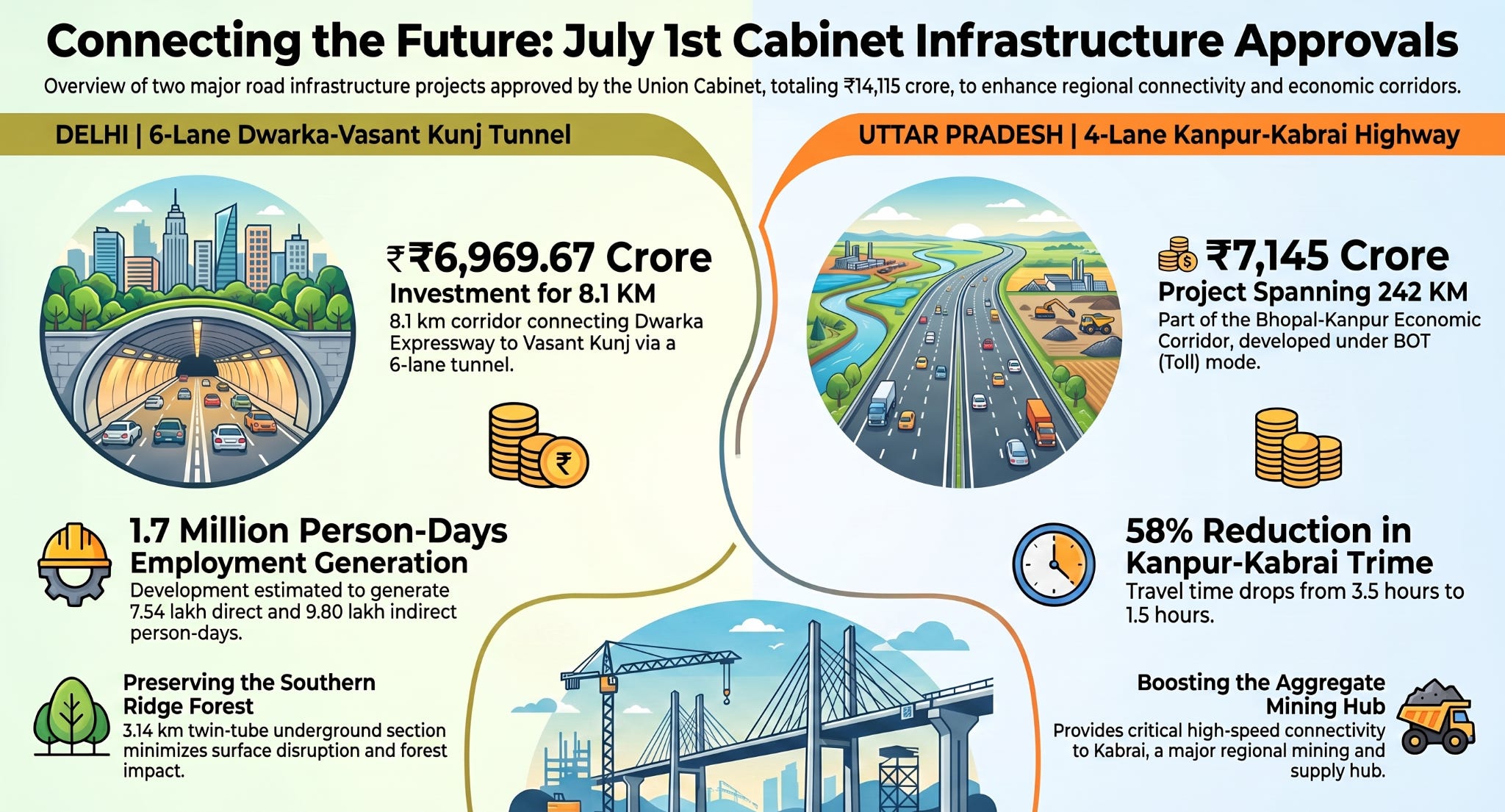
The Cabinet has officially approved the construction of a 6-lane road tunnel for NH-148AE in Delhi, backed by a substantial capital investment of ₹ 6,969.67 crore. Developed on a Greenfield alignment under the Hybrid Annuity Mode (HAM), this extensive 8.1 km infrastructure project is slated for completion over a 5-year period.
The project aims to provide faster connectivity between West and South Delhi by connecting the Dwarka Expressway (NH 248 BB) at the Shivmurti Interchange with Nelson Mandela Marg in Vasant Kunj. It features a 3.14 km underground twin-tube tunnel (constructed via Tunnel Boring Machine) that deliberately passes beneath the Southern Ridge Forest to minimize surface disruption and preserve the environment. To further mitigate congestion, the project incorporates an additional 1.8-km elevated road, a new flyover, and an elevated U-turn.
This corridor will drastically decongest existing saturated routes and major bottlenecks around Dhaula Kuan, IGI Airport, Mahipalpur, and Rangpuri. It is expected to benefit roughly 37,000 Passenger Car Units (PCUs) per day, connecting 6 PM Gati Shakti economic nodes and 4 logistics nodes. Furthermore, the project will generate approximately 7.54 lakh direct and 9.80 lakh indirect person-days of employment, significantly boosting the local economy.
II. Four-Laning Of Access-Controlled Highway From Kanpur To Kabrai
The Cabinet has authorized the development of a 4-lane access-controlled highway from Kanpur to Kabrai in Uttar Pradesh, with a total capital outlay of ₹ 7,145 crore. Spanning a total length of 242 km, the massive project will be developed under the Build-Operate-Transfer (BOT-Toll) mode over a period of 2.5 years.
As part of the Bhopal-Kanpur Economic Corridor, the project splits development into two sections: a 118 km Greenfield alignment with 4 lanes of access control, and a 124 km Brownfield overlay/strengthening section. It spans across Kanpur, Hamirpur, and Mahoba (an aspirational district), upgrading the corridor to meet the rising traffic demand from Kabrai, a major hub for aggregate mining supplying materials to Kanpur and Bhopal.
This extensive development will enable significant de-congestion in Kanpur, Ghatampur, Hamirpur, and Kabrai, driving regional economic growth. It will slash travel time between Kanpur and Kabrai from 3.5 hours down to 1.5 hours (a 58% reduction), support a high-speed design of 80–100 km/h, and improve connectivity to 4 PM Gati Shakti economic nodes and 10 logistics nodes.
Together, the two projects represent an investment of over ₹14,100 crore across 250 km of strategic road infrastructure, targeting two of India’s most pressing transport challenges i.3 urban congestion and inter-city freight efficiency. While the Delhi tunnel is expected to decongest one of the National Capital Region’s busiest corridors, benefiting approximately 37,000 Passenger Car Units (PCUs) daily and generating 17.34 lakh person-days of employment, the Kanpur–Kabrai corridor will reduce travel time by 58%, significantly lowering logistics costs for one of North India’s key mining and industrial belts.
More importantly, these approvals reinforce a broader shift in India’s infrastructure strategy, from constructing isolated assets to developing integrated economic corridors. Both projects are aligned with the PM Gati Shakti National Master Plan, improving connectivity to 10 economic nodes and 14 logistics nodes, thereby strengthening multimodal freight movement and regional value chains. As logistics accounts for an estimated 13–14% of India’s GDP, compared to 8–10% in many advanced manufacturing economies, targeted investments that reduce travel times, eliminate bottlenecks, and improve network efficiency can deliver productivity gains extending well beyond the transport sector. In this context, infrastructure spending is increasingly serving not merely as a fiscal stimulus, but as a structural reform that enhances competitiveness, crowds in private investment, and supports India’s long-term objective of becoming a developed economy by 2047.
Also, please consider subscribing to NFPRC Foundation’s focused centres covering latest economic, policy and administrative developments -
Centre for Law, Policy and Governance - Link
Centre for Accelerating India’s Growth - Link
Centre for Studies in Indian Social Systems - Link
NFPRC Foundation - Link