
On 3rd June, 2026, the Union Cabinet, chaired by Prime Minister Shri Narendra Modi Ji, approved several major initiatives aimed at strengthening infrastructure, improving regional connectivity, ensuring economic stabilisation, and promoting clean mobility. The decisions included the creation of a ₹10,000 crore Aviation Turbine Fuel (ATF) Price Stabilisation Fund, a ₹5,041 crore scheme for phasing out old commercial vehicles in Delhi-NCR, and a massive package of highway widening and upgradation projects across Odisha, Bihar, Telangana, and Madhya Pradesh totaling ₹24,249.69 crore. These proactive measures are expected to accelerate economic development, safeguard public transit and aviation industries from external global energy shocks, generate lakhs of local jobs, and significantly elevate logistics, road safety, and environmental outcomes across the nation.
I. Aviation Turbine Fuel (ATF) Price Stabilisation Fund
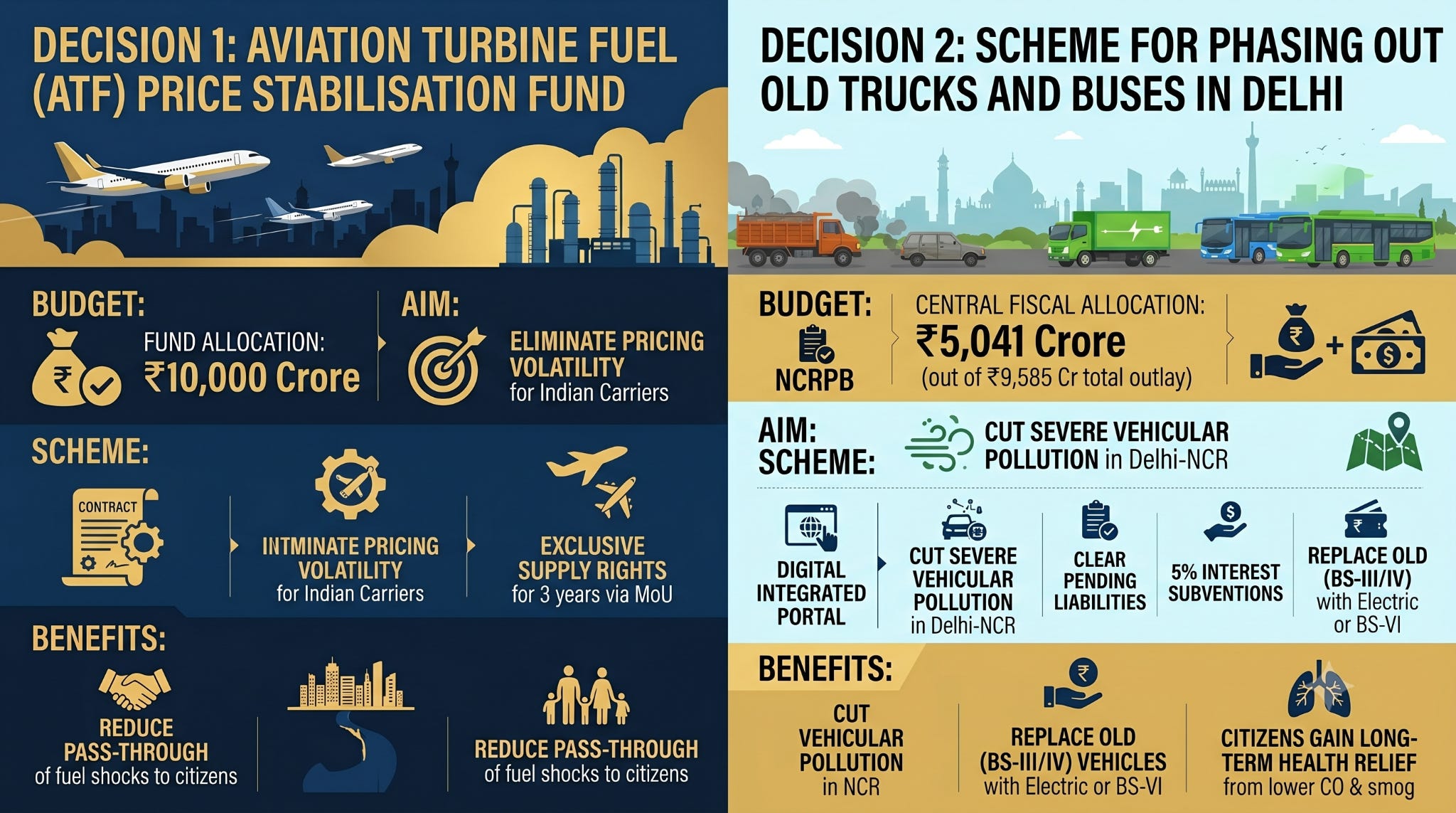
The Union Cabinet has officially approved the creation of an Aviation Turbine Fuel (ATF) Price Stabilisation Fund with a substantial financial allocation of ₹10,000 crore. This targeted fiscal mechanism allows the Government to extend a one-time budgetary support package as an interest-free advance directly to Oil Marketing Companies (OMCs). The allocated fund compensates OMCs for operating losses whenever the prevailing Import Parity Price surpasses the official domestic benchmark.
The initiative primarily aims to introduce cost predictability and eliminate major pricing volatility for scheduled Indian air carriers operating across both domestic and international routes. Under a structured Memorandum of Understanding (MoU), participating airlines commit to exclusive rights of ATF supply from OMCs for up to 3 years. This stabilisation mechanism will remain in force for a 36 month support period.
This development will reduce the aggressive pass-through of global fuel price shocks to everyday citizens, successfully moderating unpredictable passenger fare volatility. Furthermore, it protects critical international long-haul connectivity routes and directly preserves the continuity of air services.
II. Scheme for Phasing Out Old Trucks and Buses in Delhi
The Union Cabinet has approved a 2-year transport support scheme to replace old commercial vehicles registered in Delhi-NCR, backed by a central fiscal allocation of ₹5,041 crore out of a total ₹9,585 crore outlay. Funded via the National Capital Region Planning Board (NCRPB), it incentivises owners of heavy vehicles complying with old BS-IV or earlier emission standards to replace them with electric or BS-VI vehicles.
The initiative aims to replace roughly 2.07 lakh older commercial vehicles, consisting of 1.91 lakh trucks and 16,329 buses across Delhi, Haryana, Rajasthan, and Uttar Pradesh. It deploys a fully digital integrated portal to systematically mandate scrapping for old BS-III vehicles, clear pending vehicle liabilities, and offer 5% interest subvention alongside monthly fuel vouchers worth up to ₹4,800.
This will cut severe vehicular pollution in the NCR, as older heavy vehicles generate an incredibly disproportionate share of local particulate matter emissions. Truck and bus owners receive direct monetary upgrades via massive 8% ex-showroom discounts from manufacturers. Meanwhile, citizens gain long-term health relief from diminished smog, lower carbon monoxide, and cleaner urban air.
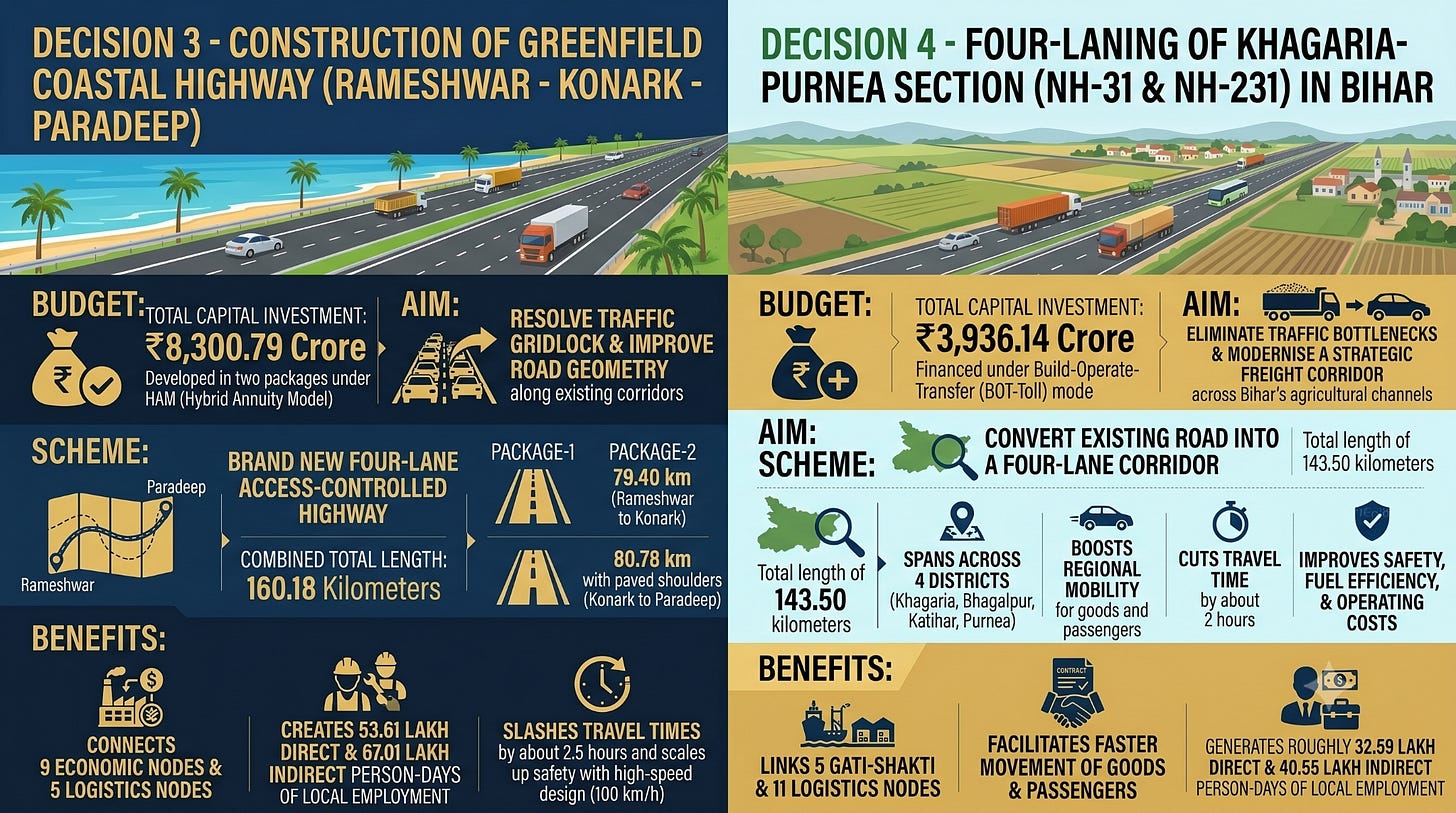
Image 2: Cabinet Decisions on 3rd June, 2026.
III. Construction of Greenfield Coastal Highway (Rameshwar - Konark - Paradeep)
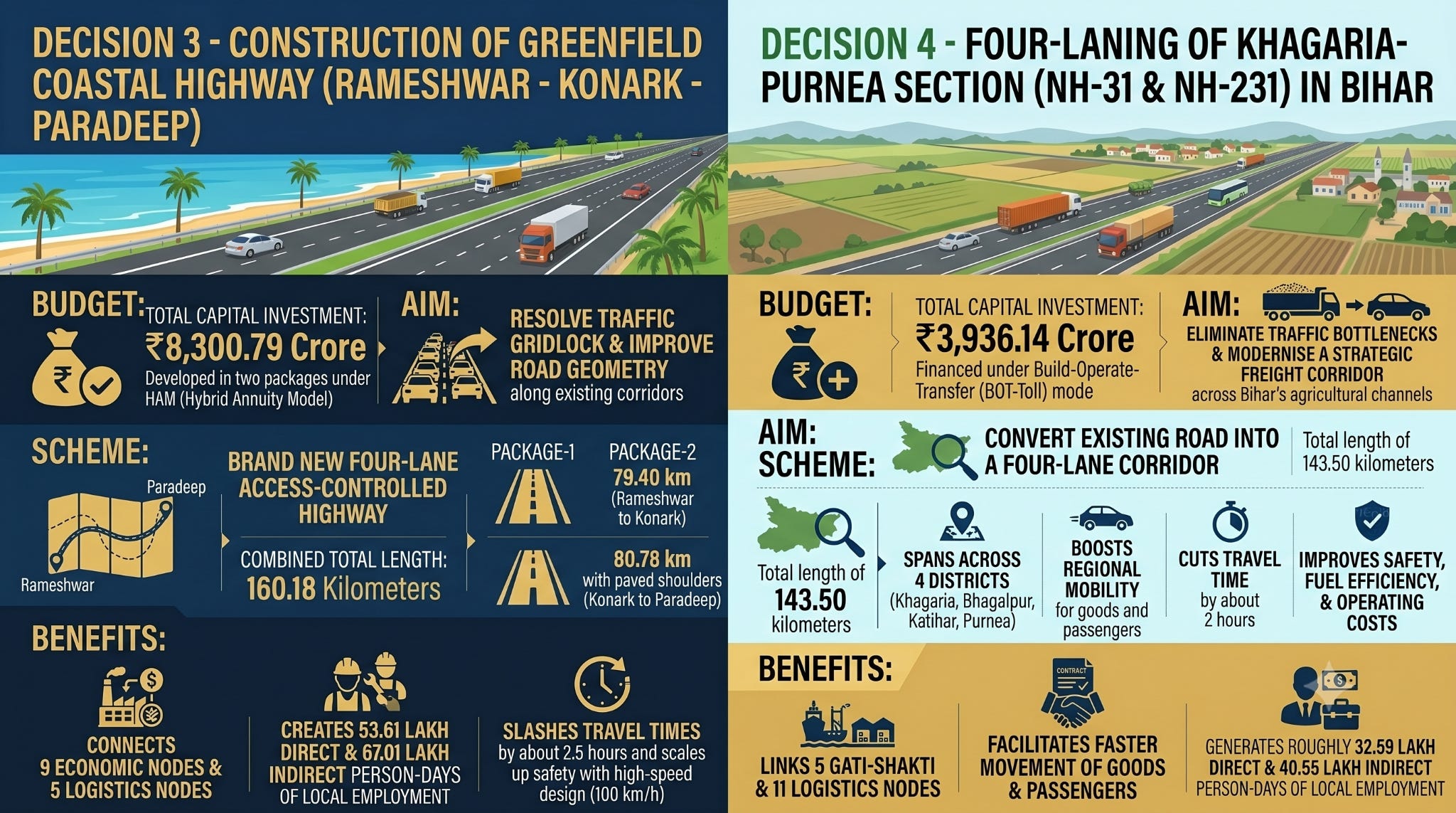
The Cabinet Committee on Economic Affairs (CCEA) has approved the construction of a new Greenfield coastal highway from Rameshwar to Paradeep in Odisha, involving a combined capital investment of ₹8,300.79 crore. Developed in two packages under the Hybrid Annuity Model (HAM), this extensive infrastructure project will cover a combined total length of 160.18 kilometers across multiple districts.
The project aims to resolve poor road geometry and intense local traffic gridlock along the current Puri–Satapada and Puri–Konark corridors. It establishes a brand new four-lane access-controlled highway spanning 79.40 kilometers between Rameshwar and Konark (Package-1), followed by an 80.78-kilometer wide two-lane highway with paved shoulders extending directly from Konark to Paradeep (Package-2).
This mega corridor boosts regional mobility, generating 53.61 lakh direct and 67.01 lakh indirect man-days of employment while connecting 9 economic nodes and 5 logistic nodes. For citizens, it scales up safety, ensures a high-speed design of 100 km/hour, and slashes travel times between Rameshwar and Paradeep by 2.5 hours.
IV. Four-Laning of Khagaria-Purnea Section (NH-31 & NH-231) in Bihar
The CCEA has approved the four-laning of the Khagaria-Purnea section covering parts of NH-31 and NH-231 in Bihar. Financed with a total capital investment of ₹3,936.14 crore, this extensive infrastructure project will convert the existing single/two-lane road into a four-lane corridor under the Build-Operate-Transfer (BOT-Toll) mode.
The project aims to eliminate chronic traffic bottlenecks across Bihar’s high-density agricultural transport channels. Spanning a total length of 143.50 kilometers across the Khagaria, Bhagalpur, Katihar, and Purnea districts, it modernises a strategic freight corridor that facilitates faster movement of goods and passengers across the region.
The project will raise average speeds, cut travel time to about 2 hours, and improve safety, fuel efficiency, and operating costs, boosting regional mobility and development. It will link 5 Gati-Shakti nodes and 11 logistics nodes and create about 32.59 lakh direct and 40.55 lakh indirect person-days of local employment.
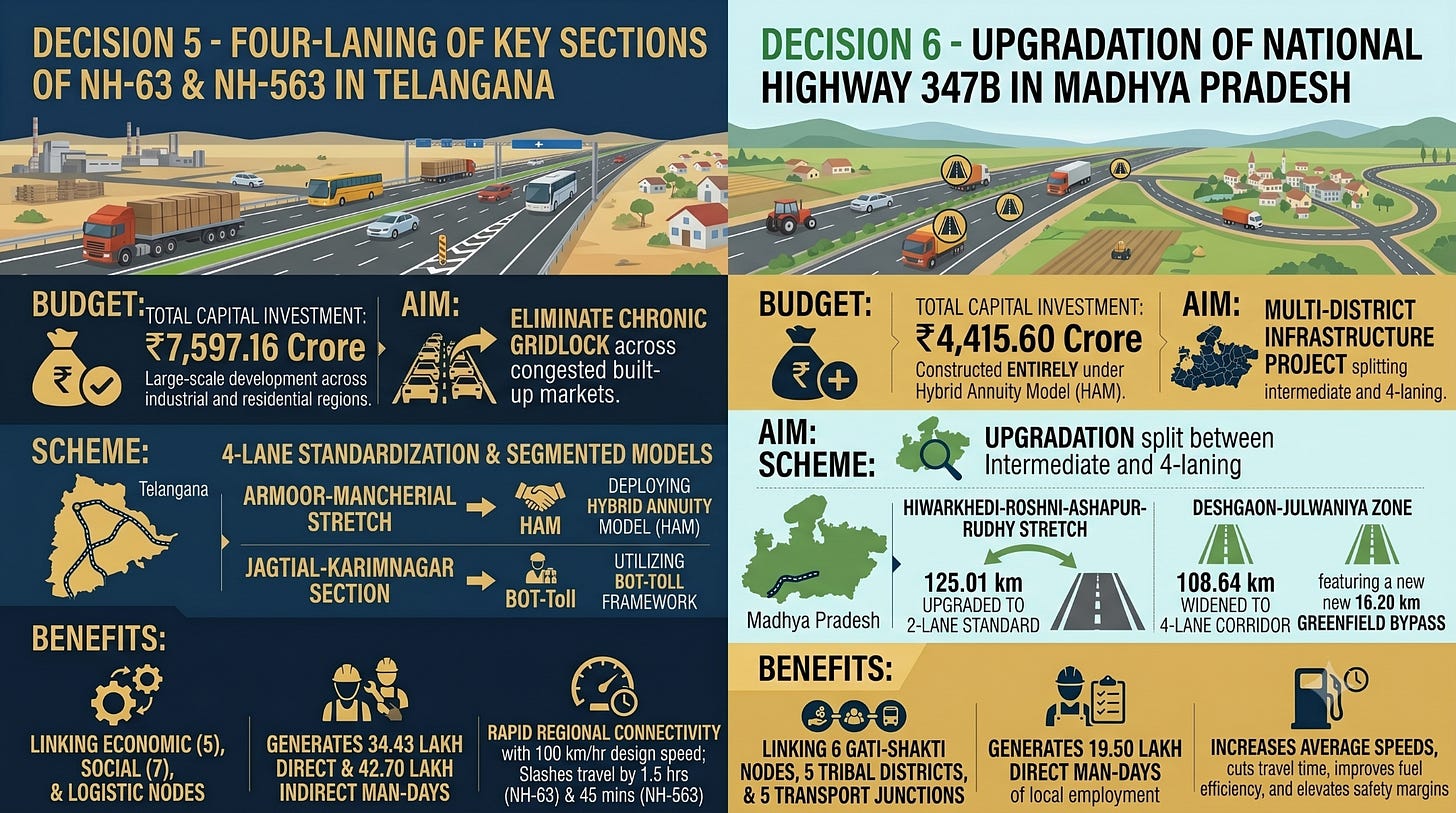
Image 3: Cabinet Decisions on 3rd June, 2026.
V. Four-Laning of Key Sections of NH-63 & NH-563 in Telangana
The CCEA has approved the widening of the Armoor-Jagtial-Mancherial section of NH-63 and the Jagtial-Karimnagar section of NH-563 to the 4-lane standard. Carrying a total investment value of ₹7,597.16 crore, the massive development spans a total length of 190.76 kilometers across several key industrial and residential regions in the state of Telangana.
The project aims to eliminate chronic highway gridlock across severely congested built-up markets. It implements a 4-lane configuration featuring specialised bypasses with open tolling systems, deploying the Hybrid Annuity Model (HAM) for the Armoor-Mancherial stretch and the Build-Operate-Transfer (Toll) [BOT (Toll)] framework for the Jagtial-Karimnagar section to seamlessly bridge commercial freight routes.
This corridor provides rapid regional connectivity, generating 34.43 lakh direct and 42.70 lakh indirect man-days of employment while linking 5 economic, 7 social, and multiple railway logistic nodes. Commuters achieve safe, uninterrupted travel with a 100 km/hour design speed, cutting travel times by 1.5 hours on NH-63 and 45 minutes on NH-563 while lowering carbon emissions.
VI. Upgradation of National Highway 347B in Madhya Pradesh
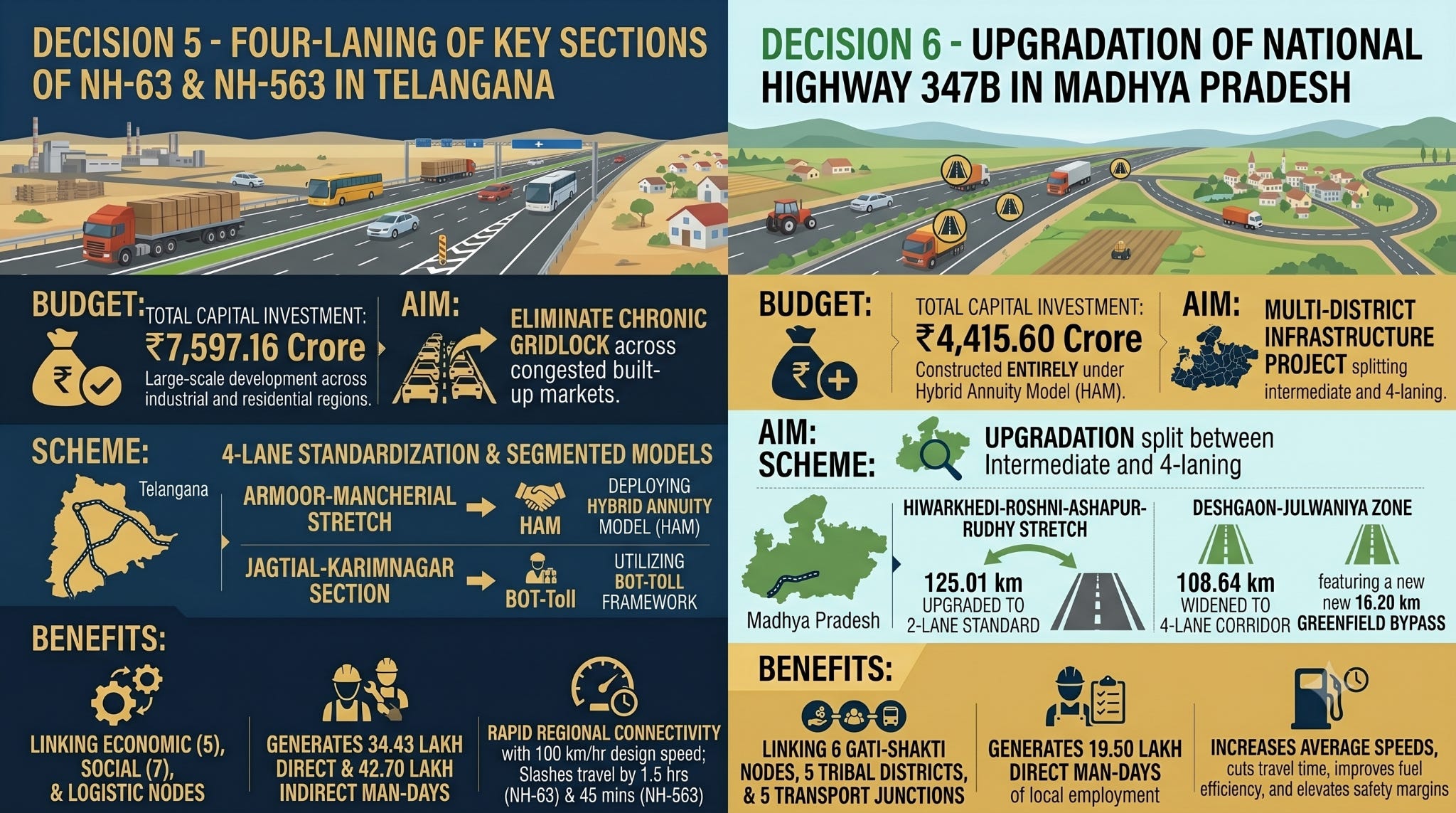
The CCEA has authorised the upgradation of 233.65 kilometers of National Highway 347B in Madhya Pradesh, backed by ₹4,415.60 crore. Constructed entirely under the Hybrid Annuity Model (HAM), the multi-district infrastructure project splits work between intermediate-lane widening to a 2-lane standard with paved shoulders and full 4-laning sections.
The project explicitly aims to eliminate severe geometric deficiencies, dangerous sharp road curves, and intense vehicular congestion in heavily built-up areas. It upgrades 125.01 kilometers of the Hiwarkhedi-Roshni-Ashapur-Rudhy stretch to a 2-lane paved shoulder highway while widening 108.64 kilometers of the Deshgaon-Julwaniya zone into a 4-lane corridor featuring a brand new 16.20-kilometer Greenfield Bypass around Khargone.
The development enhances multi-modal integration by linking 6 PM Gati-Shakti economic nodes, 5 tribal/aspirational social districts, and 5 transport junctions, generating 19.50 lakh direct man-days of local employment. For everyday citizens, it increases average travel speeds, reduces commute times, improves localised fuel efficiency, and elevates overall road safety margins.
Also, please consider subscribing to NFPRC Foundation’s focused centres covering latest economic, policy and administrative developments -
Centre for Law, Policy and Governance - Link
Centre for Accelerating India’s Growth - Link
Centre for Studies in Indian Social Systems - Link
NFPRC Foundation - Link