
Executive Summary
Odisha’s 2026–27 Budget combines fiscal consolidation with targeted developmental and capital expansion, aligned with the vision of transforming the state into a $ 500 billion economy by 2036.
The state projects a GSDP growth of 12% (₹ 11.07 lakh crore) alongside per capita income growth of 10.65% (₹ 1.87 lakh) for 2025-26 AE, with a continued revenue surplus of 2.98% of GSDP.
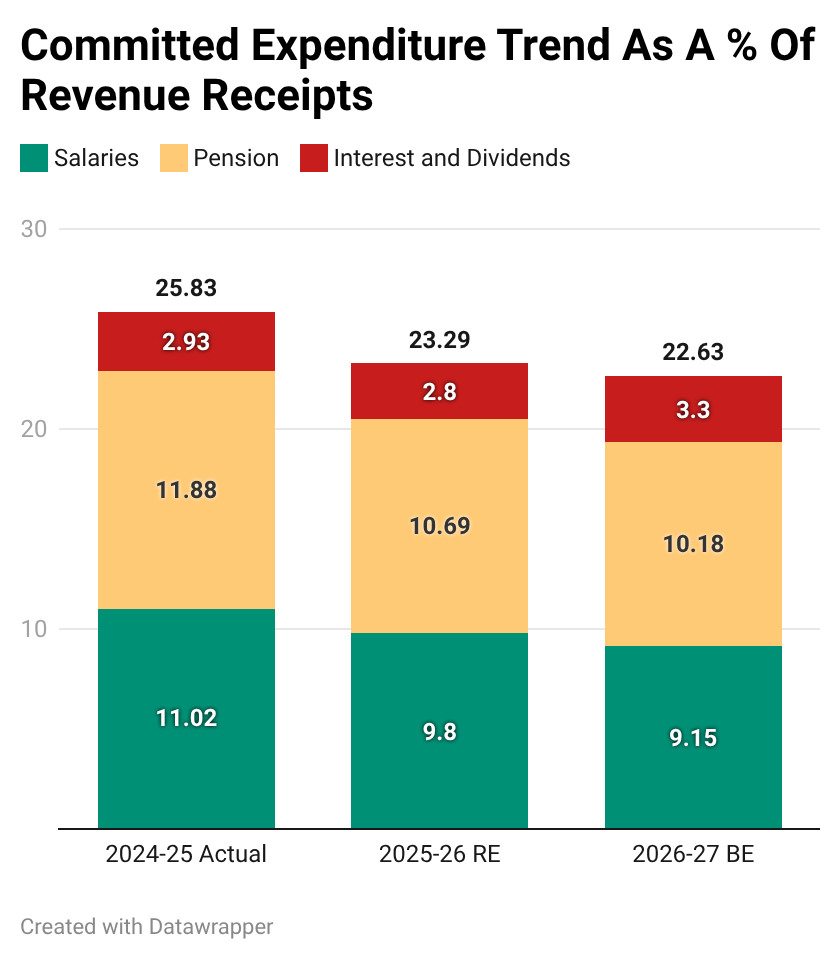
The proportion of salaries, pensions, and interest payments has fallen to 22.63% in 2026–27 BE from 25.83% of revenue receipts in 2024–25, with Odisha having the best quality of expenditure among 18 major states.
Capital outlay at 6.51% of GSDP is more than twice the national average of 3.0%, with absolute spending rising from ₹ 43,273.38 crore in 2023–24 actuals to a proposed ₹ 72,100 crore in 2026–27 BE, while outstanding debt at 14.1% of GSDP remains among the lowest across major states.
The fiscal deficit, however, is targeted at 3.50% of GSDP (inclusive of SASCI-linked borrowings), exceeding the 3.0% base ceiling under the Fiscal Responsibility and Budget Management Act, 2005, by 50 basis points.
The Chief Minister, who also holds the Finance portfolio of the state, Shri Mohan Charan Majhi, presented the Odisha Budget 2026-27 before the State Legislature on 20th February, 2026.
The budget places a specific emphasis on the agriculture sector with a separate part of the budget speech being dedicated to the same. Overall, the Government aims to achieve Sabka Saath, Sabka Vikas, Sabka Biswas, Sabka Prayas alongside transforming Odisha into a $ 500 billion economy by 2036.
I. Financial Highlights
Gross State Domestic Product (GSDP): Odisha’s GSDP for 2026–27 (at current prices) is projected to be ₹ 11.07 lakh crore, amounting to a growth of 12% over the advance estimates (AE) for 2025–26 (₹ 9.88 lakh crore).
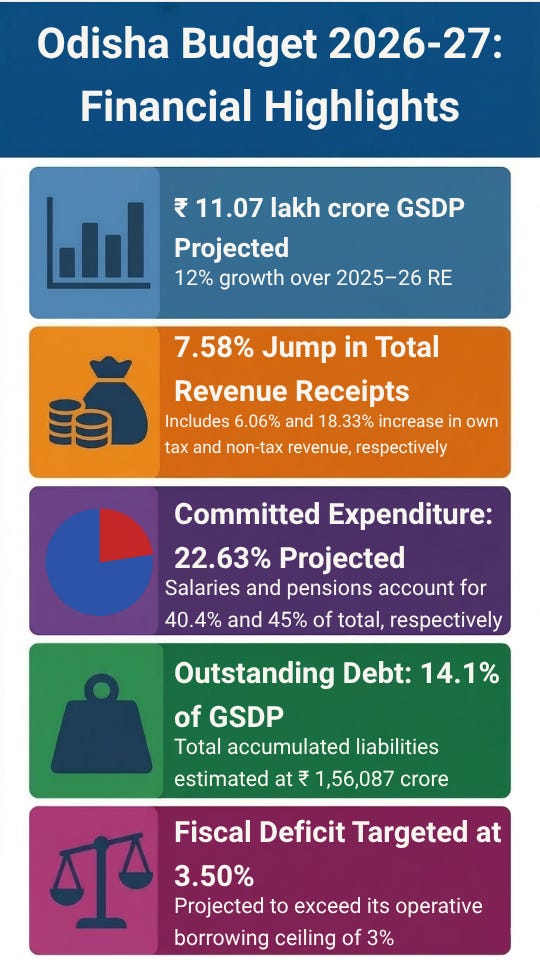
Image 1: Key Financial Highlights Per Capita Income: As per the 2025-26 (AE), the per capita income in Odisha was ₹ 1.87 lakh, an increase of 10.65% over the 2024-25 figure. In 2024–25, Odisha’s per capita income (at current prices) was ₹ 1.69 lakh, an increase of 12.33% over that of 2023–24 (₹ 1.50 lakh). In 2022–23, the per capita income had increased by 0.63% over 2021–22 (₹ 1.34 lakh).
Revenue Surplus (RS): Revenue Surplus in 2026–27 is estimated at ₹ 33,000 crore, 2.98% of GSDP, as compared to an RS of ₹ 27,000 crore, 2.73% of GSDP in 2025–26 RE.
Fiscal Deficit (FD): FD for 2026–27 is targeted at ₹ 38,800 crore, 3.50% of GSDP, as compared to an FD of ₹ 34,200 crore, 3.46% of GSDP, in 2025–26 RE.
Expenditure: Expenditure (including debt repayment) for Odisha in 2026–27 is estimated to be ₹ 2.88 lakh crore, an increase of 7.95% over the revised estimates of 2025–26 (₹ 2.67 lakh crore).
Receipts: Receipts (excluding borrowings) for Odisha for 2026–27 are estimated to be ₹ 2.49 lakh crore, an increase of 7.14% as compared to the revised estimates of 2025–26 (₹ 2.33 lakh crore).
II. Policy Highlights
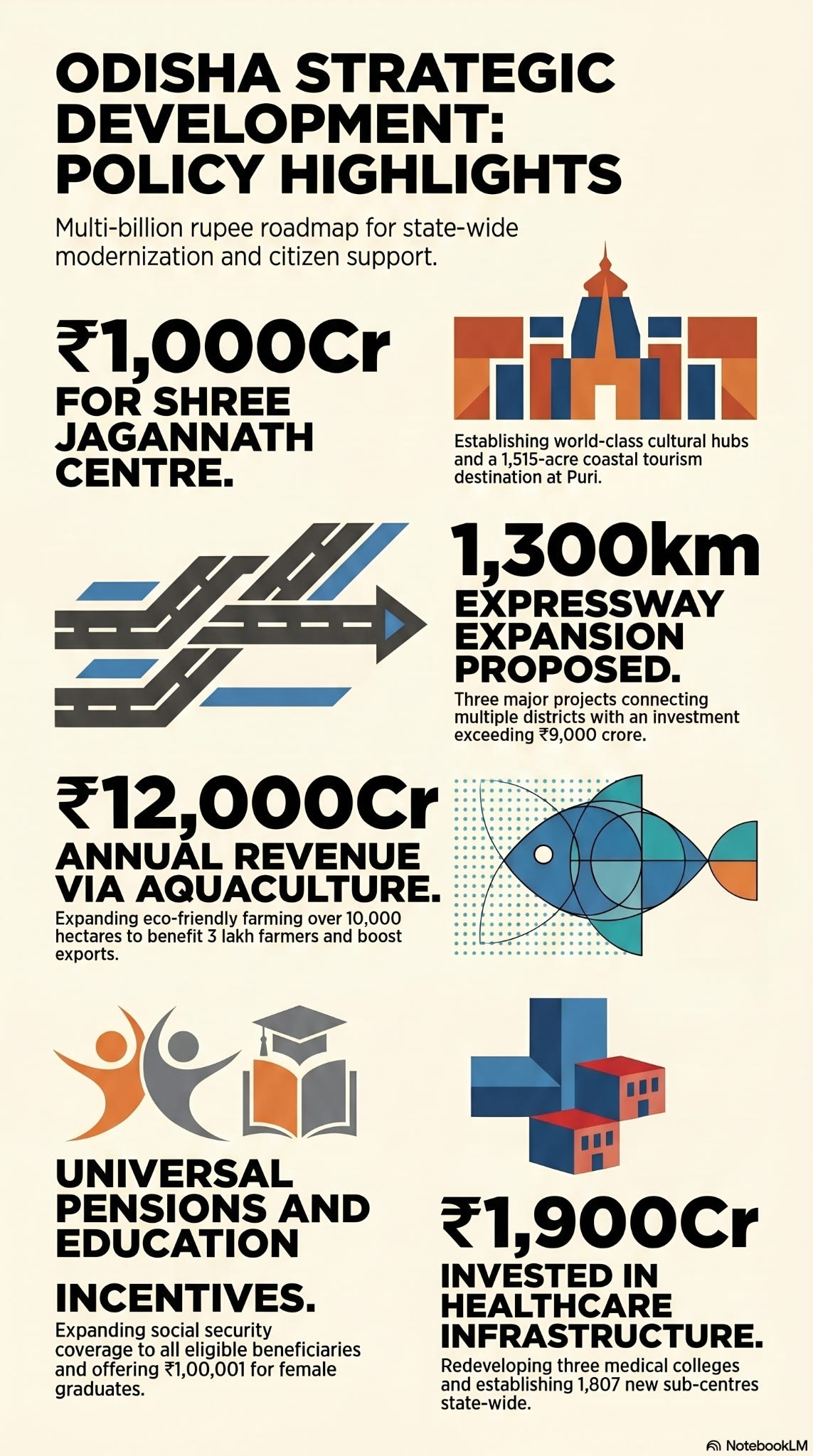
Shree Jagannath Interpretation Centre: The Government has proposed the establishment of a world-class Shree Jagannath Interpretation Centre at Puri with an estimated cost of ₹ 1,000 crore.
Shamuka Tourism Project: The Shamuka project at Puri and Hirakud has been proposed as a major coastal tourism destination spanning over 1,515 acres with the aim of Odisha’s rich cultural and spiritual heritage with premium beach experiences and contemporary infrastructure.
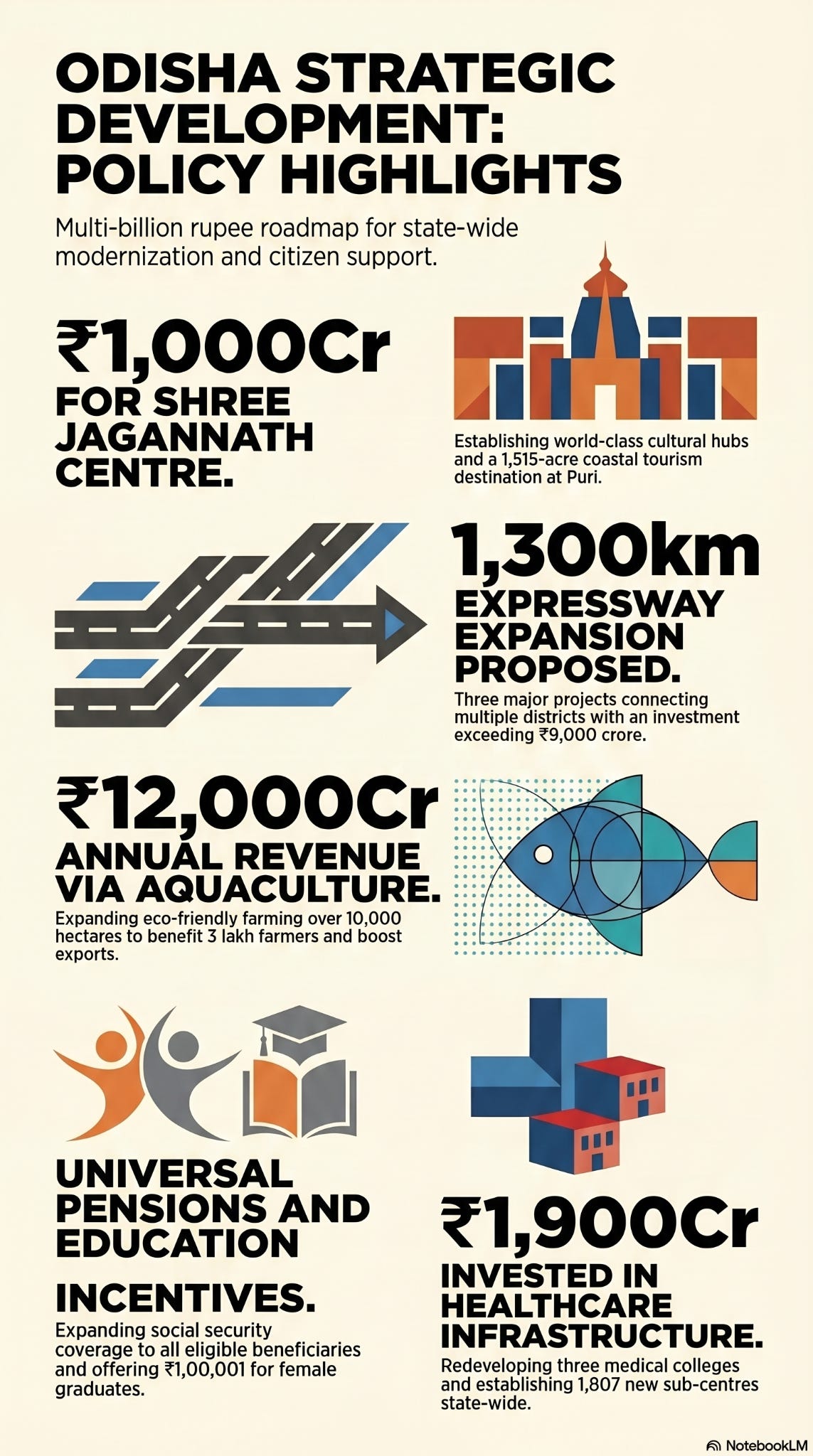
Image 2: Key Policy Highlights Major Expressway Projects: Three expressway projects have been proposed which aim to connect Brahmapur - Jeypore, Gajapati - Ambahona, and Malkanagiri - Mayurbhanj districts covering a length of more than 1,300 kilometres at a cost of more than ₹ 9,000 crore.
Aquaculture Missions: Through the missions, the Government aims to expand eco-friendly aquaculture over 10,000 hectares, enhance seafood exports by more than 1 lakh metric tonnes, annually generating ₹ 12,000 crore, and benefit over 3 lakh farmers through employment, training, and higher incomes. Additionally, it also aims to boost Odisha’s marine fish production through building 150 new deep-sea vessels, upgrading 500 mechanized boats and developing harbours as well as modern fish markets.
Development Of Tertiary Health Infrastructure: A cumulative outlay of more than ₹ 1,900 crore has been proposed for the redevelopment of three medical colleges, establishment of three new Ayurvedic Medical Colleges, and establishment of 1,807 additional sub-centres across the state.
Support For Rural Piped Water Supply Projects: With the aim of ensuring that every rural household in Odisha has access to a safe, reliable and sustainable source of drinking water, the scheme will support incomplete projects, cover left-out habitations, address water quality issues and promote innovative technologies. ₹ 800 crore has been allocated for the same.
Operationalisation Of Block Level Stadiums: With a total investment of ₹ 4,124 crore over five years, the Government aims to complete and operationalise block level stadiums with the aim of providing state-of-the-art training facilities at the grassroots level.
Samrudha Anganwadi Yojana: Under this scheme, Anganwadi Centres (AWCs) will be constructed at a unit cost of ₹ 15 lakh per centre without crèche facilities and ₹ 20 lakh per centre with crèche facilities with a total outlay of ₹ 635 crore.
Madhubabu Pension Yojana: Given that more than 6 lakh eligible persons are deprived of social security pension in Odisha, the Government has announced this scheme in order to provide pension coverage to all eligible beneficiaries. This marks a change from the earlier practice where an eligible beneficiary was required to wait for the death of another existing beneficiary.
Mukhyamantri Kanya Sumangal Yojana: With the aim of promoting women’s education, a savings instrument of ₹ 20,000 will be created in the name of a female born in an economically weaker section (EWS) family. On completion of graduation, she will be awarded ₹ 1,00,001.
III. Odisha’s Economy
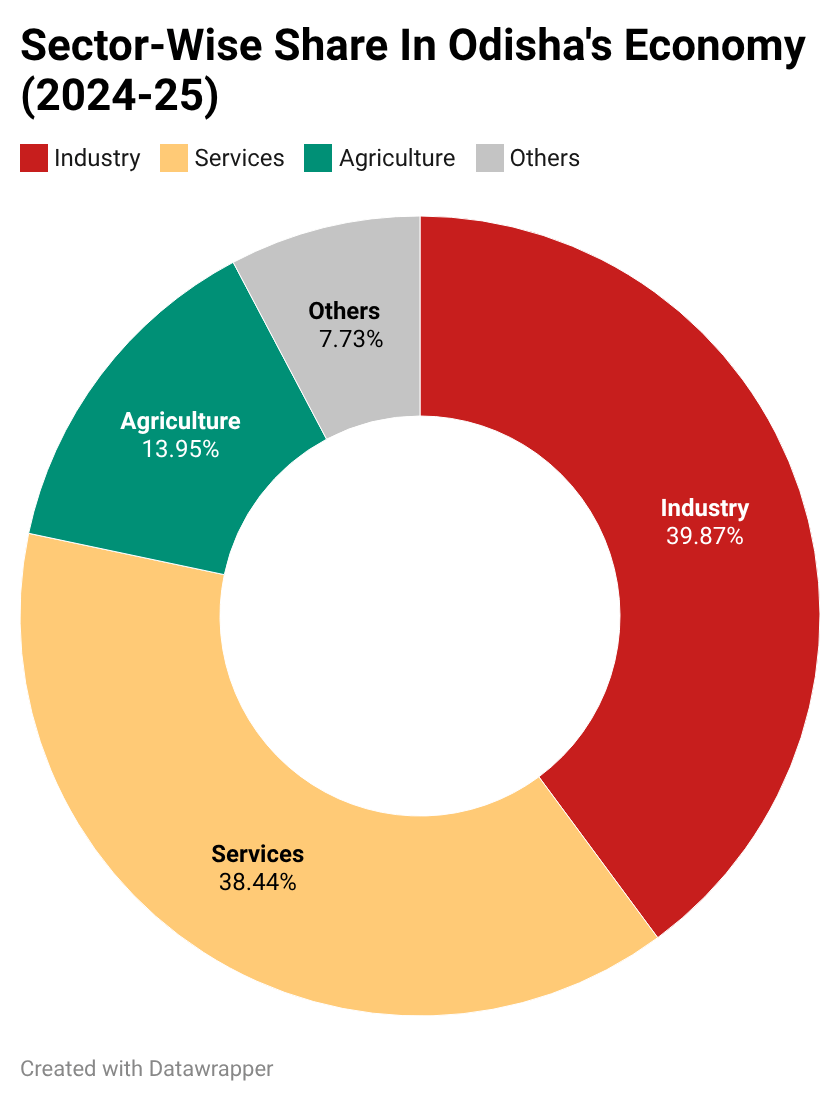
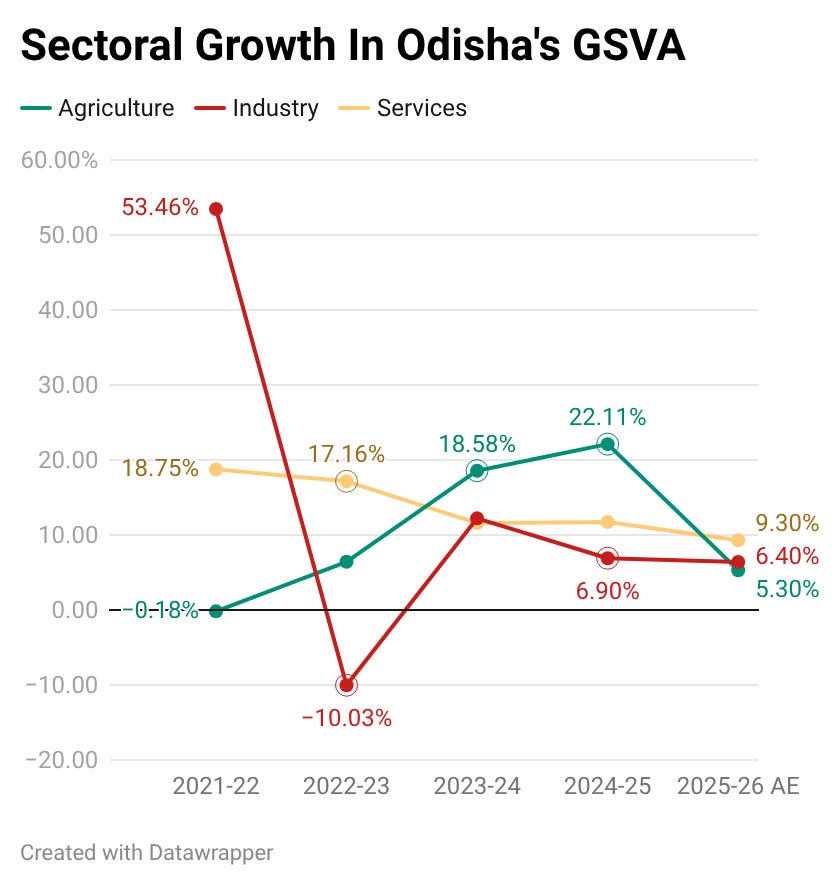
GSVA Contribution Of Sectors: In 2024–25, agriculture, industry, and services sectors are estimated to contribute 13.95%, 39.87%, and 38.44% of Odisha’s economy, respectively (at current prices).
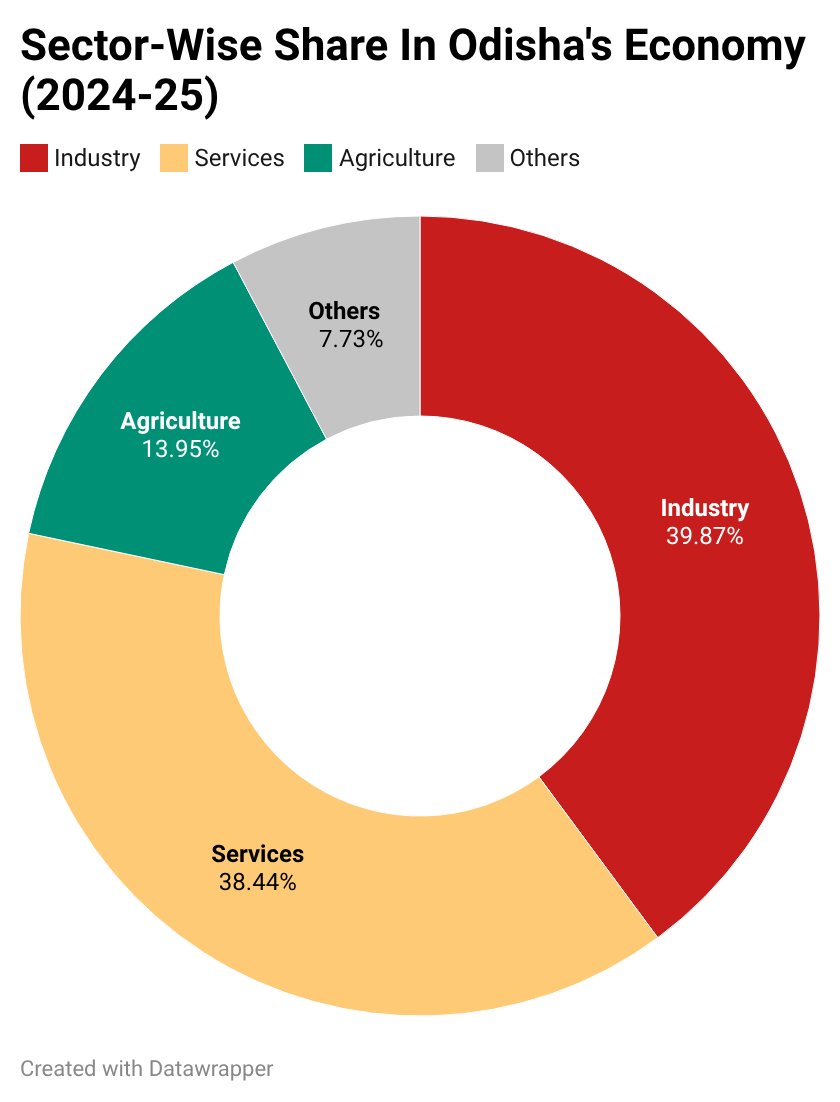
Image 3: Sector-wise Share In Odisha’s Economy (2024–25, at Current Prices) 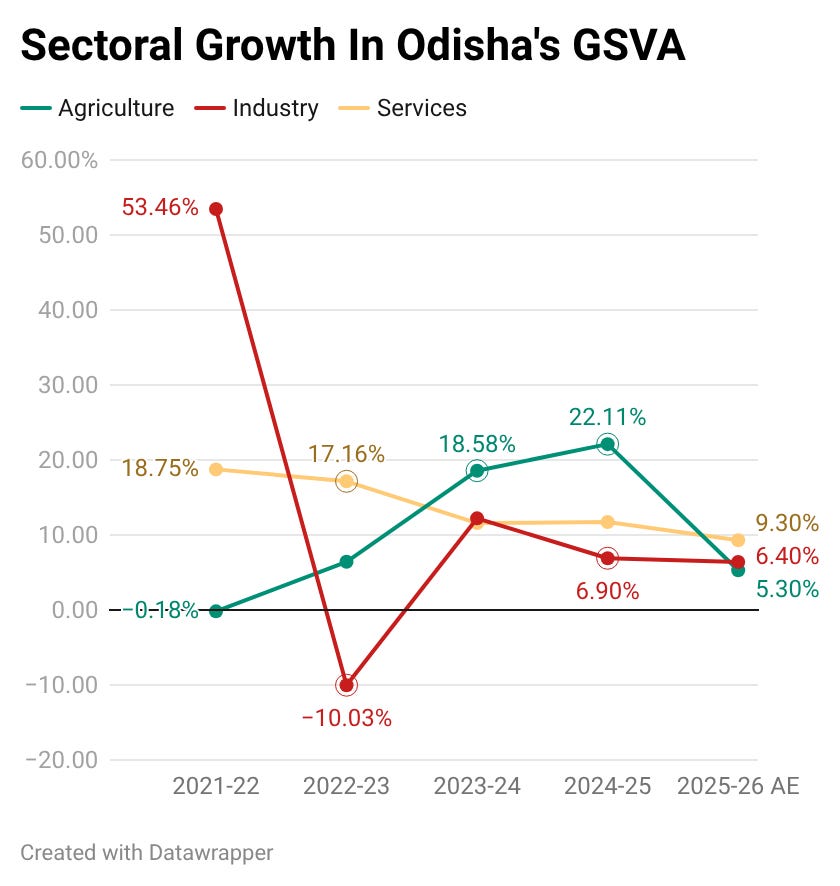
Image 4: Sectoral Growth In Odisha’s GSDP At Current Prices
IV. Expenditure
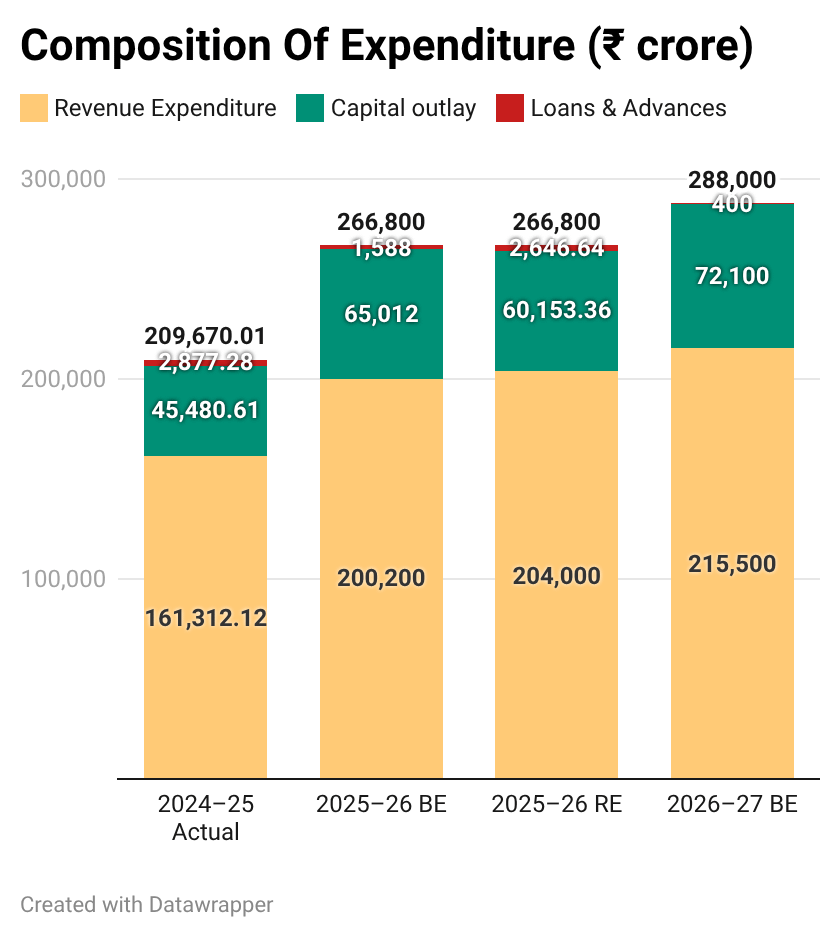
Revenue Expenditure: Revenue expenditure for Odisha for 2026–27 is proposed to be ₹ 2.16 lakh crore, an increase of 5.64% over the 2025–26 RE (₹ 2.04 lakh crore). This includes the expenditure on salaries, pensions, interest, grants, and subsidies.
Committed Expenditure:
In 2026–27, Odisha is estimated to spend ₹ 56,229.55 crore on committed expenditure, which is 22.63% of its estimated revenue receipts of ₹ 2.49 lakh crore. In 2024–25, as per actual figures, 25.83% of revenue receipts were spent towards committed expenditure(₹ 47,523.83 crore out of revenue receipts of ₹ 1.84 lakh crore).
This comprises spending on salaries (₹ 22,737.23 crore), pension (₹ 25,292.32 crore), and interest payments (₹ 8,200.00 crore). This low expenditure allows the state to orient spending toward capital.
Out of every rupee that comes in as revenue receipts, 22.63 paise is estimated to be spent on committed expenditure in 2026–27, lower than 25.83 paise in 2024–25 (actuals). The largest share of this expenditure is on pensions, followed by salaries and interest payments.
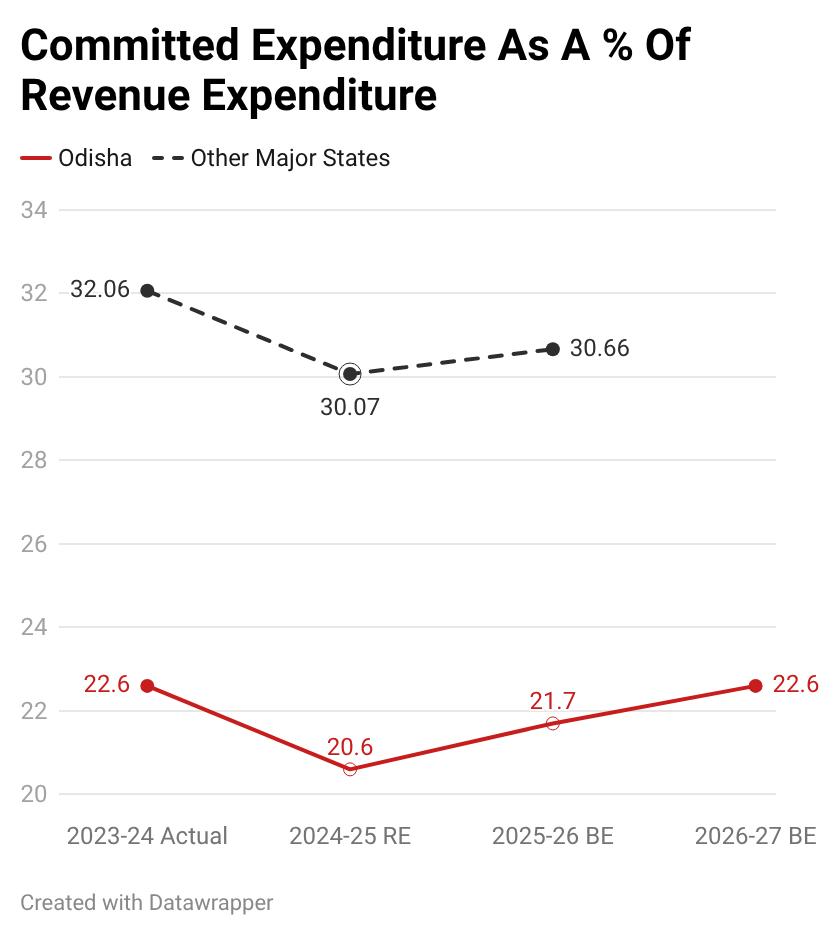
As a result of such low committed expenditure, Odisha ranks first among 18 major states, indicating a superior fiscal position among states, ranking first on the metric of quality of expenditure as well.
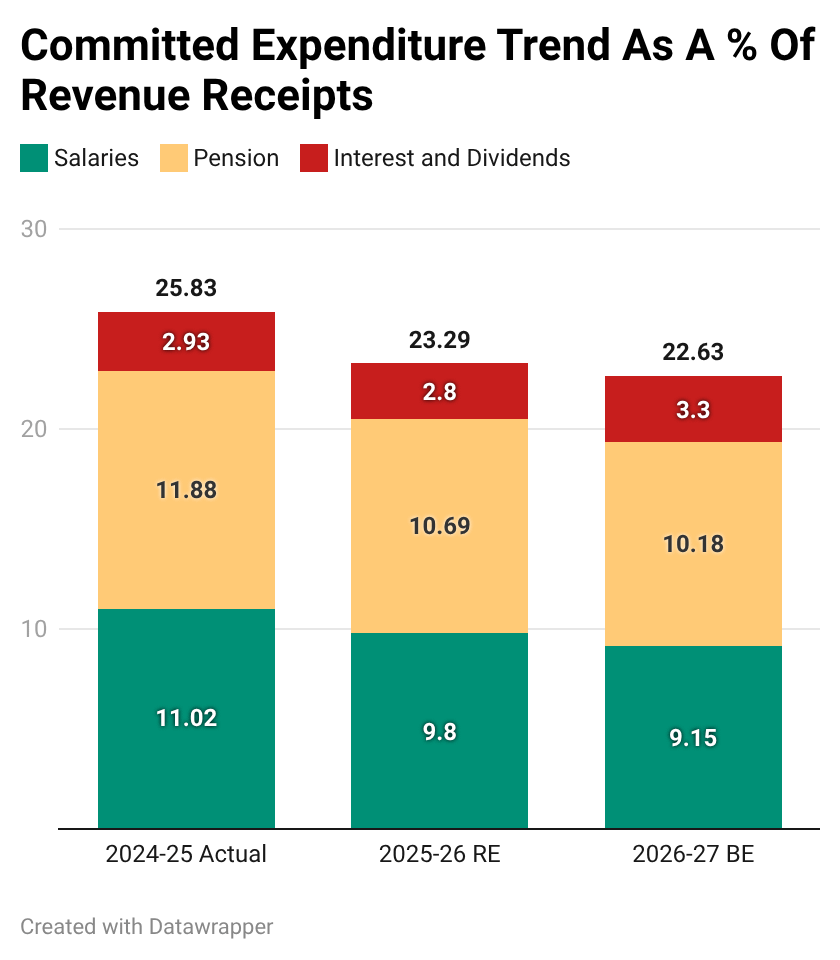
Image 5: Odisha’s Committed Expenditure Trend As % Of Revenue Receipts 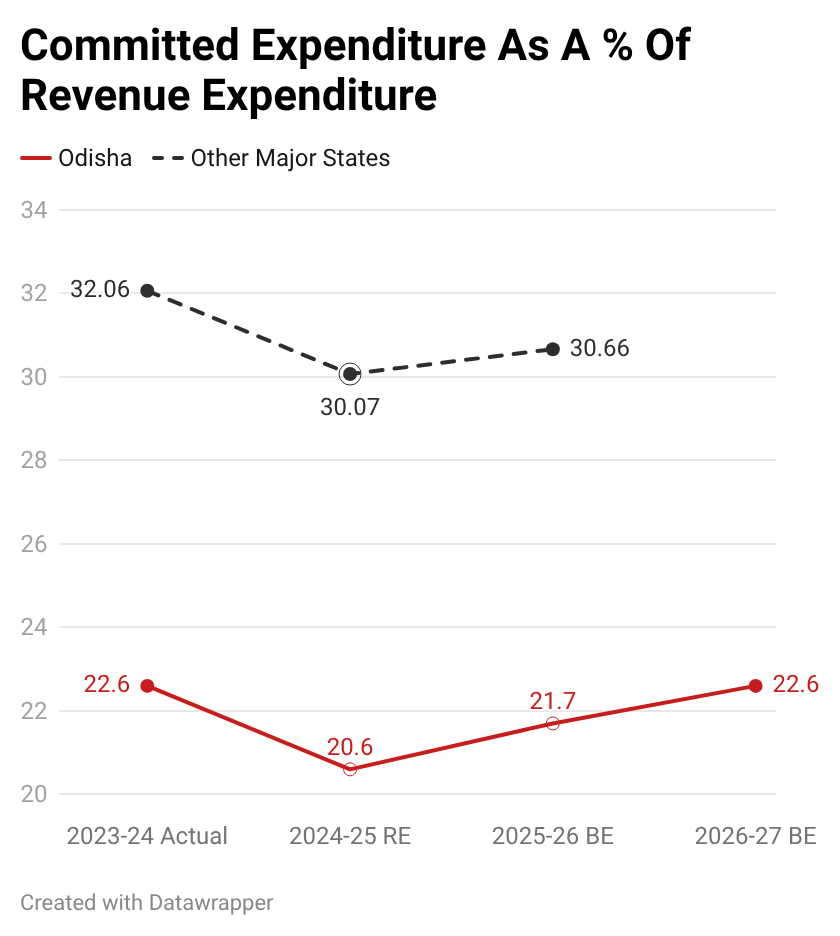
Image 6: Odisha’’s Committed Expenditure Trend As % Of Revenue Receipts Compared To Other Major States 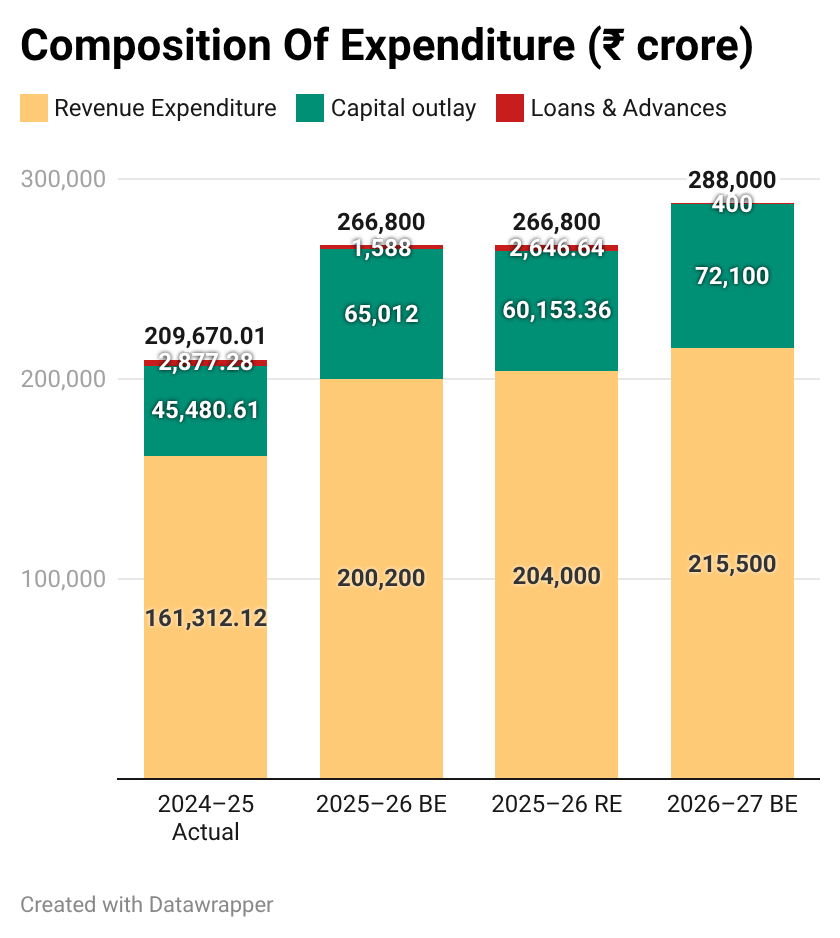
Image 6: Composition Of Odisha’s Expenditure (in ₹ crore)
Capital Outlay: Capital outlay for Odisha for 2026–27 is proposed to be ₹ 72,100 crore, an increase of 19.86% over the revised estimate of 2025–26 (₹ 60,153.36 crore).
In 2026–27, capital outlay of Odisha is projected to account for 23.26% of the total expenditure (₹ 3.10 lakh crore) and 6.51% of the GSDP (₹ 11.07 lakh crore).
Compared to previous years, the proposed outlay reflects a positive trend in capital spending. Capital outlay was ₹ 45,480.61 crore in 2024–25 (actuals) and ₹ 43,273.38 crore in 2023–24 (actuals), indicating a significant increase compared to the two years and a continuation of the trend expected in 2026–27.
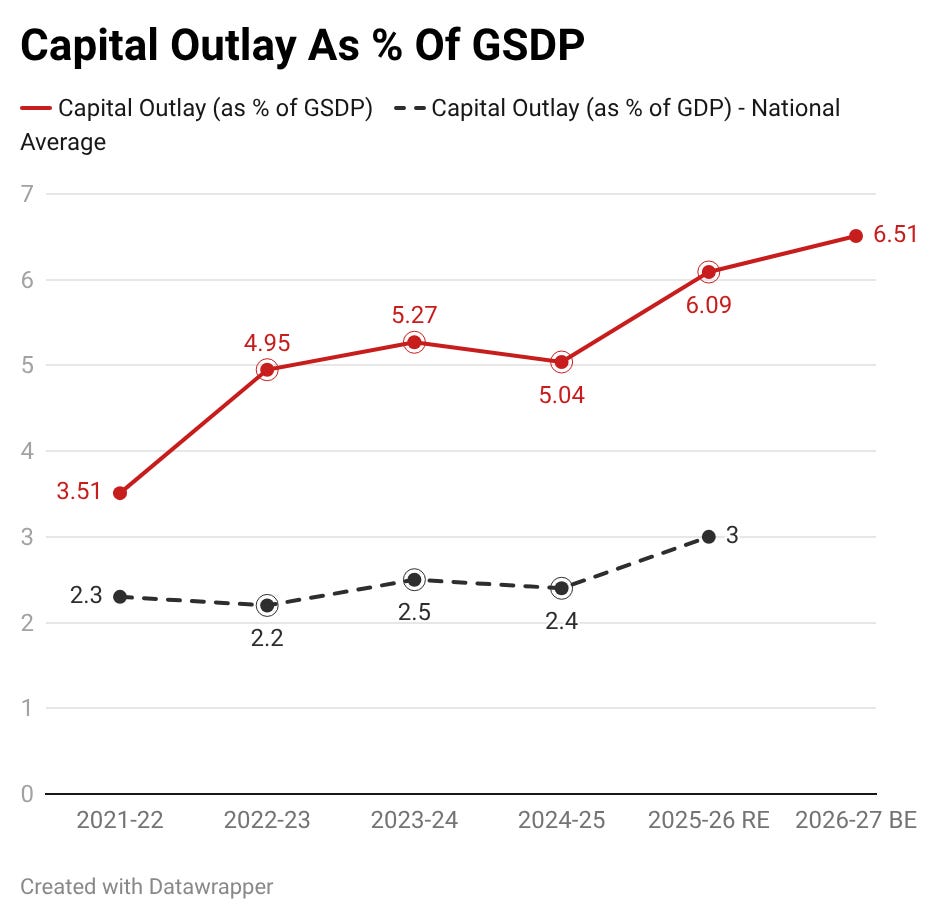
At 6.51% of GSDP, the capital outlay of Odisha remains significantly higher than the national average of 3.0%. Compared to the 2025-26 revised estimate (6.09%) there is a significant increase in absolute capital spending of ₹ 11,946.64 crore.
V. Revenue Receipt
Total Revenue Receipts:
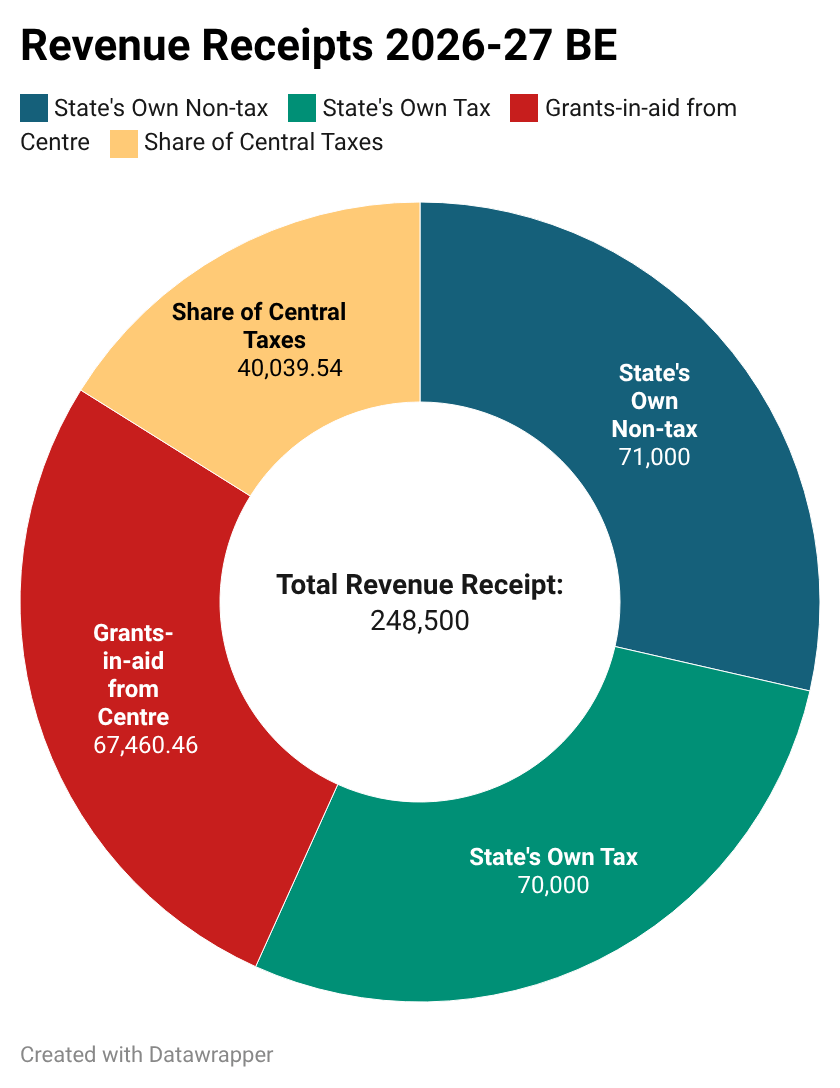
Total revenue receipts for Odisha for 2026–27 are estimated to be ₹ 2.49 lakh crore, an increase of 7.58% over the revised estimate of 2025–26 (₹ 2.31 lakh crore). Of this, ₹ 1.41 lakh crore (56.74%) will be raised by the state through its own resources, and ₹ 1.08 lakh crore (43.26%) will come from the centre.
Resources From The Centre: Resources from the centre for Odisha consist of the state’s share in central taxes (27.15% of revenue receipts) and grants-in-aid (16.11% of revenue receipts). This represents a moderate reliance on transfers from the centre leaving the state’s finances not significantly affected by volatility in Central allocations.
16th Finance Commission: In 2026–27, the state’s share in central taxes is estimated at ₹ 67.460.46 crore, an increase of 6.95% over the revised estimate of 2025–26 (₹ 63,073.70 crore).
Following the revision in the formula for horizontal devolution by the 16th Finance Commission, it can be concluded that Odisha has been rewarded for its performance on the criteria of contribution to national GDP, leading to an increase in devolution.
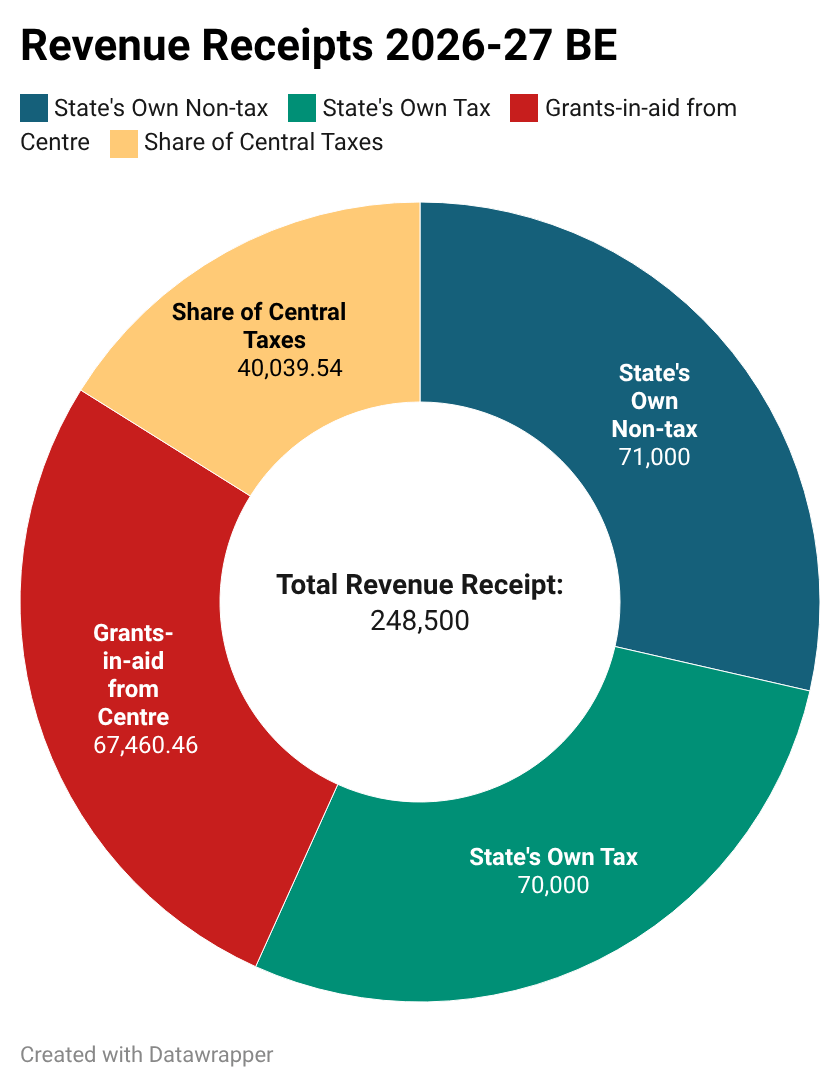
Image 7: Revenue Receipts (2026-27 BE) (in ₹ crore) Central Grants: Grants from the centre in 2026–27 are estimated at ₹ 40,039.54 crore, a decrease of 4.50% over the revised estimates for 2025–26 (₹ 41,926.30 crore) which is 0.80% higher than the budget estimate of ₹ 41,591.73 crore. The 2024–25 actual grants from the centre (₹ 17,955.51 crore) represent a decline of about 14.54% compared to ₹ 21,011.51 crore in 2023–24. The projected decrease in 2026–27 therefore represents a moderate decrease compared to the trend of growth compared to the 2025-26 BE.
State’s Own Tax Revenue: Odisha’s total own tax revenue is estimated to be ₹ 70,000 crore in 2026–27, an increase of 6.06% over the revised estimate of 2025–26 (₹ 66,000 crore). Own tax revenue as a percentage of GSDP is estimated at 6.32% in 2026–27. As per the actual figures for 2024–25, own tax revenue as a percentage of GSDP was 6.26%.
VI. Deficits And Debts
Fiscal Deficit (FD): Fiscal deficit for 2026–27 is targeted at 3.50% of GSDP (₹ 38,800 crore). Excluding SASCI loans (₹ 9,000 crore), the FD is expected to be 2.69%. In 2025-26, as per the revised estimates, the fiscal deficit is expected to be 3.46% of GSDP (₹ 34,200 crore). As per the 2025-26 RE, the FD excluding SASCI loans was 2.75%.
Under the Fiscal Responsibility and Budget Management Act, 2005, the state’s base borrowing ceiling is 3.0% of GSDP. Against this, the fiscal deficit of 2026–27 budget estimate (including SASCI loans) is expected to be 3.50% of GSDP. This marks a slight increase over the revised estimate of 2025-26 (3.46%). As such, the fiscal deficit for the two years exceeds the ceiling by 50 and 46 basis points, respectively.
Primary Deficit: Primary deficit for 2026–27 is estimated to be at 2.76% of GSDP (₹ 30,600 crore). In 2025–26, as per the advance estimate, the primary deficit is expected to be 2.66% of GSDP (₹ 26,294.20 crore).
Outstanding Debt: The outstanding debt of Odisha in 2026-27 is projected at ₹ 1.56 lakh crore, equivalent to 14.1% of GSDP, which is slightly higher than the revised estimate of 13.1% of GSDP (₹ 1.29 lakh crore) in 2025-26.
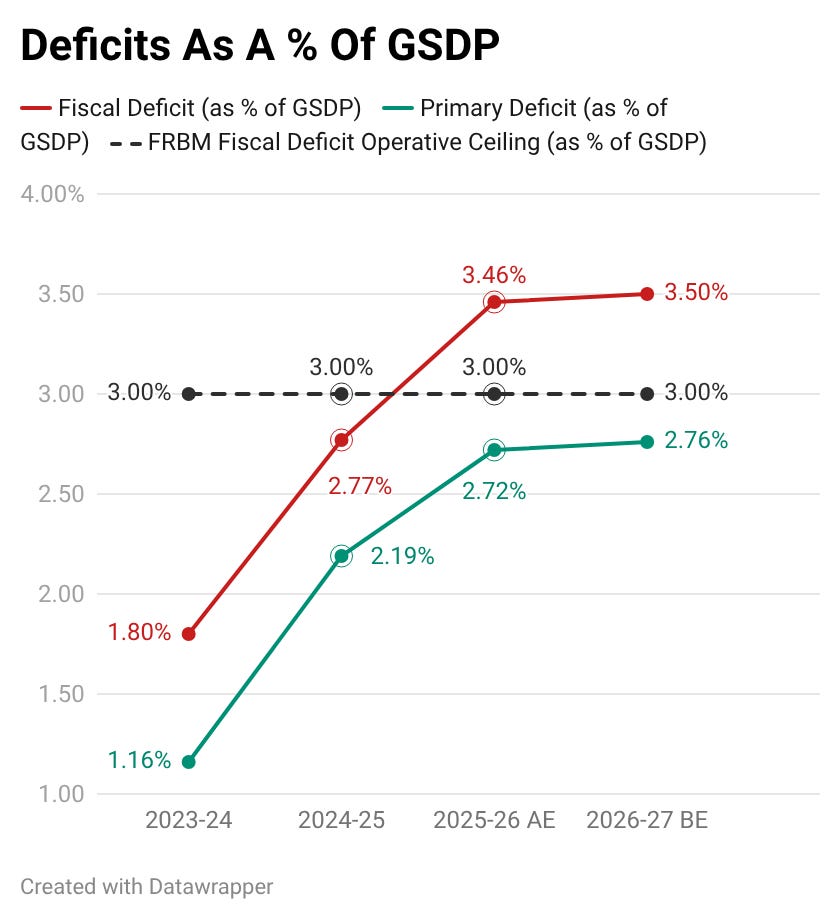
Image 8: Odisha’s Deficits As A % Of GSDP,
VII. Fiscal Health
Over the past 10 years, Odisha has consistently ranked as a top performing state with respect to its fiscal health. This can be attributed to the state’s ability to maintain a high quality of expenditure alongside a low debt burden.
Within NITI Aayog’s Fiscal Health Index 2026, Odisha secured the top position among major states on the metrics of quality of expenditure as well as the debt index, the two sub-indices where the state has consistently outperformed peers over the past decade.
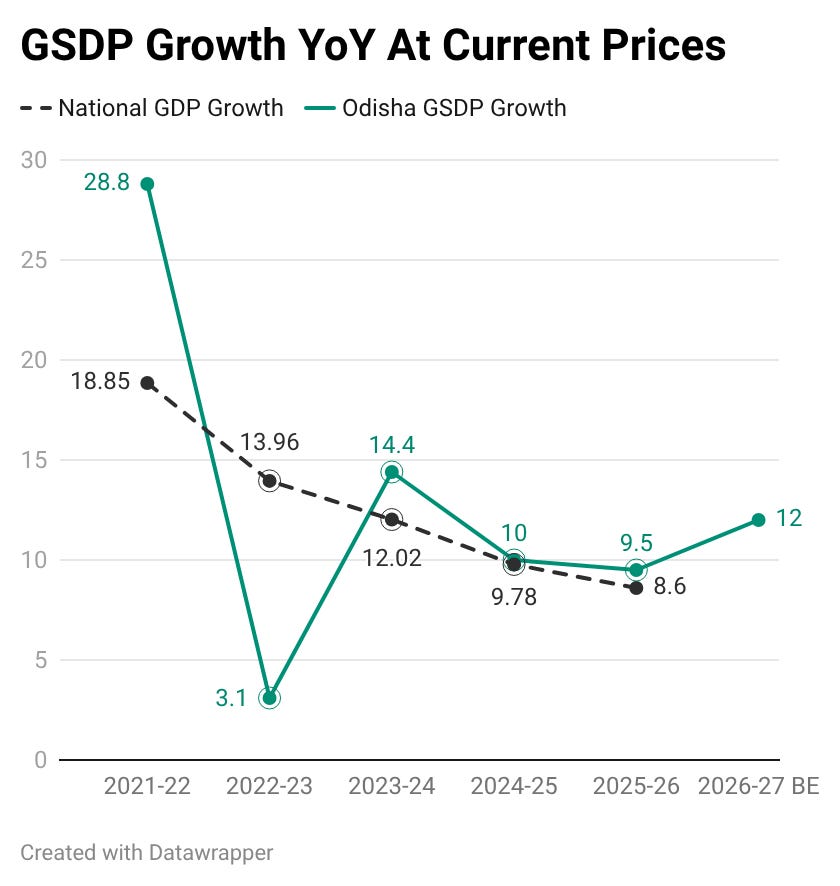
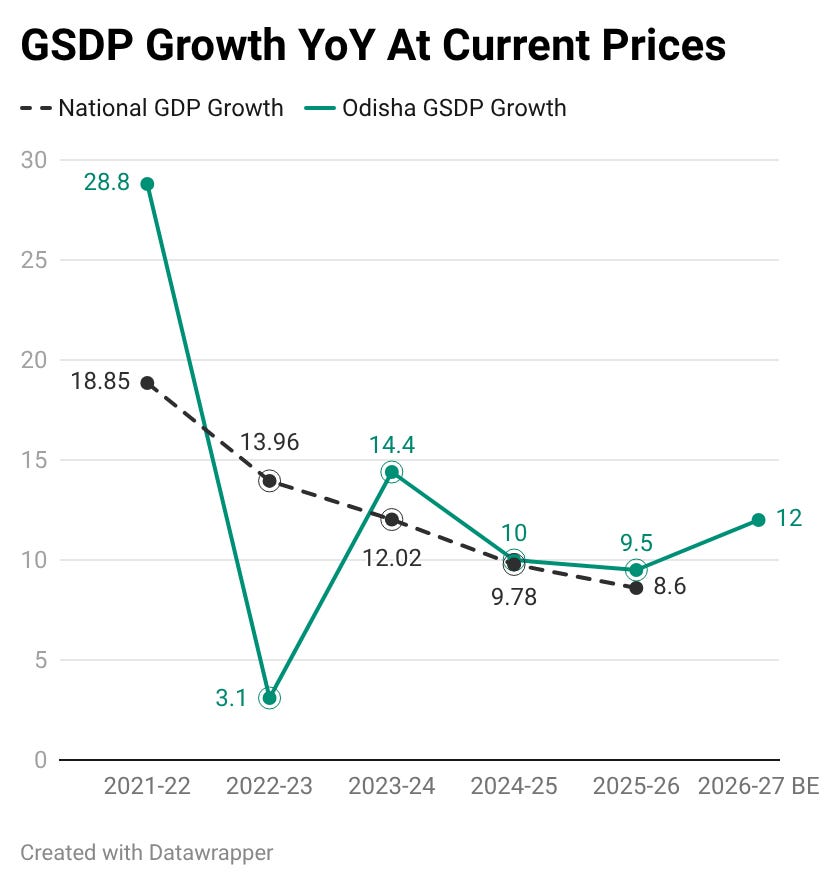
Image 9: Odisha’s GSDP Growth Compared To National GDP Growth This performance is reflected in the state’s GSDP growth over the past five years, where it has consistently exceeded the national GDP growth rate with the exception of 2022-23.
VIII. High Quality Of Expenditure
Odisha ranks first among 18 major states on the Quality of Expenditure sub-index in NITI Aayog’s Fiscal Health Index 2026, reflecting sustained restraint in committed expenditure coupled with a steadily expanding capital outlay.
Capital outlay at 6.51% of GSDP in 2026-27 BE is more than twice the national average of 3.0%, with absolute capital spending growing from ₹ 43,273.38 crore in 2023-24 actuals to a proposed ₹ 72,100 crore in 2026-27 BE, an increase of 66.61% over three years.
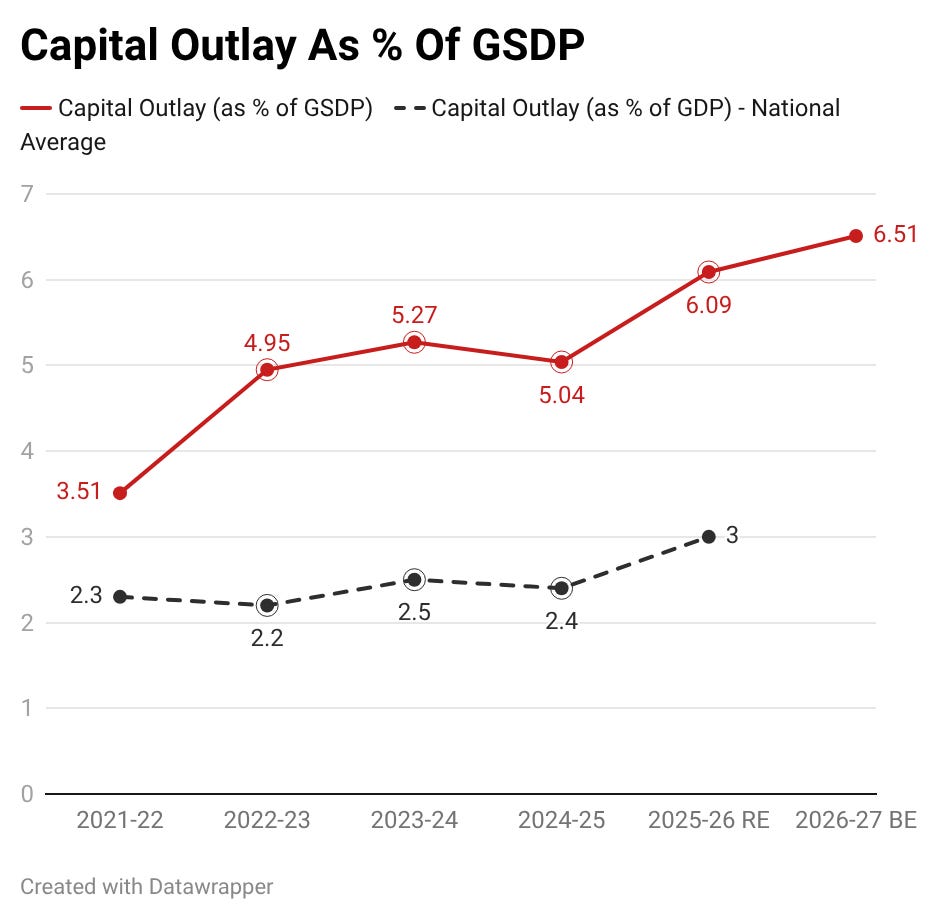
Image 10: Odisha’s Capital Outlay As A % Of GSDP 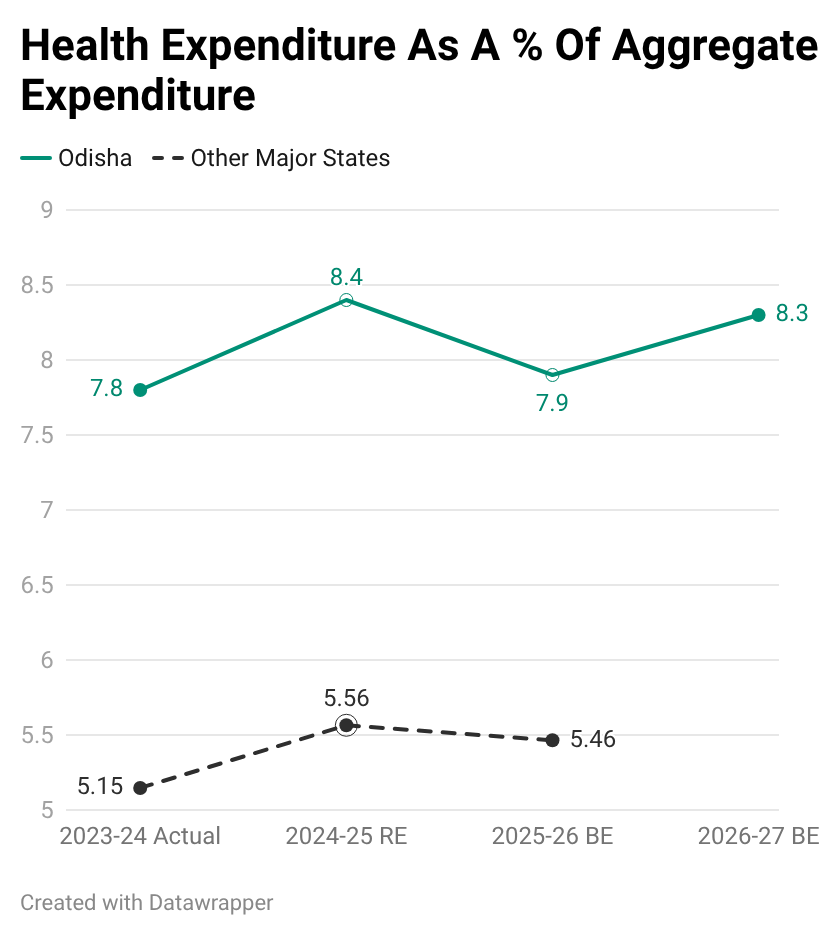
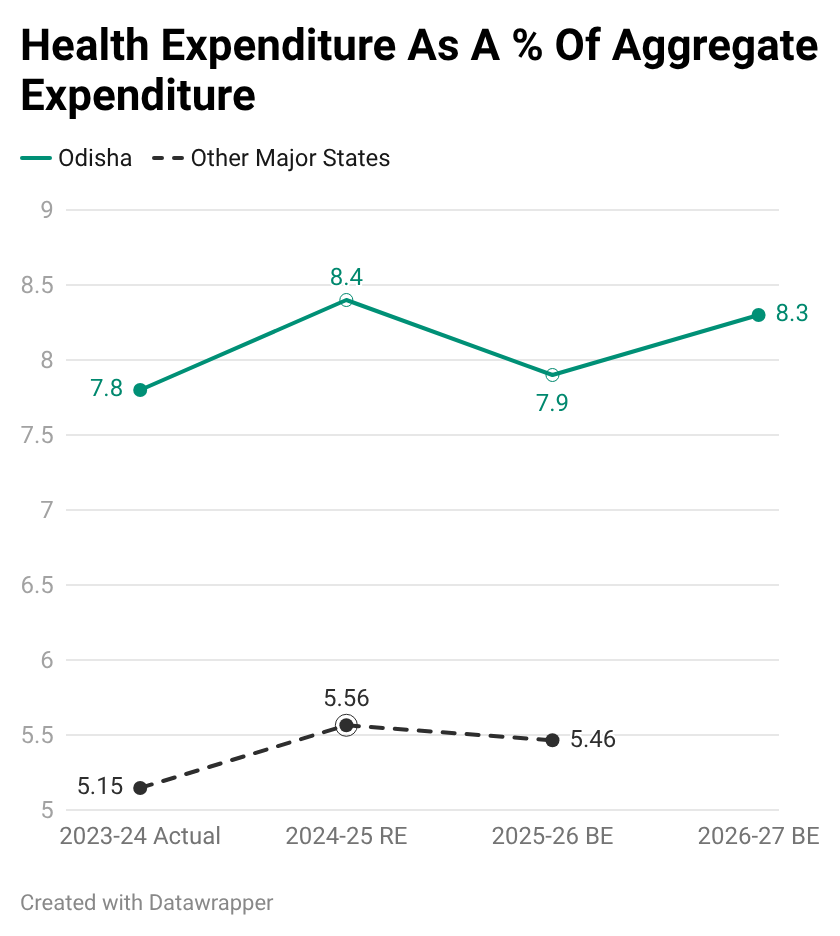
Image 10: Odisha’s Health Expenditure Compared To Other Major States Odisha also manages to outperform other major states on the metric of health expenditure as a percentage of aggregate expenditure reflected in Image 10. As such it can be concluded that the state makes prudent decisions with respect to how it allocates funds. The same is reflected in the state being ranked highest on the sub-index of ‘Fiscal Prudence’ among all major states.
IX. Low Debt Burden
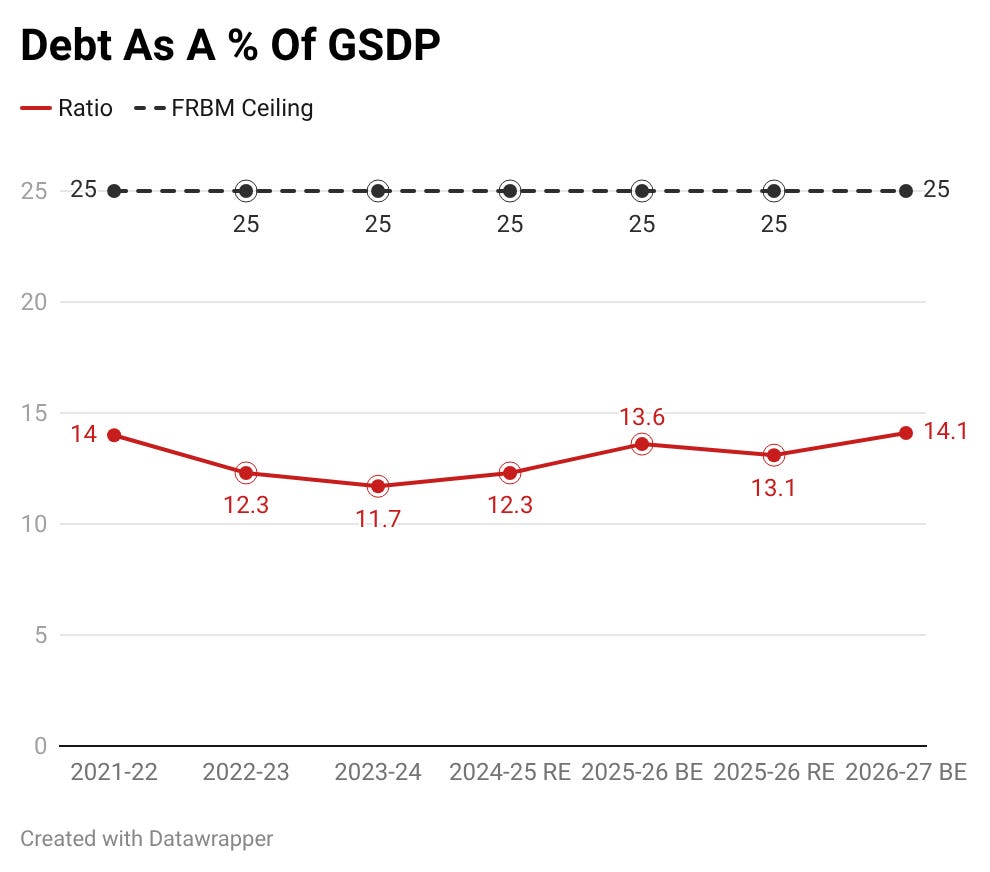
The outstanding debt of Odisha at 14.1% of GSDP in 2026-27 BE remains amongst the lowest across major Indian states, well below the debt sustainability benchmarks set by the 15th Finance Commission. This reflects sustained restraint in incremental borrowings over the medium term.
Such restraint is reflected, for instance, in the fact that the state’s market borrowings for the years 2022-23 and 2023-24 are 0. Only in 2024-25 did the state borrow an amount of ₹ 20,780 crore which is lower than that of all major states except Goa, a much smaller state.
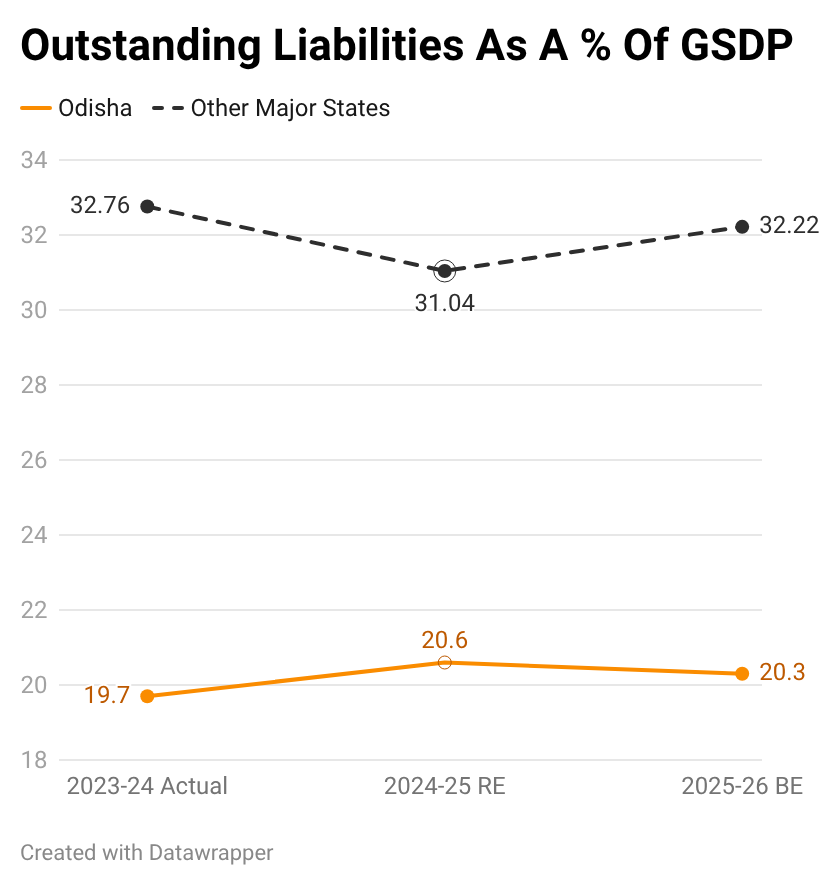
Odisha holds the highest debt index score among all states at 95.8, with the next highest being 76, as per NITI Aayog’s Fiscal Health Index 2026. Comparing the outstanding liabilities of Odisha and other major states, it can be seen that there exists a consistent 10 percentage point difference between the two.
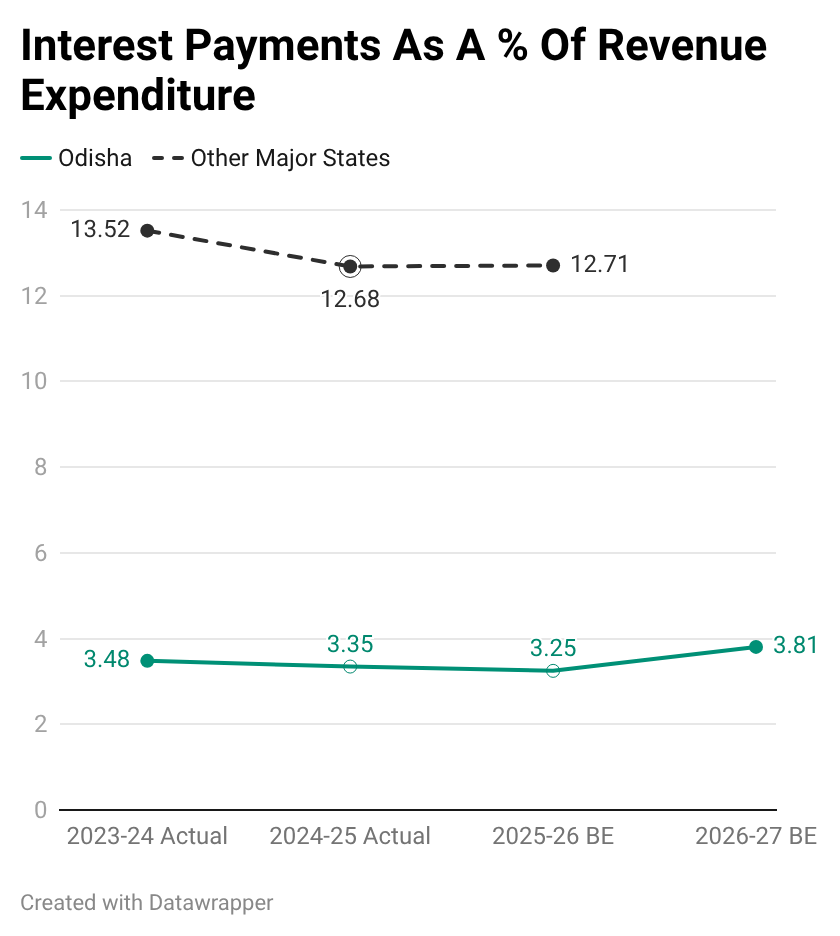
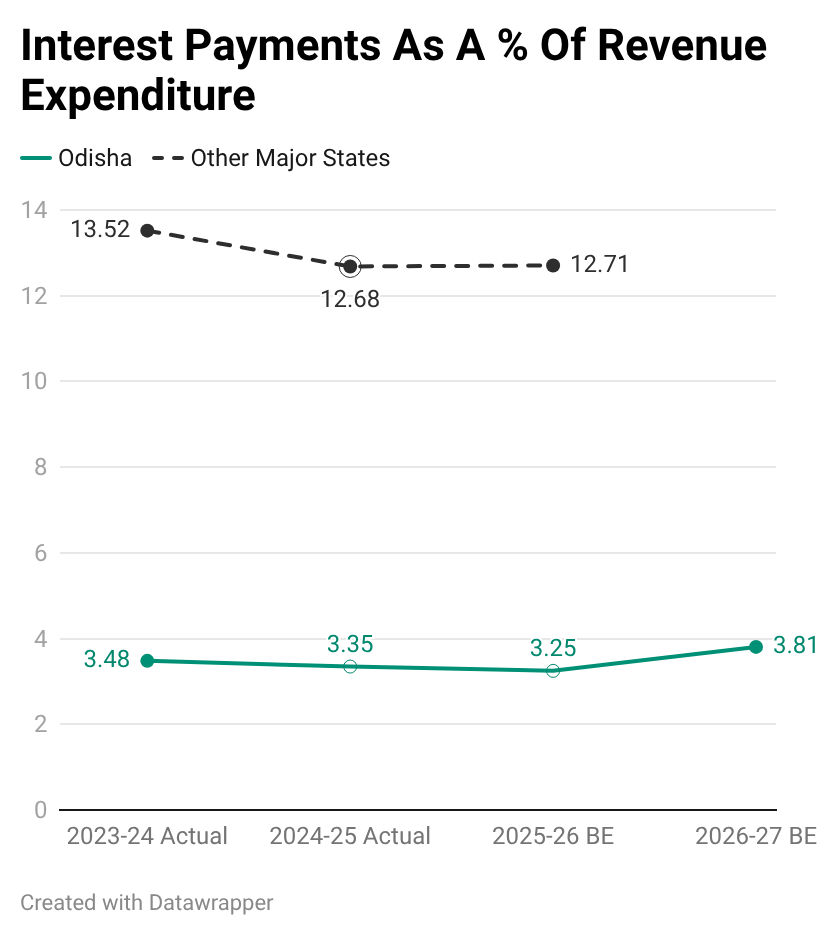
Image 13: Odisha’s Interest Payments As A % Of Revenue Expenditure Interest payments at 3.80% of revenue expenditure in 2026-27 BE remain structurally lower than peer states, reinforcing the fiscal flexibility available for developmental and capital allocations.
The combination of minimal market borrowing reliance, one of the lowest debt-GSDP ratios among major states, and contained interest obligations creates substantial fiscal headroom for Odisha to absorb shocks while sustaining its capital-led growth strategy.
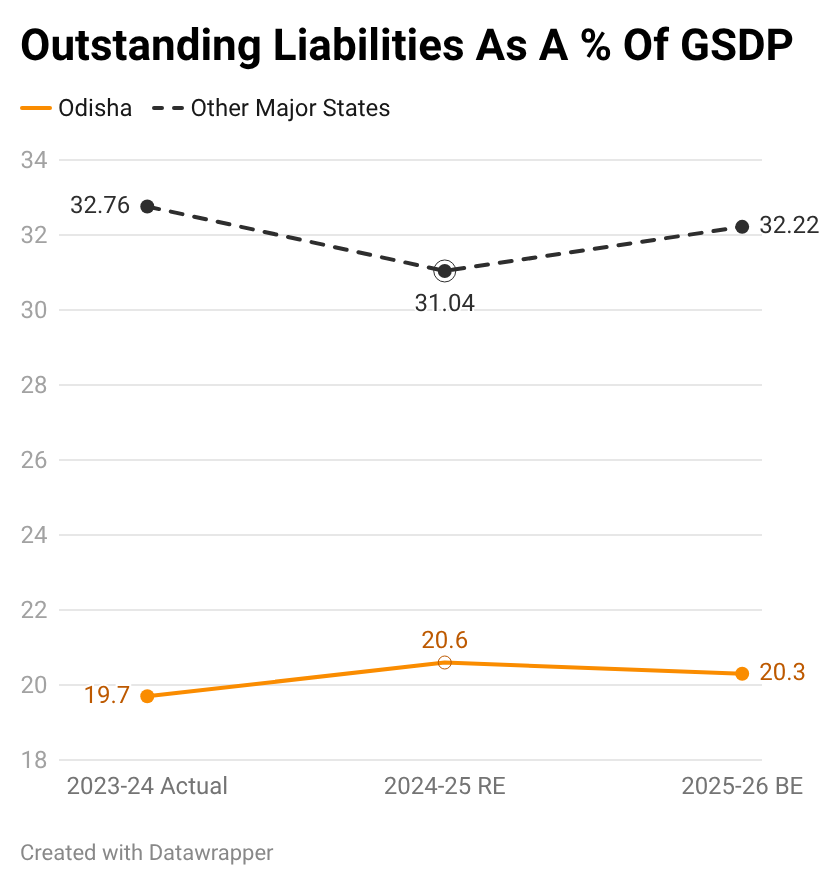
Image 14: Odisha’s Outstanding Liabilities As A % Of GSDP
Annexure I -
Annexure II -
Annexure III -
Annexure IV -
Annexure V -
Also, please consider subscribing to NFPRC Foundation’s focused centres covering latest economic, policy and administrative developments -
Centre for Law, Policy and Governance - Link
Centre for Accelerating India’s Growth - Link
Centre for Studies in Indian Social Systems - Link
NFPRC Foundation - Link