
Executive Summary
On 16th May 2026, ASML Holding NV partnered with Tata Electronics to strengthen India’s domestic semiconductor manufacturing capabilities, marking a major step in the country’s chip ambitions.
Tata Electronics is investing US $11 billion to establish India’s first commercial 300mm (12-inch) semiconductor fabrication facility in Dholera, Gujarat. This facility will support the automotive, mobile devices, and AI sectors on a global scale.
Gujarat’s Dholera fab facility, being developed with Taiwan’s PSMC, will manufacture 28nm wafers, while ASML’s role as the sole supplier of EUV lithography machines secures India a critical technology partner for its first commercial front-end semiconductor fab.
This deal marks a significant step toward building a robust and self-reliant domestic semiconductor ecosystem, supporting India’s long-term ambition to emerge as a leader in advanced semiconductor manufacturing.
The agreement advances India’s long-term goals of reducing import dependence, serving key sectors such as automobiles and electronics, creating high-value jobs, and building capacity in fabrication, design, packaging, and semiconductor research.
Semiconductors have become the new geopolitical currency of power. The semiconductor chips power modern technology and are critical for everything from smartphones to cars to artificial intelligence systems and defence technology. On 16th May 2026, during Prime Minister Narendra Modi’s visit to Hague, Netherlands, a strategic partnership was signed between lithography company ASML and Tata Electronics. The partnership will help India venture into front-end manufacturing. Front-end manufacturing refers to the building of microscopic circuits onto a blank silicon wafer using specialised lithographic machines. Lithography is the heart of manufacturing, and ASML stands as its undisputed global leader. ASML is the only producer of the world’s extreme ultraviolet (EUV) lithography machines, which are heavily utilized in the manufacturing of advanced semiconductors. This alone has transformed the Netherlands from a moderate European power into a critical node in global technology rivalry.
On 1st April 2025, the Dutch government expanded export controls on advanced semiconductor manufacturing equipment, citing concerns over their potential use in advanced military applications and therefore required case-by-case control. In this background, a high-visibility ASML partnership with Tata is strategically meaningful for India. The agreement adds the most difficult missing layer: a world-class lithography partner for India’s first front-end commercial semiconductor fabrication facility (fab).
I. Why Semiconductor Matters For India
Mounting Global Pressure: The global semiconductor industry is undergoing profound restructuring because of the US-China competition, export controls and supply chain vulnerabilities as exposed during the COVID-19 pandemic. Semiconductors are central to the push for technological reliance under initiatives such as Make In India, Digital India, and the new Semiconductor Mission. The Dutch Technology giant ASML holds a monopoly power in the global chip ecosystem.
Manufacture Readiness: The proposed Tata semiconductor fab in Dholera, Gujarat, with a planned investment of $11 billion, proves the country’s ambitious attempt to enter the advanced manufacturing segment of the global supply chain. With the increasing export restrictions to China under pressure from Washington, India appears increasingly attractive as a democratic, politically stable and strategically aligned alternative manufacturing destination within the broader China ‘plus-one’ framework. The collaboration could help India avoid the mistake of becoming merely a low-cost assembly base and move up the value chain toward chip design, semiconductor R&D, advanced materials and an AI-integrated manufacturing system.
Reliance on Imported Chips: At present, India imports the bulk of its microchips from abroad to meet the domestic demand. India does not manufacture advanced chips like 7-nanometer (nm) or 3nm, essential for AI or smartphones. This creates a vulnerable dependency and stress on the foreign reserves of the country. The first indigenous produced space microchip was Vikram 3201, a 32-bit microprocessor.
Supply Chain Issues: The global automotive industry faces a semiconductor supply chain issue, especially DRAM and NAND flash storage. As automakers accelerate the production of software-defined and electric vehicles, they are increasingly competing with AI infrastructure companies for a constrained global semiconductor supply. A modern passenger vehicle now incorporates between 1,400 and 3,000 semiconductor chips. During the pandemic, the Indian automobile industry is estimated to have lost nearly ₹ 25,000 crore in sales due to chip shortages. Most of the affected chips were built on mature nodes such as 28nm, 40nm, 65nm, and 90nm, not advanced 3nm technology. With the new partnership, India would be able to tend to the automotive industry’s semiconductor needs.
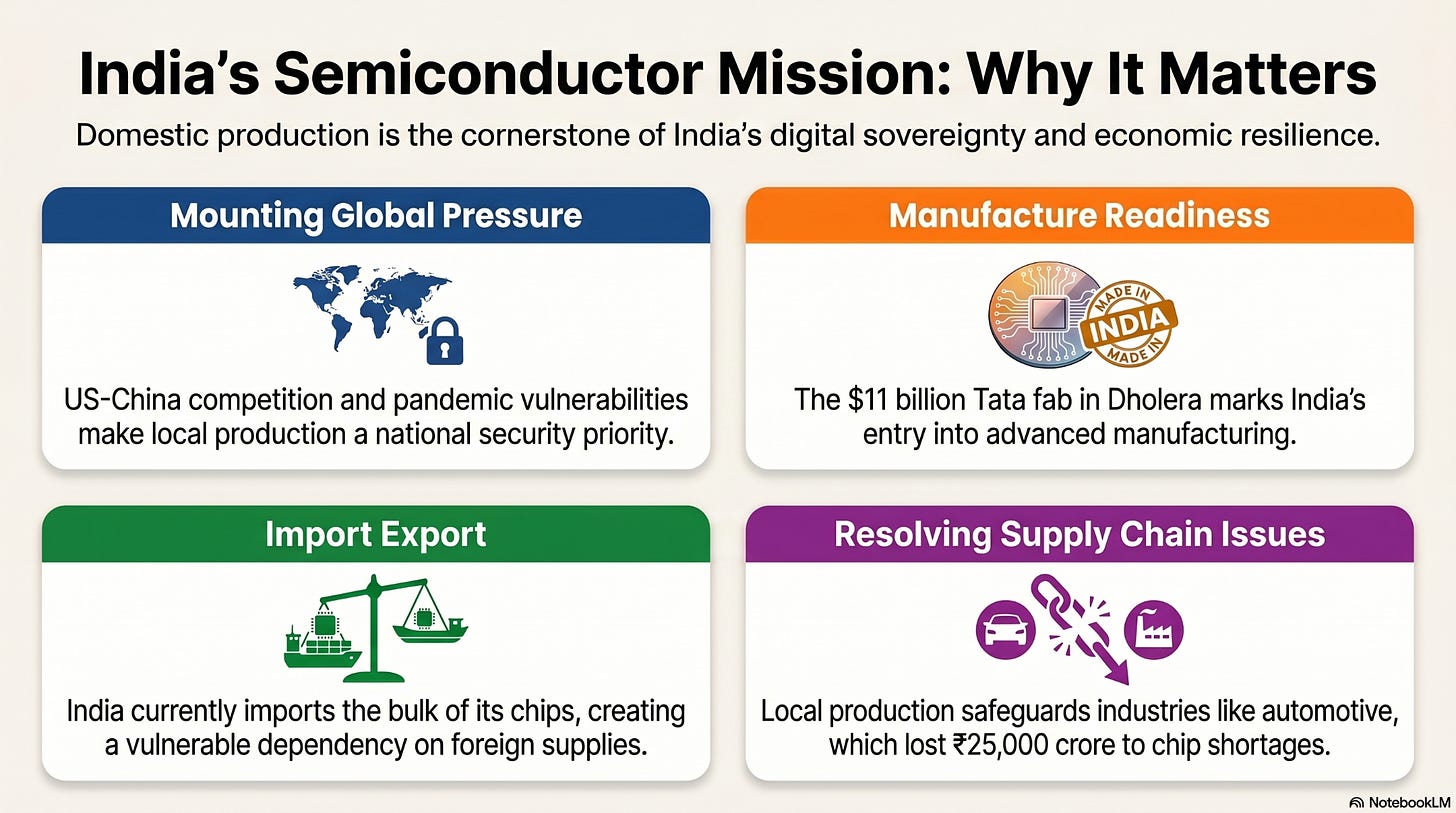
Figure 1: India’s Semiconductor Mission
II. Semiconductor Industry Growth In India
India is emerging as a global semiconductor hub, supported by major investments, expanding manufacturing capacity, and initiatives such as SEMICON India 2025 that reflect growing global confidence in its semiconductor ecosystem. A provision of ₹ 1,000 crore has been made for India Semiconductor Mission (ISM 2.0) for FY 2026–2027, with a strong emphasis on industry-led research and training centres to drive technology development and create a future-ready skilled workforce.
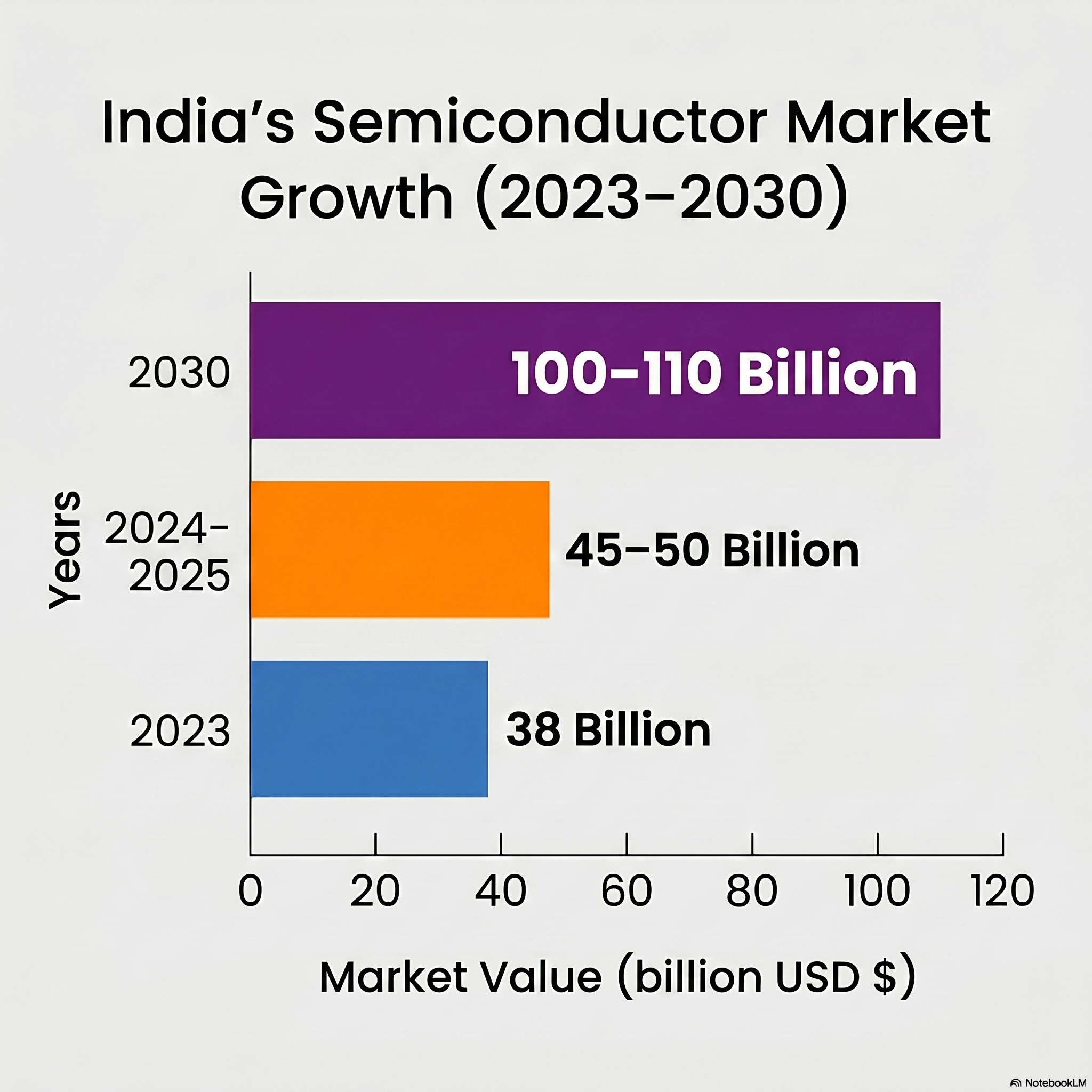
According to industry estimates, India’s semiconductor market was valued at around $38 billion in 2023, increased to approximately $45–50 billion during FY 2024–2025, and is projected to reach $100–110 billion by 2030.
III. Production Base and Approved Capacity
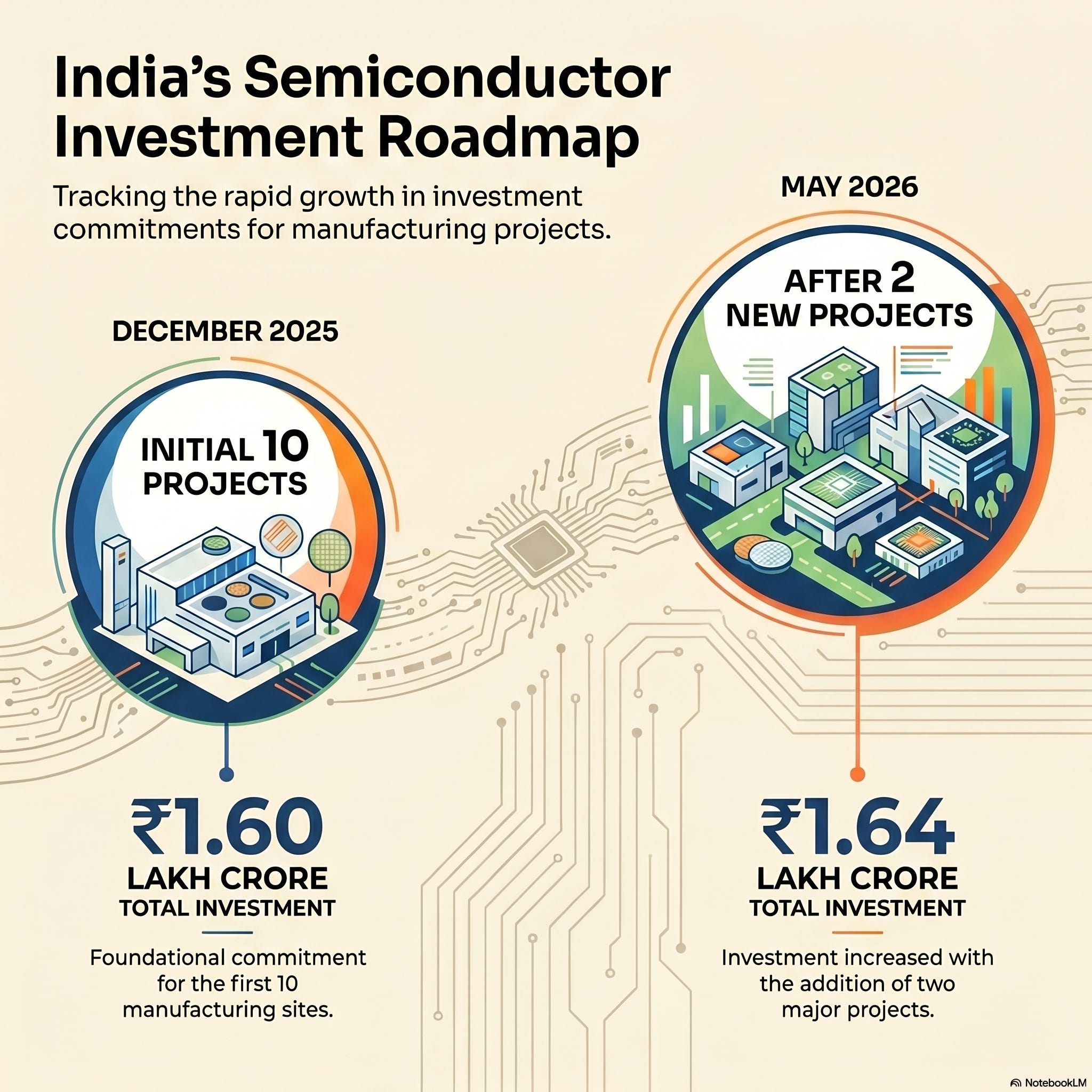
India’s production story is still early-stage, but it is no longer hypothetical. Officially, India had 10 approved semiconductor manufacturing projects across 6 states with investment commitments of about ₹1.60 lakh crore as of December 2025. On 5 May 2026, the Union Cabinet approved 2 additional projects in Gujarat, taking the total to 12 approved projects and cumulative investment to around ₹1.64 lakh crore. The cabinet approved two units in Gujarat: a fab unit for wafer production in Dholera and an Assembly Testing Marketing and Packaging (ATMP) unit in Sanand, and one ATMP unit in Morigaon, Assam. These units have an employment potential of direct employment of 20 thousand advanced technology jobs and about 60 thousand indirect jobs.
This outlines several high-value projects, including front-end fabrication and advanced packaging facilities spread across regions like Gujarat, Assam, and Uttar Pradesh. Major corporate players such as Tata Electronics, Micron, and CG Power are spearheading these initiatives to boost the country’s production capacity for essential hardware components. These facilities focus on a diverse range of technologies, from DRAM and NAND memory to specialized display driver integrated circuits. Collectively, these ventures represent a multi-billion-dollar commitment to achieving domestic self-reliance in chip assembly and testing.
IV. ASML-Tata Agreement
The Tata Electronics Private Limited’s mega fabrication unit in Dholera is planned in partnership with Powerchip Semiconductor Manufacturing Corporation (PSMC), Taiwan. The TEPL plant is projected to be operational by the second quarter of FY 2027–2028. Through this venture, India is building its first commercial front-end chip fab. The Memorandum of Understanding (MoU) aims to set up India’s first commercial 300 mm semiconductor fabrication plant. The 300 mm refers to the size of the silicon wafer on which the chips are printed.
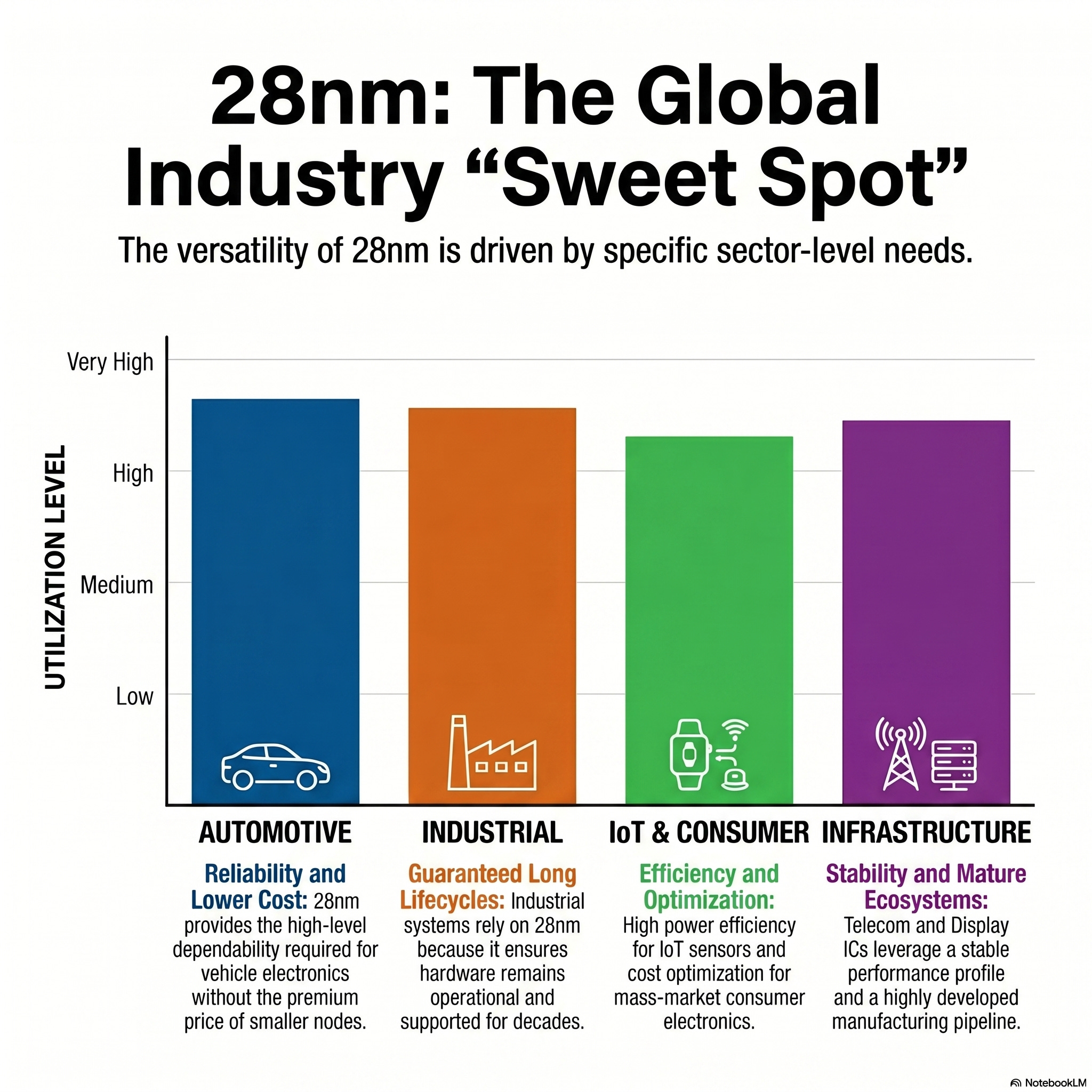
The real metric that defines a chip’s power is the process node, and Tata’s fab will operate at 28nm to 110nm nodes. The fab will not be using EUV but will be utilizing ASML’s DUV (Deep Ultraviolet) lithography tools and multi-patterning capabilities. These nanometer nodes are the workhouses of most of the automotive electronics, power management, displays and sensors. 70% of the global wafer market lives at 28 nm and above. The chips India’s economy actually buys, in their billions, sit at 28 nm and above. The fab unit in Dholera has the capacity to produce 50,000 wafers every month as of 2024. The focus on mature node production is the right entry point for India, rather than directly chasing the cutting-edge 2nm or 3 nm.
This deal would create billion-dollar long-term service revenue for ASML, whereas for India, it is more about building an ecosystem and employment generation, for a country that has never had a front-end semiconductor fab.
V. The Final Takeaway
Behind the Tata-ASML deal is India’s attempt to move beyond being a low-cost assembly hub and its function as an execution bridge. The deal aims to develop India’s semiconductor operating system and transfer of manufacturing discipline. India presently lacks a sufficiently large pool of professionals with deep semiconductor domain expertise required to operate world-class semiconductor manufacturing facilities. The country already had policy intent, subsidies, a fab approval, and a fiscal support agreement. What it still needed was a trusted high-end lithography partner for the country’s first front-end commercial fab. ASML helps fill that gap. This deal makes Dholera the nucleus of a real fabrication ecosystem.
The semiconductor chips manufactured at Dholera will not rely on advanced ASML High-NA EUV lithography systems. The fabrication facility is expected to produce its first commercial wafer by late 2026 and achieve full operational capacity by 2028. The fab will primarily operate at the 28nm technology node, reflecting India’s pragmatic and phased approach toward building semiconductor manufacturing capabilities. This marks the beginning of a long-term strategic journey that may span several decades, with current efforts focused on establishing a strong foundational ecosystem before advancing toward leading-edge technologies such as 3nm nodes.
Also, please consider subscribing to NFPRC Foundation’s focused centres covering latest economic, policy and administrative developments -
Centre for Law, Policy and Governance - Link
Centre for Accelerating India’s Growth - Link
Centre for Studies in Indian Social Systems - Link
NFPRC Foundation - Link