

The Indian economy sits at a delicate juncture where it needs to attract investment while keeping domestic stability intact. The recent move of increasing Securities Transaction Tax (STT) seems to strike at heart of this issue, arguably in an adverse manner. For context, the Union Finance Minister Smt Nirmala Sitharaman hiked the STT rates for the Futures and Options (F&O), which are financial derivatives that allow investors to hedge against or speculate on price movements of underlying listed assets, such as stocks, indices, and commodities, without requiring actual ownership. The changes made in STT structure are as provided below:
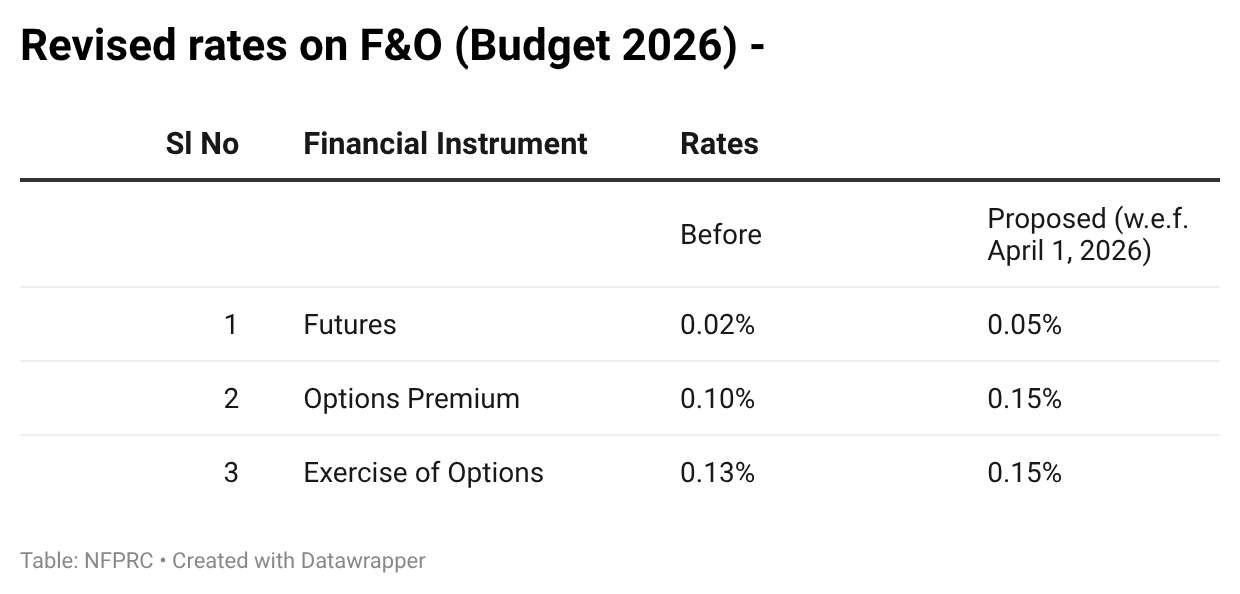
The official rationale communicated by Chief Economic Advisor V. Anantha Nageswaran is that the objective of the STT hike is not revenue generation but the protection of household savings. Considering that 90% of retail investors have faced significant losses in 2024, the underlying logic seems to be fair since the volume of contracts within the F&O segment has reached over 500 times the nation’s GDP. This suggests that the line between disciplined wealth creation and high-stakes gambling has been blurred.
I. Industry Perspectives and Challenges to the Security Market
This decision has invited hue and cry from traders and industry experts who are concerned about its immediate impact on market dynamics and the broader economy. Critics argue that the most direct consequence is a sharp rise in trading costs, which disproportionately affects high-frequency and intraday traders. Since STT is levied on every transaction, active participants face a substantial reduction in net profits, forcing them to become overly cautious in their trade selection.
Nithin Kamath, founder of Zerodha, has expressed concerns that the measure may not effectively curb speculation, given that most retail speculative activity is concentrated in options trading (~95%) rather than futures. Further, STT on futures is linked to full contract value where marginal increase in rates can raise trading cost significantly as compared to most options trading, where the STT is levied only on premium at the time of sale. The increased cost will deter all kinds of traders to place their bets cautiously, impacting overall liquidity.
Radhika Gupta, CEO of Edelweiss Mutual Fund, criticised the STT by highlighting that higher STT does not differentiate between retail speculation and institutional participation and is penalising institutional investors and retail investors equally. Dhiraj Relli, CEO of HDFC Securities, said that this hike will have serious repercussions on liquidity, which is already under pressure.
II. The Government's Rationale: A Convergence of Economic and Welfare Perspectives
While critics argue that the hike is counterproductive to the operation of the F&O market, it is essential to consider the Government’s underlying rationale, which focuses on protecting retail investors from systemic losses. The free market proponents conveniently overlook the grim reality of the mounting losses of retail investors in the past 4-5 years. Contrasting this with the influence of institutional players to drive market volatility by leveraging massive positions at the expense of smaller participants, the picture becomes clear. The F&O market is a zero-sum game and the retail investors are often at the losing end.
This policy comes as a long string of government intervention through SEBI to curb retail participation in F&O trading. In this regard, Ashwani Bhatia, whole time member of the Securities and Exchange Board of India (SEBI), in 2024 warned investors against chasing quick returns and turning high-risk trading into a ‘national pastime’. The SEBI Report, 2022 revealed a massive surge in retail participation from 7.1 lakh traders in FY 2018-19 to 86.3. lakhs in FY 2023-24, coupled with alarming financial outcomes. This prompted SEBI to consistently monitor this issue, cautioning against the negative ramifications from excessive retail investment as early as 2023.
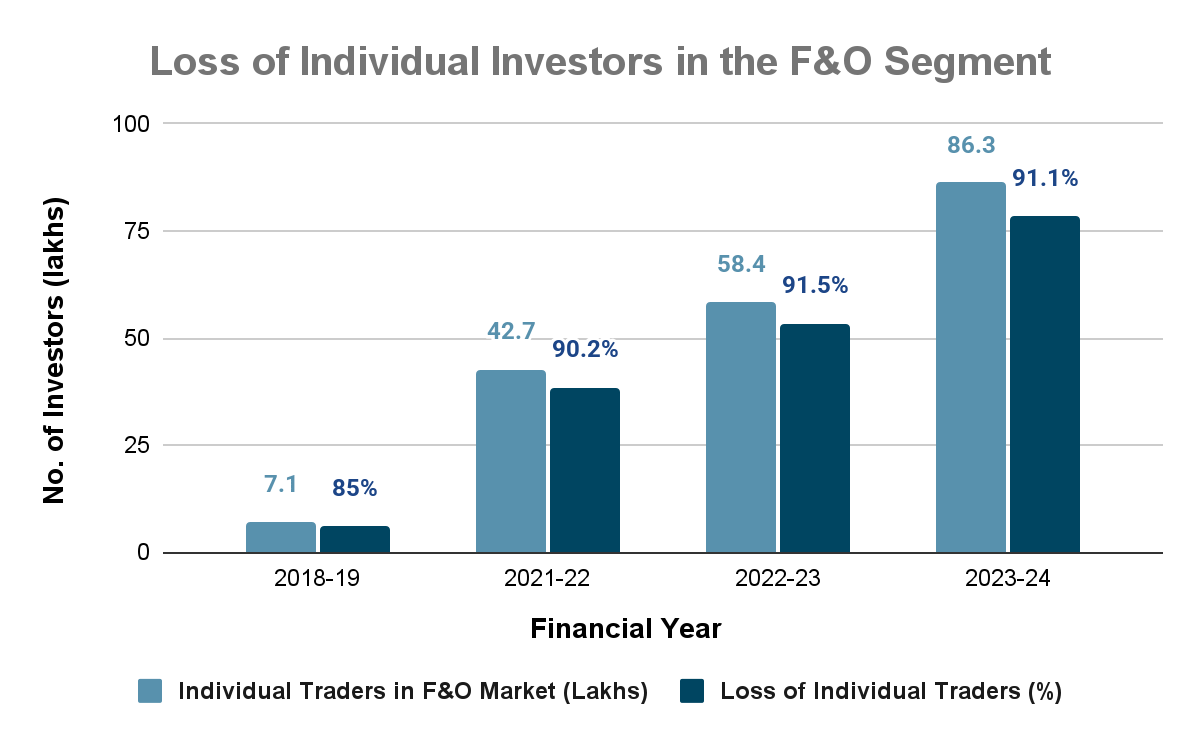
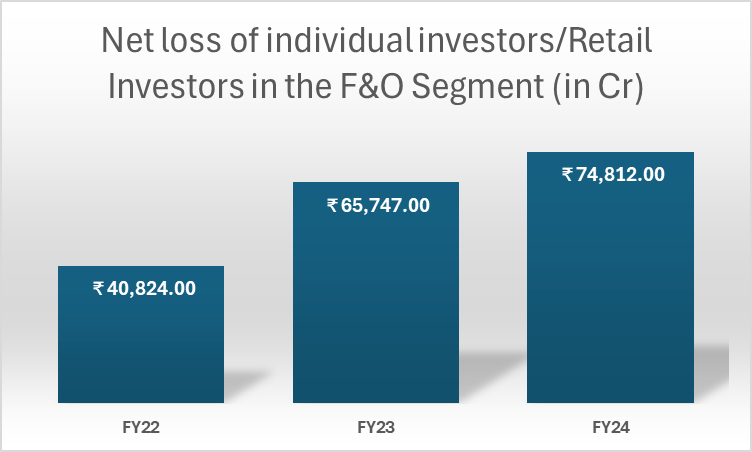
The intervention made by the regulator is essential to protect the Indian household from the financial trap and protecting their hard earned money from getting eroded. There are many instances where youth, lured by social media, have lost millions. For instance, recently one user reported that his “smartest cousin” lost over ₹1 crore in F&O and is now buried under ₹70 lakh in debt. This is just one of the cases to illustrate a vicious cycle where educated but inexperienced youth continue trading in hopes of recovering lost capital, only to incur greater losses that, in turn, affects their psychological well-being.
Guided more by emotion and the fear of missing out than by financial literacy, today’s youth are entering the market in large numbers. Influenced by social media hype and easy-to-use trading apps, their journey often lacks a long-term vision. The SEBI Investor Survey 2025 shows derivative awareness is below 15%, unlike 53% for Mutual Funds, with limited functional understanding. A case study from Chaitanya University, also notes that 90% of retail traders lose money in the ‘F&O mania’ due to errors like overconfidence and misunderstanding complex instruments.
Originally, F&O was meant as a hedging tool for institutional investors, but now lets people make huge, leveraged bets on small price changes. This excessive speculation causes sudden, large sell-offs, making the market much more unpredictable than simple stock buying. This lack of functional understanding of derivative markets, makes retail participants particularly more vulnerable to the market’s inherent volatility.
Data from a SEBI’s study on the equity derivatives segment (FY 2022–2024) highlights a distressing wealth transfer from lower-income households to the market. Investors earning less than ₹5 lakh annually suffered a collective net loss of ₹42,790 crore, with a staggering 92.2% of traders in this bracket losing money. In contrast, only the “Very High Income” category (earning over ₹1 crore) managed to post a positive net profit.
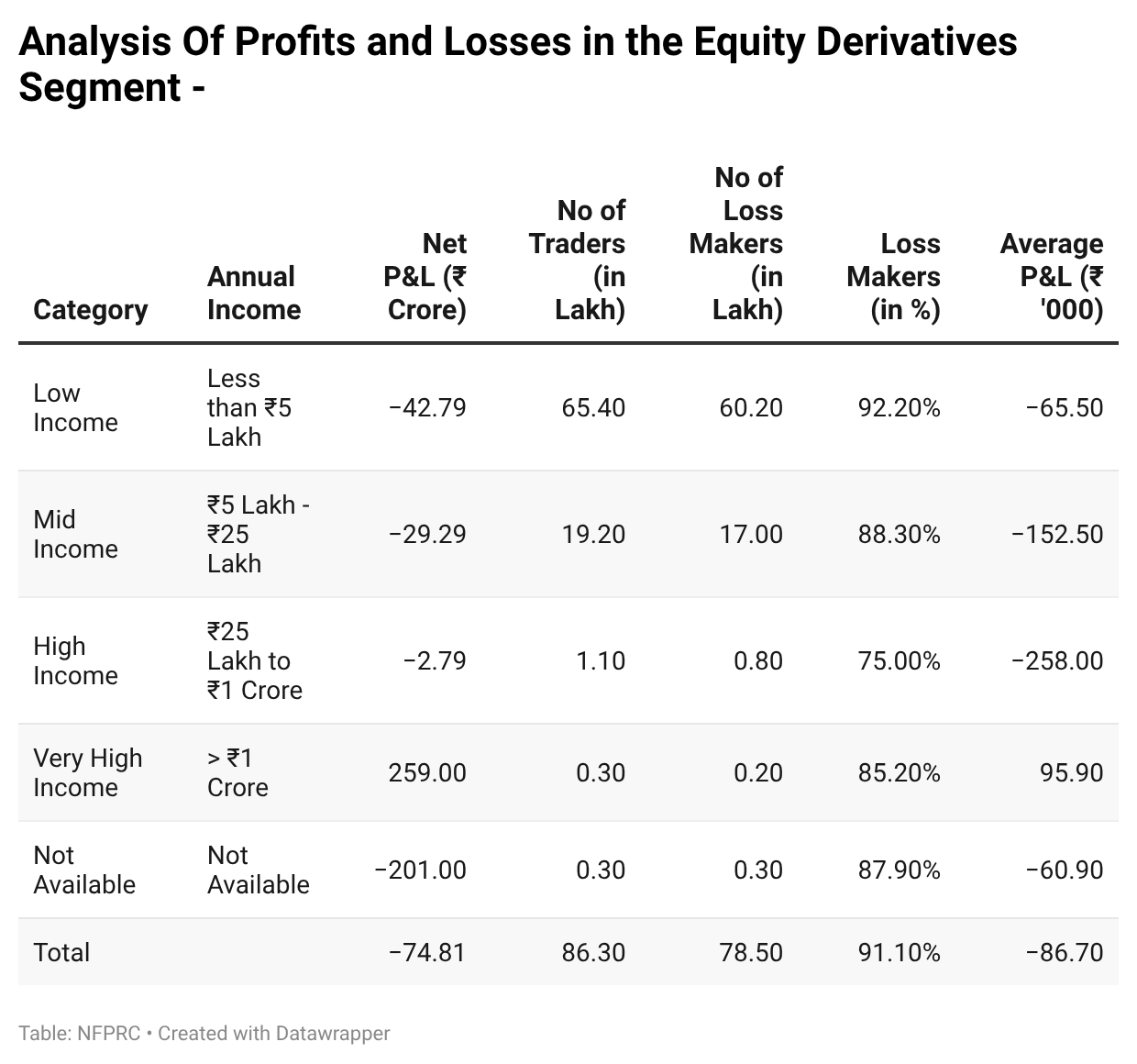
Furthermore, SEBI data shows that while individuals lost money, proprietary traders and Foreign Portfolio Investors (FPIs) earned gross profits of ₹33,000 crore and ₹28,000 crore, respectively, in FY2024. Crucially, 97% of FPI profits and 96% of proprietary profits were generated by “Algo entities,” highlighting a massive technological and information asymmetry among the retail investors and institutional investors. The participation of retail inventors is further fueled by aggressive marketing from “finfluencers” who promote short-term strategies without adequate risk disclosure. This increasing participation in F&O trading is significantly fueled by aggressive social media marketing from “finfluencers” who promote short-term profit strategies without adequate risk disclosures or transparency regarding conflicts of interest.
These staggering losses are not just bad luck but rather represent a ‘market failure.’ When retail traders with limited information compete against institutional investors like, the ‘invisible hand’ of the market stops working for the common good and starts causing harm. In this regard, the recent STT hike aligns well with the recent Policy measures of SEBI such as October 2024 circular and crackdown on unregistered influencers to guard the retail investors from the negative fallout of the market. The STT acts as a targeted tax, curbing excess trading, protecting retail investors, and restoring efficiency, hence addressing market failures arising out of information asymmetry, negative externalities and misuse of dominant position.
Furthermore, the Government aims to redirect household savings from traditional schemes to stable, long-term capital market investments such as mutual funds for sustainable wealth creation. By adjusting taxes on quick trades, the policy discourages risky short-term bets in favor of steady, stable and more predictable financial investments. This regulatory change can also be seen as part of a broader vision to significantly increase the low participation rate of India’s households (only 9.5% of 33.72 crore) in the securities market. In general, the risk appetite of retail investors is low compared to institutional and large investors. This policy encourages retail investors to invest in stable equity funds such as mutual funds by making the F&O trading costly for them.
Lastly, Government interventions must be evaluated independently of the narratives pushed by institutional lobbying groups, who often prioritise profit margins over the precarious reality of the retail investor in F&O trading. In the face of global geopolitical turmoil and a surge in retail investors in risky investments, the state’s shift toward stricter oversight is a necessary corrective measure. In no way, this hike restricts market access as for long term investors, the impact is minimal, and for institutional entities with substantial balance sheets, the effect is negligible.
III. Way Forward:
Notwithstanding the government’s noble intention to protect retail investors and their household savings, any intervention in the free market must be balanced and effectively designed to meet the desired goal. The STT hike has undoubtedly raised the cost of entry for everyone. Taxation, being one lever in a larger regulatory machine, should function as a last resort utilised primarily when administrative nudges have failed to achieve the intended outcome. The logical step is to pursue calibrated fiscal reforms (if at all) to avoid unintended outcomes with a genuine investor centric regulation regime, which empowers all strata of investors to make informed decisions..
To truly safeguard the public interest while fostering a mature market, the Government can bridge the information gap through nationwide awareness campaigns. A successful example is the AMFI’s marketing scheme promoting ‘Mutual Funds Sahi Hai‘, that prompted retail investment in the mutual funds segment. SEBI could launch a similar collaborative campaign for the F&O segment as well. By making the retail investors more informed, the state can move away from simply making the market more expensive and instead make the retail investors more resilient and empowered. This vision of an investor-centric regulatory framework involves pairing educational efforts with tighter accountability measures. This can be done by SEBI through fixing accountability of “finfluencers”. These measures would ensure that the digital advice reaching common people is unbiased.
Further, by exploring other administrative measures and considering recommendations from industry experts, such as fixing the eligibility criteria based on the financial profile in F&O trading, fixing some cooling off period after series of losses, putting more checks and balances on algorithmic trading would further help in strengthening the security market by protecting the retail investors at the same time. By evolving from the broad stroke of the STT toward these behavioural nudges and structural reforms, the Government can transform the market into a space where the common man doesn’t just participate out of hope, but thrives with genuine confidence and informed clarity.
This piece was authored by Shinjani, Team Lead at NFPRC with interest in economic laws and Rohit, intern at NFPRC, pursuing his MPP from NLS Bangalore (X: @ShinjaniAgNO3 and X :@Rohitg334)