
This edition of States in Motion highlights major developments across states and Union Territories, including Arunachal Pradesh’s deregulation framework, Delhi’s Electric Vehicle Policy and Fire Services Master Plan, Gujarat’s new industrial policy, and Maharashtra’s unmanned systems and rural drinking water policies. It also covers Andhra Pradesh’s medical registration reforms, Haryana’s digital transfer reforms, and Kerala’s Mission Samudra for port-led economic development.
I. Assam: Land And Regulatory Reforms Package
Source: Click Here
The Development: The Assam Government recently approved a land and regulatory reform package comprising the Assam Regulation of Re-classification and Re-classification-cum-Transfer of Lands (Amendment) Bill, 2026, amendments to the Assam Private Universities Act, 2007, and the Assam Tourism Accommodation (Development and Registration) Rules, 2026. The reforms aim at expanding land reclassification eligibility, reduce private university land requirements from 60 to 35 bighas in rural areas and 30 to 21 bighas in urban areas, and simplify registration and renewal procedures for homestays.
Key Takeaway: Assam’s services sector contributes around 46% of Gross State Value Added (GSVA), while manufacturing remains relatively limited, highlighting the need to reduce barriers to industrial expansion. By replacing approval-based land conversion with automatic conversion, reducing land thresholds for educational institutions, and simplifying tourism accommodation compliance, the reforms seek to improve investment readiness, support MSME growth, and enable local entrepreneurship.
II. Arunachal Pradesh: 51-Point Deregulation And Simplification Framework
Source: Click Here
The Development: Arunachal Pradesh enacted a 51-point deregulation package introducing third-party certification options and auto-renewal systems for vital environmental and operational approvals. The framework drastically rationalises industrial building norms, integrates departmental clearances into a single digital platform, and grants a strict three-year inspection moratorium for MSMEs.
Key Takeaway: Despite its raw economic potential, the state has historically suffered from weak private capital formation and low foreign direct investment inflows, securing a mere ₹ 53.25 crore in Foreign Direct Investment between 2019 and 2025. By shifting from strict ex-ante regulatory control to simplified ex-post compliance monitoring, these reforms aim to slash administrative friction, reduce compliance costs, and create a highly competitive climate for new investments.
III. Gujarat: Viksit Gujarat Industrial Policy, 2026
Source: Click Here
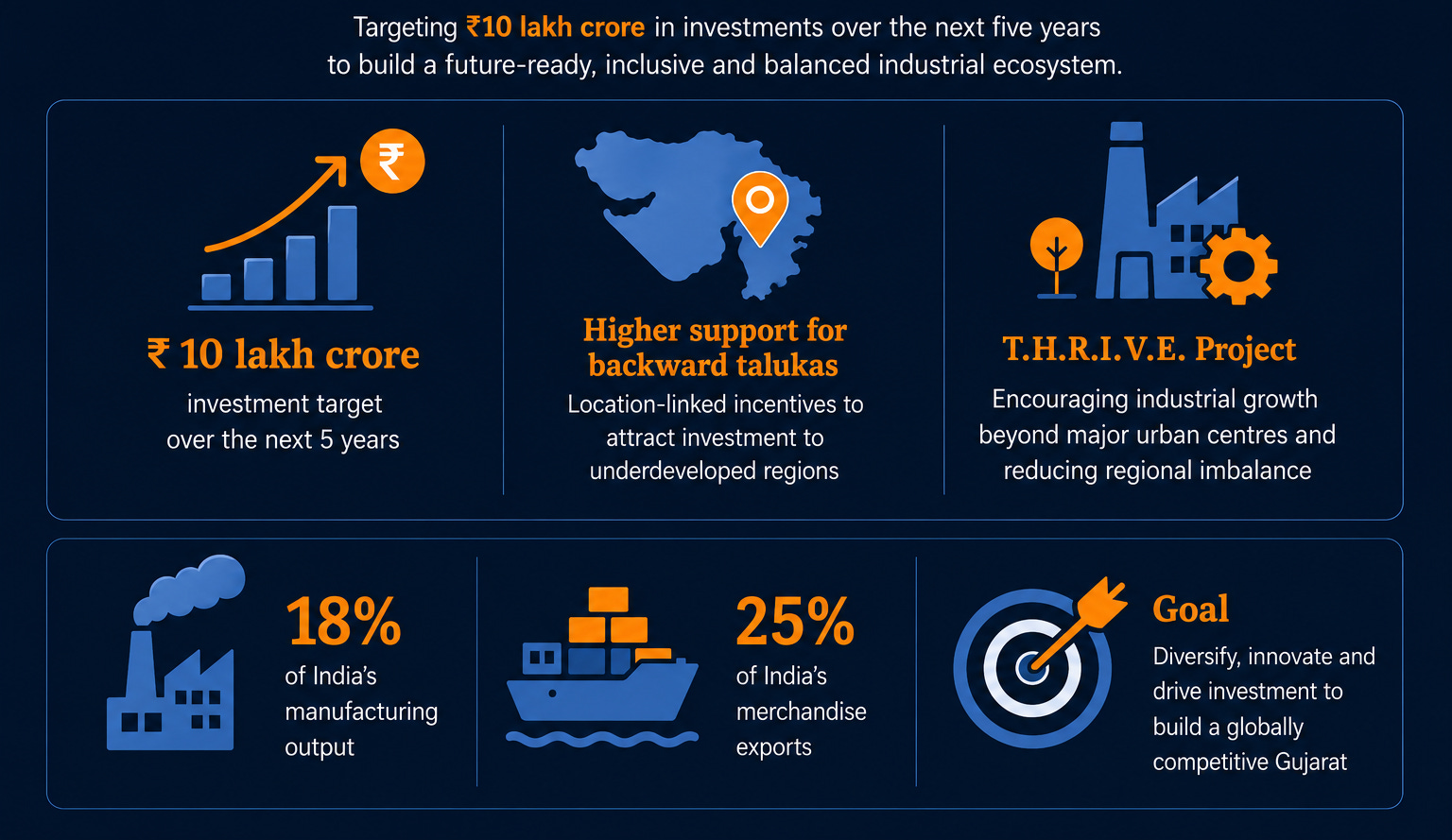
The Development:. The Gujarat Government recently unveiled the Viksit Gujarat Industrial Policy, 2026, targeting ₹ 10 lakh crore in investments over the next five years. The policy promotes advanced manufacturing through targeted incentives, higher support for backward talukas, and the T.H.R.I.V.E. Project for balanced regional industrialisation.
Key Takeaway: Gujarat contributes nearly 18% of India’s manufacturing output and 25% of merchandise exports, but its industrial base remains concentrated in sectors such as petrochemicals and textiles. By promoting high-technology industries and location-linked incentives, the policy seeks to diversify Gujarat’s industrial base and channel investment into underdeveloped regions.
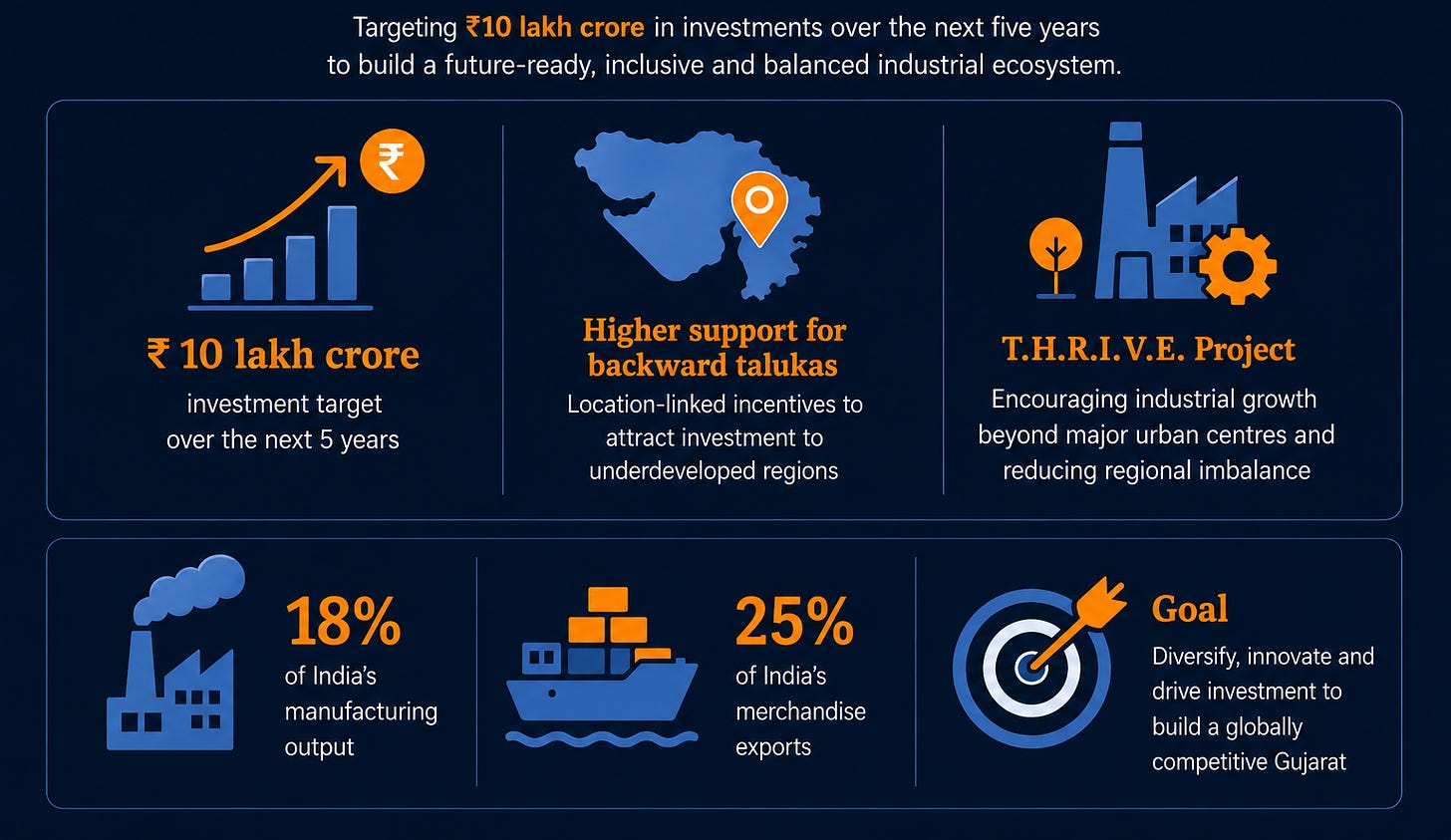
Image 1: Highlights Of Viksit Gujarat Industrial Policy, 2026
IV. Maharashtra: Unmanned Systems Policy, 2026
Source: Click Here
The Development: The Maharashtra Cabinet approved the Unmanned Systems Policy, 2026 to propel the state as a leading hub for drones, robots, and autonomous vehicles through targeted research and manufacturing support. The framework outlines the establishment of dedicated Centres of Excellence and mandates the training of 5,000 remote pilots. The State will launch the Maharashtra Unmanned Systems Mission to promote innovation, manufacturing, testing, certification, skilling, and responsible governance of unmanned systems.
Key Takeaway: With India’s drone ecosystem rapidly expanding to over 38,500 registered drones, this policy aims to secure a first-mover advantage for Maharashtra while attracting ₹ 25,000 crore in investments. By linking technological development with practical demand creation, particularly in agriculture, the state intends to build a highly skilled workforce and integrate emerging technologies into its broader economic growth.
V. Delhi: Electric Vehicle Policy 2026
Source: Click Here
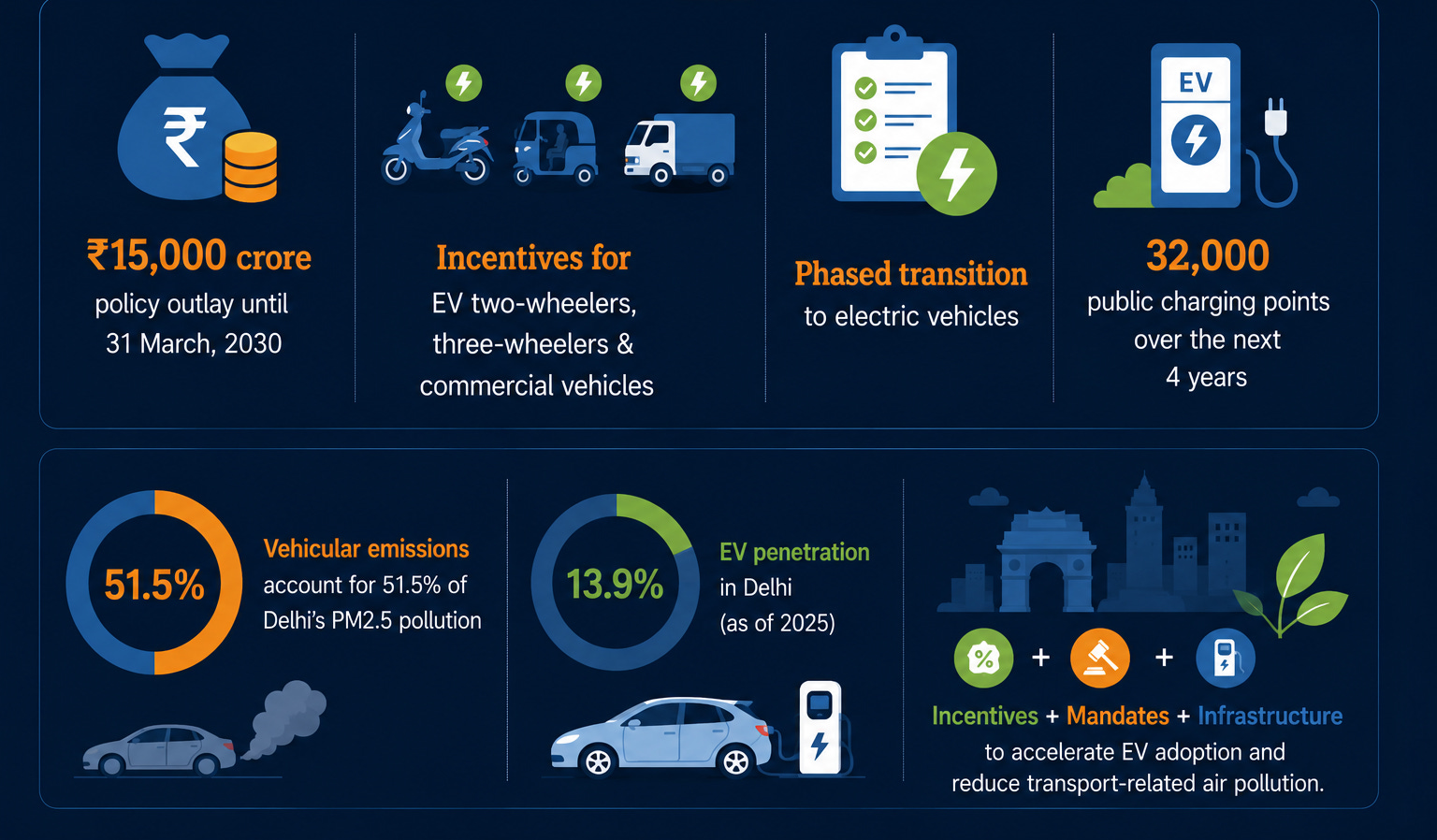
The Development: The Delhi Government approved the Electric Vehicle (EV) Policy, 2026, with an outlay of ₹ 15,000 crore until 31st March, 2030. The policy provides phased purchase and scrappage incentives for EVs, and mandates a phased transition to electric vehicles, and targets the installation of 32,000 public charging points over the next four years.
Key Takeaway: Vehicular emissions account for 51.5% of Delhi’s PM2.5 pollution, making transport the city’s largest local pollution source. Building on Delhi’s 13.9% EV penetration rate, the third highest in India, the policy combines phased mandates, financial incentives, and charging infrastructure to accelerate the replacement of older, high-emission vehicles and reduce air pollution.
VI. Andhra Pradesh: Removal Of Mandatory State Medical Council Registration
Source: Click Here
The Development: The Andhra Pradesh Government issued a regulatory order allowing doctors registered with any state or Union Territory Medical Council to practice within the state without requiring separate local registration or a No Objection Certificate. The order introduces a streamlined online portal for credential verification and declaration submission, removing severe administrative hurdles for incoming medical professionals.
Key Takeaway: Andhra Pradesh is rapidly expanding its healthcare infrastructure to build 17 new medical colleges, increasing the demand for highly skilled professionals. By eliminating duplicate registration procedures, the state intends to attract top-tier specialists from across the country, strengthening its regional healthcare market and positioning itself as a premier medical tourism destination.
VII. Maharashtra: Rural Drinking Water Policy, 2026
Source: Click Here
The Development: The Maharashtra Cabinet approved the Rural Drinking Water Policy 2026 to ensure equitable potable water access under the Jal Jeevan Mission 2.0. The policy caps monthly household water charges between ₹ 150 and ₹ 400 and mandates local self-Governments to achieve 100% cost recovery for operations and management.
Key Takeaway: Despite achieving 88% rural tap-water coverage, Maharashtra continues to face severe water scarcity, with 127 villages requiring tanker-based supply in May 2026 alone. By shifting focus from mere asset creation to long-term service delivery and financial viability, the policy seeks to address high operational costs and ensure sustainable water security across regions.
VIII. Haryana: Model Online Transfer Policy, 2026
Source: Click Here
The Development: The Haryana Government has notified the Haryana Model Online Transfer Policy, 2026 to regulate transfers of regular state Government employees in cadres with 50 or more sanctioned posts. The policy introduces an online scoring system based on age, experience and hardship factors, and mandates that all transfers be processed through the Human Resources Management System (HRMS).
Key Takeaway: The policy replaces discretionary transfers with a transparent, 120-point digital system that uses objective criteria and HRMS-based processing. Transfer decisions have often been influenced by administrative discretion, resulting in arbitrary postings and inadequate consideration of hardship cases. The policy seeks to make the process more transparent and rule-based.
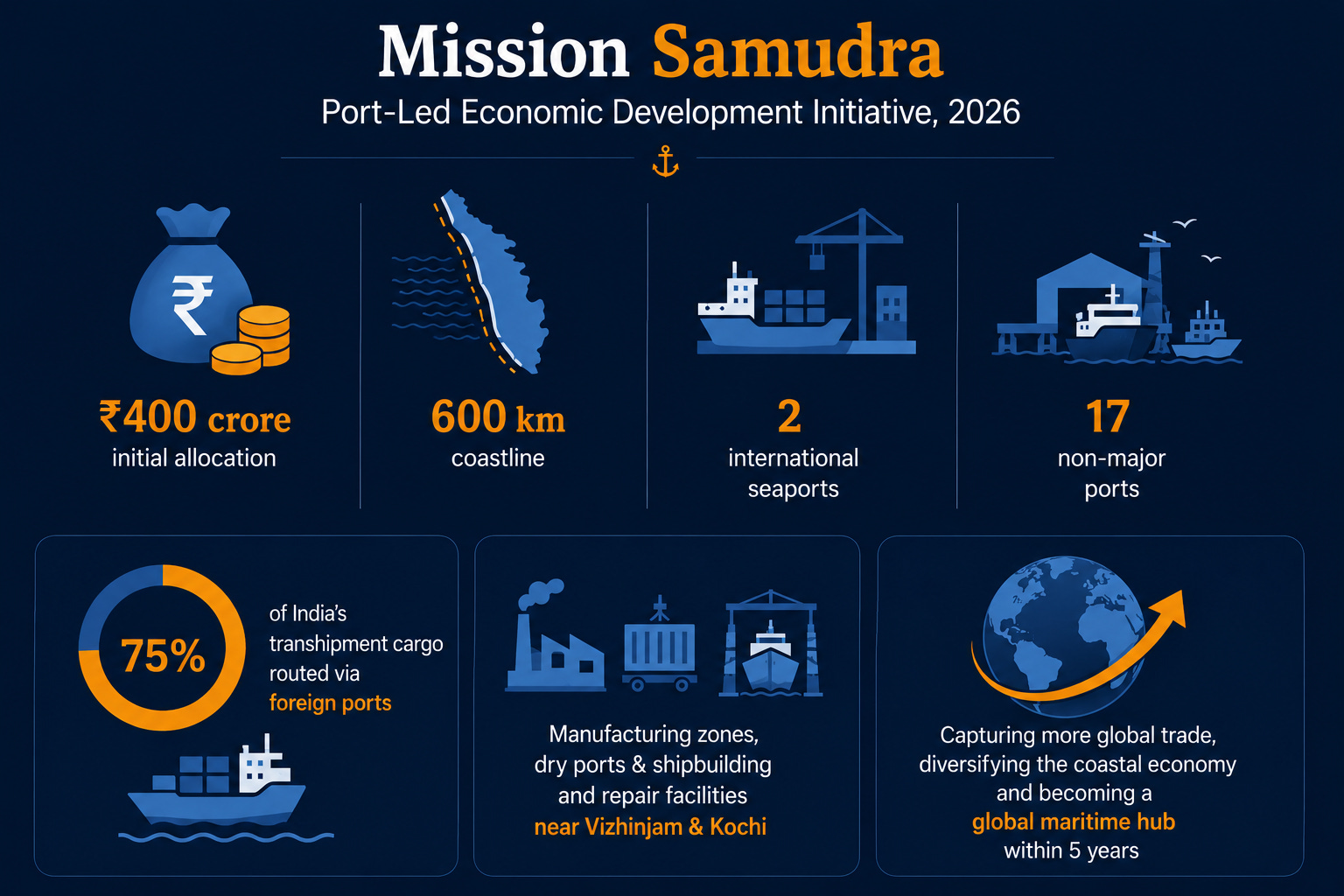
IX. Kerala: Mission Samudra - Port- Led Economic Development Initiative, 2026
Source: Click Here
The Development: The Kerala Government launched Mission Samudra with an initial ₹ 400 crore allocation to develop a port-led economic ecosystem by integrating its 600-km coastline, two international seaports, and 17 non-major ports with manufacturing, logistics, and shipbuilding infrastructure.
Key Takeaway: Historically, 75% of India’s transhipment cargo has been routed through foreign ports, leading to higher logistics costs and a massive loss of value addition. By integrating its unique maritime infrastructure with advanced logistics and manufacturing clusters, Kerala aims to capture a greater share of international maritime trade, diversify its economy, and become a global maritime hub.
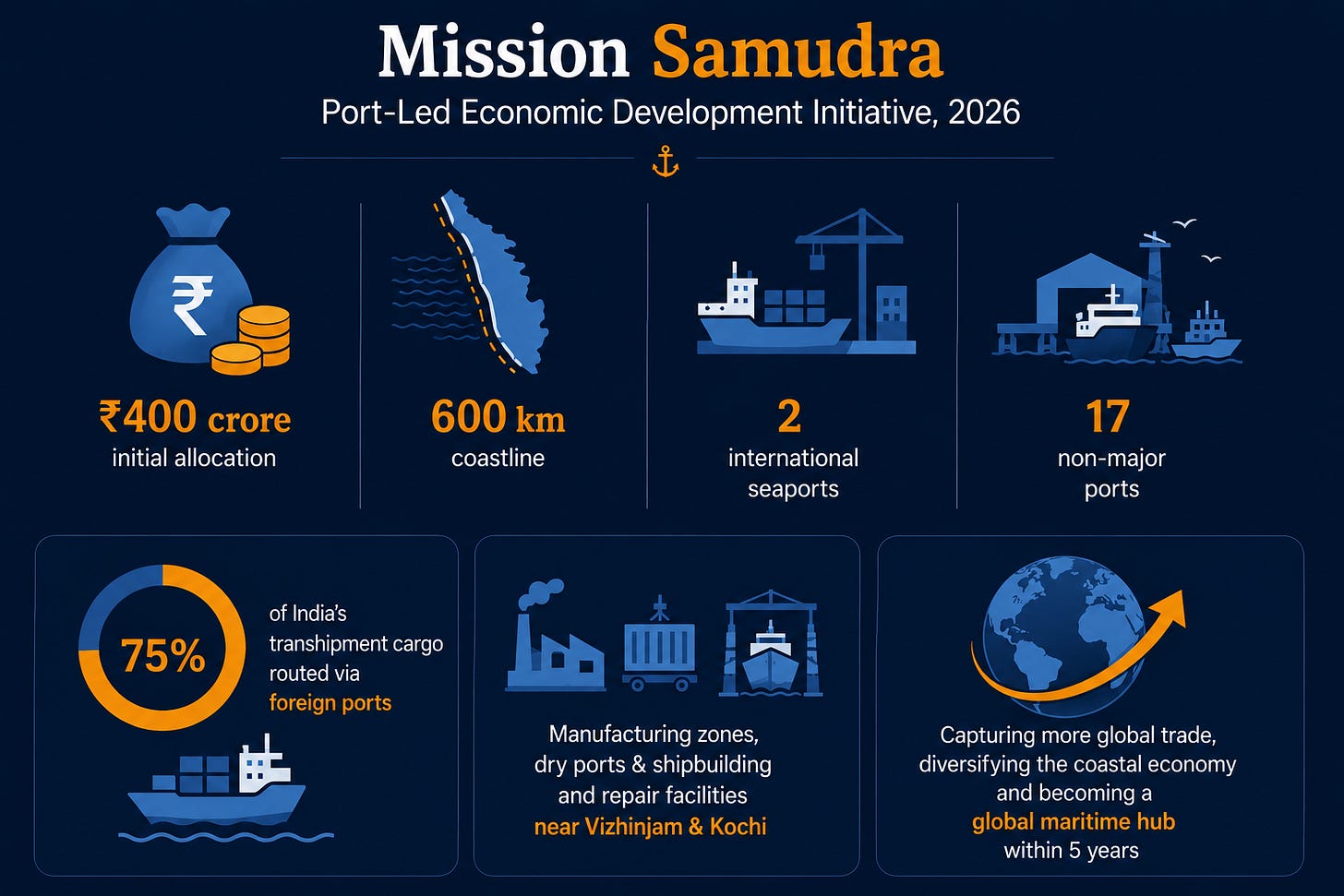
Image 3: Key Features Of Kerala’s Mission Samudra, 2026
X. Delhi: Fire Services Master Plan, 2026–2051
Source: Click Here
The Development: The Delhi Government has directed the Delhi Fire Services to prepare a Fire Services Master Plan, 2026–2051, to shift from a reactive firefighting model to a prevention and early-detection-based system. The plan proposes expanding fire stations from 71 to 196 by 2051, recruiting 9,223 personnel, doubling Quick Response Vehicles by 2032, and deploying Internet of Things-based monitoring, drones, and automated Fire Control Rooms.
Key Takeaway: Delhi Fire Services responded to over 36,000 emergency calls by March 2026, up from 26,568 in 2024–25, while the city currently has only 71 fire stations for a population of around 3.3 crore. By expanding infrastructure, addressing manpower shortages, and introducing technology-enabled early detection and real-time monitoring, the plan seeks to improve response times and strengthen fire safety in one of India’s most densely populated urban centres.
You can read the full edition of the newsletter below:
Also, please consider subscribing to NFPRC Foundation’s focused centres covering latest economic, policy and administrative developments -
Centre for Law, Policy and Governance - Link
Centre for Accelerating India’s Growth - Link
Centre for Studies in Indian Social Systems - Link
NFPRC Foundation - Link